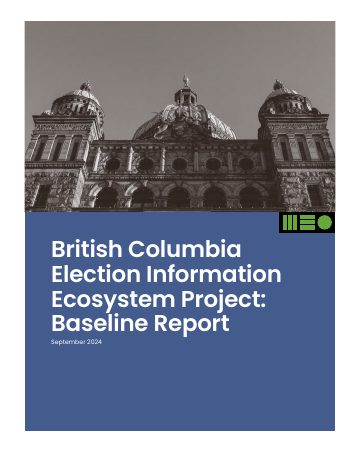
Projet sur l'écosystème informationnel de l'élection de la Colombie-Britannique : rapport final
Alexei Abrahams, Thomas Bergeron, Danielle Bohonos, Aengus Bridgman, Esli Chan, Mika Desblancs-Patel, Spencer Izen, Grace Lim, Sherry Madah, Mahnan Omar, Zeynep Pehlivan, Jennie Phillips, Saewon Park, Chris Ross, Ben Steel, Chris Tenove, Ashley Vu, Junyan Zhu
doi.org/10.66536/bc-election-final_2025Résumé analytique
The British Columbia Election Information Ecosystem Project set out to evaluate the dynamics of mis- and disinformation, media platform influence, foreign interference concerns, and public trust during the 2024 British Columbia provincial election. Through a combination of social media monitoring, digital trace analysis, and pre- and post-election surveys, the project offers key insights into the evolving information landscape and its impact on electoral integrity.
Elections BC remains a highly trusted entity among British Columbians, with no measurable population-level erosion of confidence detected; pre- and post-election surveys reveal strong public trust in the fairness and integrity of Elections BC, slightly higher than trust in Elections Canada. Online political discourse surrounding the election was notably polarized, with distinct partisan divides across social media platforms; X (formerly Twitter) emerged as the central hub for political discussion and mass engagement, significantly overshadowing platforms like Instagram and Facebook, raising concerns about high bot activity, skewed algorithms, and limited transparency. Although the official campaign period experienced minimal misinformation activity, a marked increase in online discourse questioning election integrity emerged the day of the election and in the immediate post-election phase; despite the high visibility of such discourse online, mis- and disinformation had minimal impact on public attitudes, demonstrating that extensive online activity does not necessarily reflect broader offline voter sentiment or engagement. The investigation found no evidence of foreign information manipulation or interference during the election, though misinformation and speculation about foreign interference appear to have become normalized in election-related discourse.
The project also identified vulnerabilities meriting attention: X's disproportionate political influence in both legitimate discourse and misinformation spread; persistent misinformation narratives even in the absence of evidence, amplified by algorithms that favor emotionally resonant content regardless of accuracy; and a declining ability to identify and trust reliable information, with nearly half of respondents unable to identify a trusted source. The 2024 BC election demonstrated that while democratic institutions can be effective and continue to earn citizens' trust, they operate in an increasingly volatile information landscape, and safeguarding electoral integrity now demands anticipatory communication, ongoing monitoring and reporting, and a renewed focus on public engagement.
Points saillants
- Elections BC remains highly trusted: pre- and post-election surveys show strong public confidence in Elections BC's fairness and integrity, slightly higher than trust in Elections Canada.
- No evidence of foreign information manipulation or interference was found during the election, though speculation about foreign interference has become normalized in electoral discourse.
- Despite minimal misinformation during the official campaign period, election-integrity questioning spiked sharply on election day and in the immediate post-election phase — but had minimal measurable impact on public attitudes.
- Political influencers generated 63.9% of all engagement in the BC election despite news outlets posting the most content.
- Nearly half of survey respondents were unable to identify a trusted information source, indicating broad vulnerability to confusion and manipulation.
Publications connexes
Le référendum de l’Alberta, en ligne : influenceurs, contenu généré par l’IA, intérêts étrangers et économie de l’attention à l’approche du vote du 19 octobre
Lire la suite
L’environnement d’information à l’aube de l’élection québécoise de 2026
Lire la suite
L'écosystème canadien de l'information durant l'élection fédérale de 2025
Lire la suite