
Publications
Toutes les publications
149 sur 149 résultatsAlberta’s Referendum, Online: Election Fraud Claims Ahead of the October 19 Vote
With less than two weeks to go before Alberta’s October 19 referendum, online posts raising concerns about special (mail-in) ballots have risen sharply, as Elections Alberta approved more than 652,000 of them — about 11 times more than in the 2023 general election. At the same time, confidence in Elections Alberta has fallen 18 percentage points since 2023, across the political spectrum, after a contentious 18-month process. Using the Calgary-Shaw by-election as a case study — where a recoloured copy of Wisconsin’s 2020 presidential vote count was passed off as Alberta data and drew about 260,000 views — this update shows how fraud claims are likely to circulate on referendum night, and why we expect them to be pulled into the American online ecosystem. 63% of Albertans expect U.S. political figures to try to influence the outcome, and 78% consider it inappropriate.
octobre 2026Lire la suite

octobre 2026Lire la suite
Mise à jour hebdomadaire 5 : discours et perceptions sur l'intégrité électorale
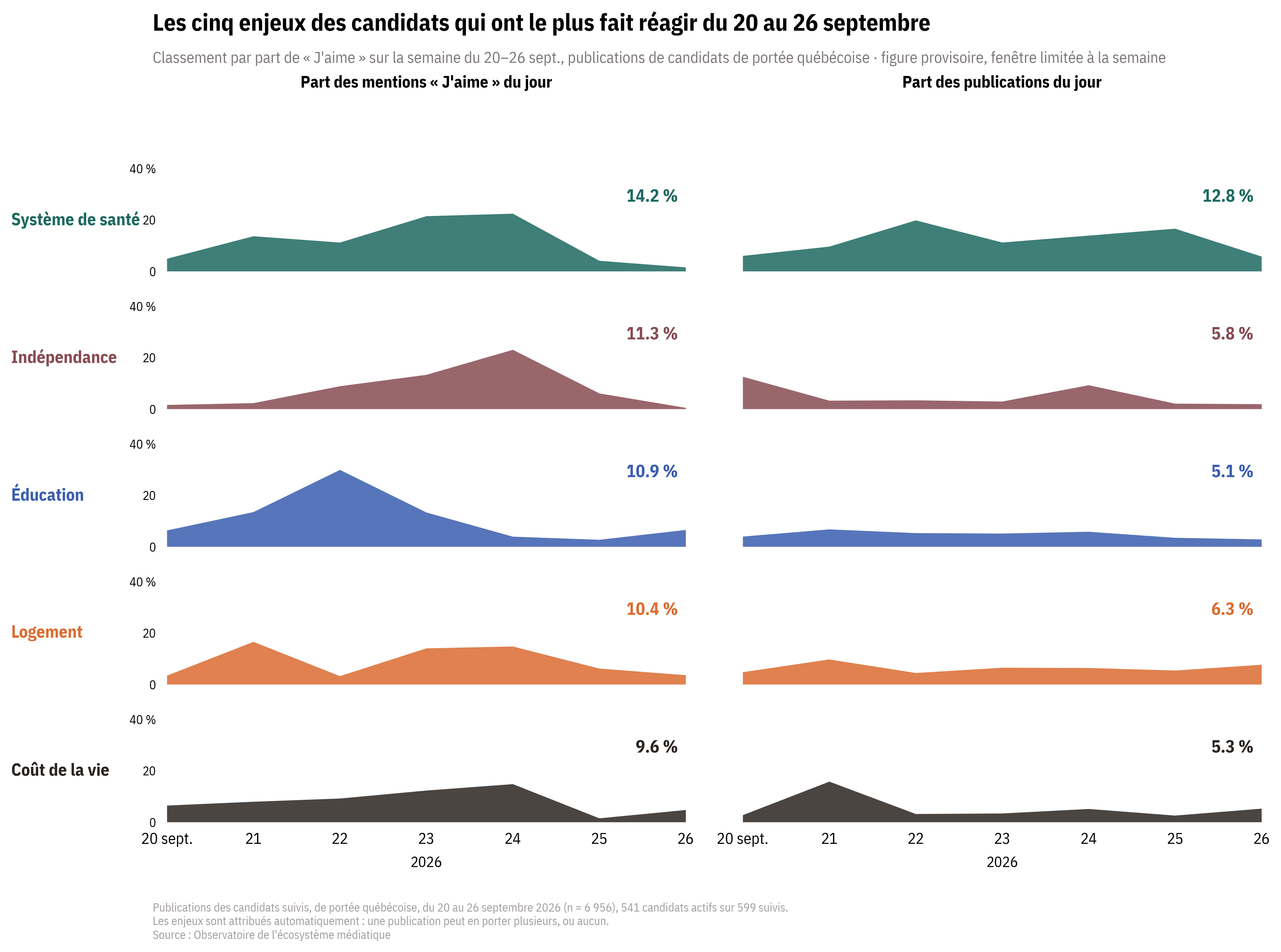
La cinquième d'une série de mises à jour hebdomadaires sur l'écosystème de l'information pendant la campagne électorale québécoise de 2026. À la suite d'un reportage sur une possible ingérence américaine et du début du vote par anticipation, cette édition se concentre sur l'intégrité électorale : l'ampleur des discussions en ligne depuis le début de la campagne, les récits ayant alimenté quatre vagues de discussion distinctes, la mesure dans laquelle les publications les affirment, les rapportent ou les réfutent, ainsi que le faible intérêt suscité par l'élection chez les influenceurs américains, les médias d'État russes et chinois et sur WeChat. Les données de sondage montrent que la majorité des Québécois font confiance à Élections Québec, que la préoccupation envers l'ingérence étrangère n'a pas augmenté après le reportage et dans quelle mesure l'électorat connaît le processus électoral. La section Sur notre radar se penche sur la légalité de publier une photo de son bulletin de vote.
octobre 2026Lire la suite
octobre 2026Lire la suite
Mise à jour hebdomadaire 4 : une élection sans médias sur Facebook
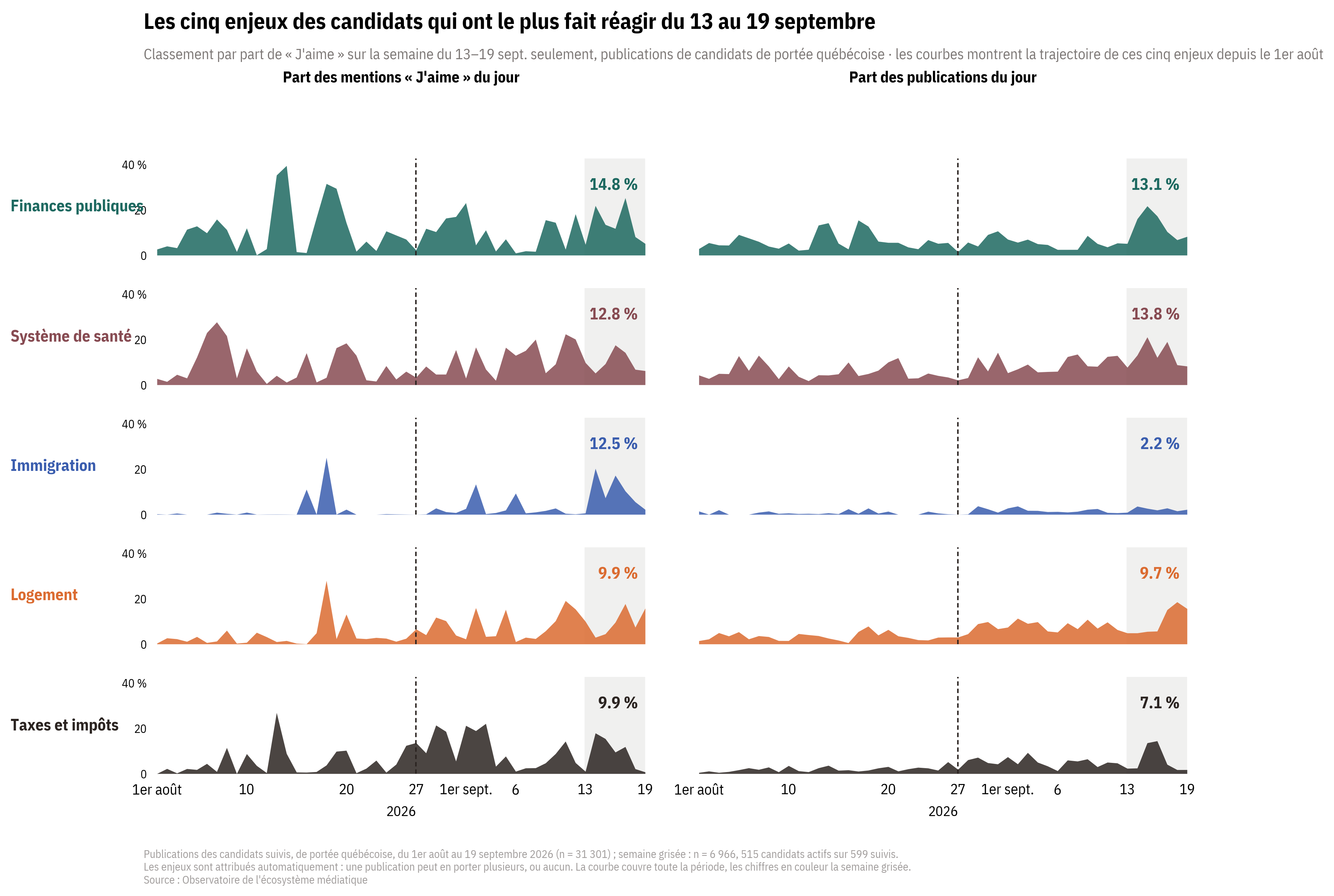
La quatrième d'une série de mises à jour hebdomadaires sur l'écosystème de l'information pendant la campagne électorale québécoise de 2026. Facebook étant la plateforme la plus utilisée par les Québécois pour s'informer en politique, mais fermée aux médias, cette édition se concentre sur l'environnement informationnel qui s'y déploie : les dépenses et le ciblage publicitaires des partis, la circulation des récits entre candidats et influenceurs, ainsi que les discussions se déroulant dans des dizaines de groupes Facebook partisans. La section Sur notre radar suit la portée grandissante du site de conseil de vote bâti à l'aide de l'IA lequebecvote.ca, la polarisation croissante autour de l'immigration, des enjeux liés à l'intégrité du processus électoral, ainsi que l'accusation d'Amnistie internationale envers le Parti québécois pour harcèlement d'une médecin critique du parti.
septembre 2026Lire la suite
septembre 2026Lire la suite
Advancing Transparency of Artificial Intelligence Systems
CMTD's submission to Innovation, Science and Economic Development Canada's public consultation on AI transparency, drawing on CMTD research to address AI-generated content, AI interaction, information about AI systems, and AI incidents.
septembre 2026Lire la suite
septembre 2026Lire la suite
Mise à jour hebdomadaire 3 : la première élection québécoise à l'ère de l'IA générative
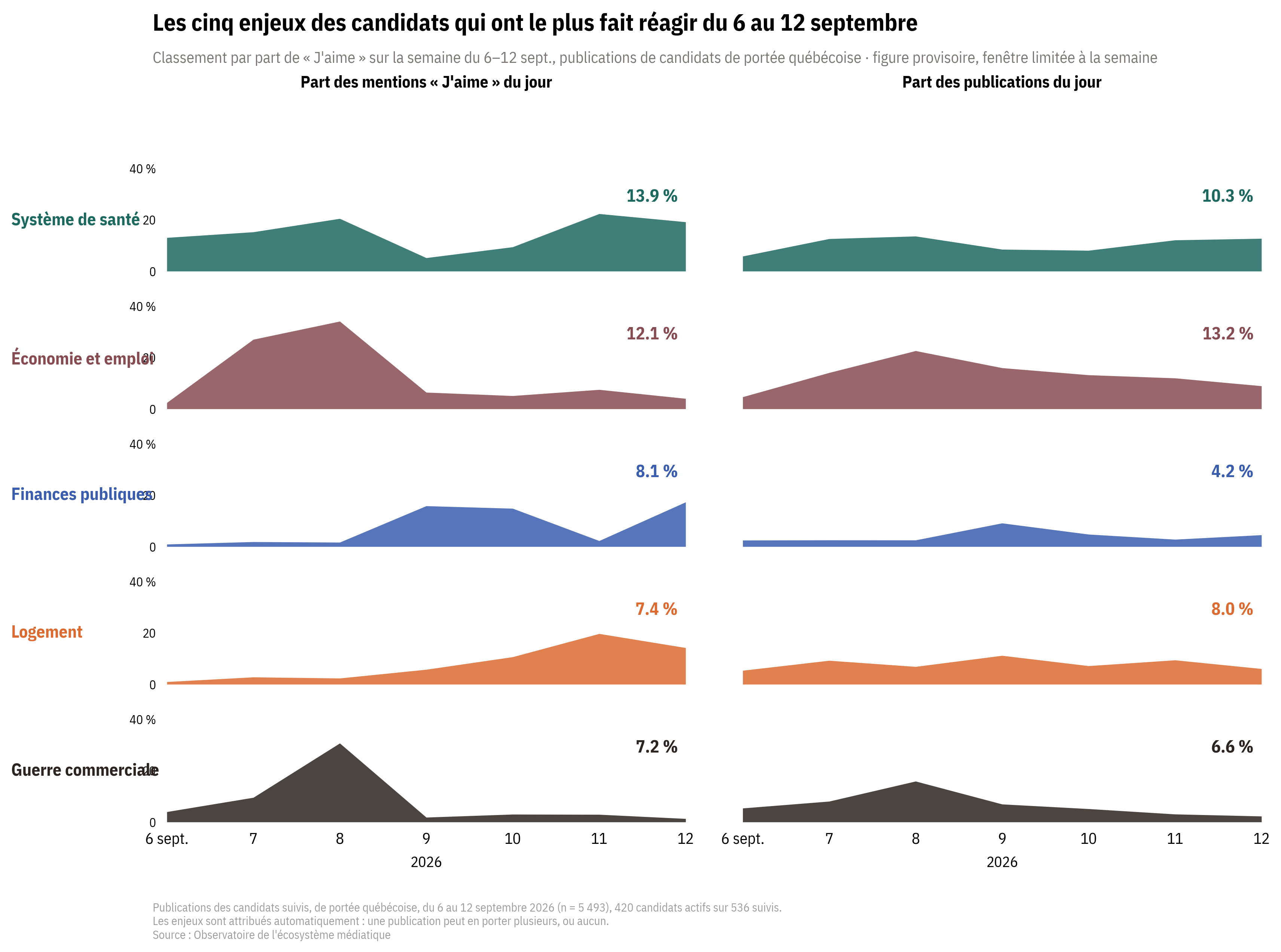
La troisième d'une série de mises à jour hebdomadaires sur l'écosystème de l'information pendant la campagne électorale québécoise de 2026. Cette édition présente les résultats d'un audit des recommandations de vote offertes par ChatGPT et le mode IA de Google, montrant comment un site web anonyme créé à l'aide de l'IA s'est imposé comme source dominante et comment le blocage des grands médias par les robots d'IA façonne l'information à laquelle les électeurs sont exposés. La section Sur notre radar aborde le vandalisme du matériel électoral, les débats sur le nom de la Coalition Avenir Québec et les discours de délégitimation du processus électoral.
septembre 2026Lire la suite
septembre 2026Lire la suite
Mise à jour hebdomadaire 2 : trois agendas, une élection
La deuxième d'une série de mises à jour hebdomadaires sur l'écosystème de l'information pendant la campagne électorale québécoise de 2026. Cette édition examine comment les priorités des candidats, des électeurs et de la discussion en ligne se sont déplacées de la guerre commerciale vers des enjeux économiques domestiques, et compare les enjeux mis de l'avant par les partis, ceux jugés prioritaires par les électeurs et ceux qui dominent la conversation en ligne, révélant trois agendas liés, mais distincts. La section Sur notre radar aborde les allégations d'ingérence du gouvernement fédéral et de La France insoumise dans la campagne, ainsi que les discours sur le vote anglophone et l'hostilité envers les personnes âgées.
septembre 2026Lire la suite

septembre 2026Lire la suite
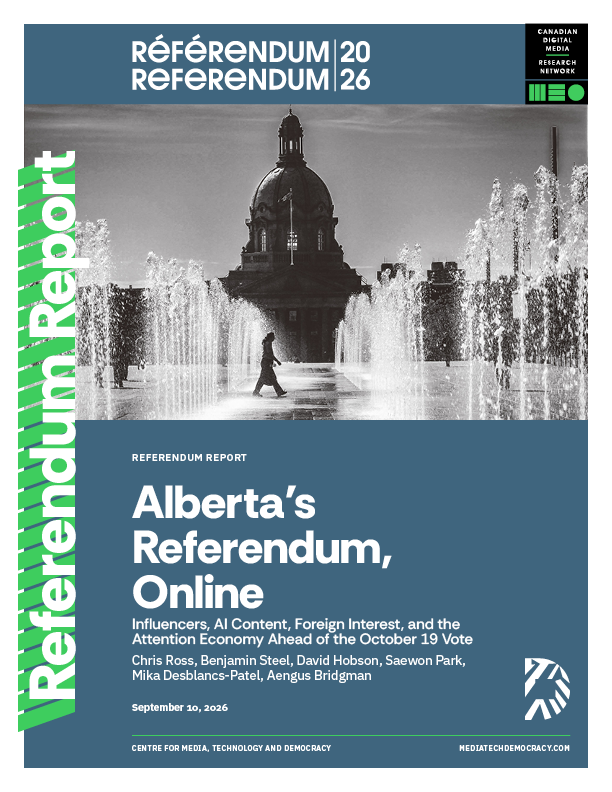
Le référendum de l’Alberta, en ligne : influenceurs, contenu généré par l’IA, intérêts étrangers et économie de l’attention à l’approche du vote du 19 octobre
L'Alberta se dirige vers un référendum le 19 octobre 2026, dans un environnement informationnel en rapide mutation. D'année en année, les influenceurs en ligne accumulent pertinence et engagement aux dépens des médias d'information et des élus, et nous disposons désormais d'une étude de cas sur ce à quoi ressemble un vote démocratique en pleine ère des influenceurs.
La conversation en ligne sur le référendum albertain est portée par une communauté passionnée de 114 comptes, non soumis aux formes traditionnelles de reddition de comptes politique, qui ont capté environ la moitié de tout l'engagement généré depuis le 1er janvier 2025 sur cinq plateformes. Parmi ces voix hautement influentes, les comptes pro-indépendance surpassent les comptes anti-indépendance dans un rapport d'environ 8 pour 1. Les publications portant sur la séparation de l'Alberta du Canada, peu importe la position défendue, reçoivent plus du double de l'engagement de publications comparables sur d'autres sujets — un « avantage albertain » en ligne.
Une seconde transformation majeure s'est récemment produite alors que les électeurs se tournent vers la recherche par IA et les clavardages IA (chatbots) pour comprendre le monde politique qui les entoure. Or, ces outils sont encore en maturation et fournissent des réponses changeantes à des questions politiques courantes et importantes dans le contexte du référendum. Nous constatons que Google AI Overview et ChatGPT donnent des réponses incohérentes, parfois directement contradictoires, aux mêmes questions. Parallèlement, l'imagerie générée par l'IA s'impose rapidement comme un outil de campagne dans l'environnement informationnel, et nous constatons que la part des images générées par l'IA parmi les publications pro-indépendance sur X a été multipliée par 3,5 depuis janvier 2025.
Ces nouvelles sources d'information et techniques de campagne ont des conséquences considérables en ce moment démocratique. Plus important encore, il existe un écart frappant entre la conversation en ligne et le grand public albertain. Alors que les sondages indiquent qu'environ les deux tiers des Albertains voteraient pour demeurer au sein du Canada, la conversation en ligne montre l'inverse, avec beaucoup plus de publications et d'engagement en ligne provenant du mouvement indépendantiste, très énergique. Un mouvement politique sans direction élue, mais doté d'une présence en ligne dominante qui exploite des technologies d'IA en rapide maturation, façonne la conversation publique sur un référendum portant sur le maintien ou non de l'Alberta au sein du Canada. Tout cela se déroule alors que la confiance envers la capacité d'Élections Alberta à tenir un vote équitable ne s'élève qu'à 59 %. Nos institutions démocratiques et notre compréhension de l'espace public doivent suivre le rythme.
septembre 2026Lire la suite
septembre 2026Lire la suite
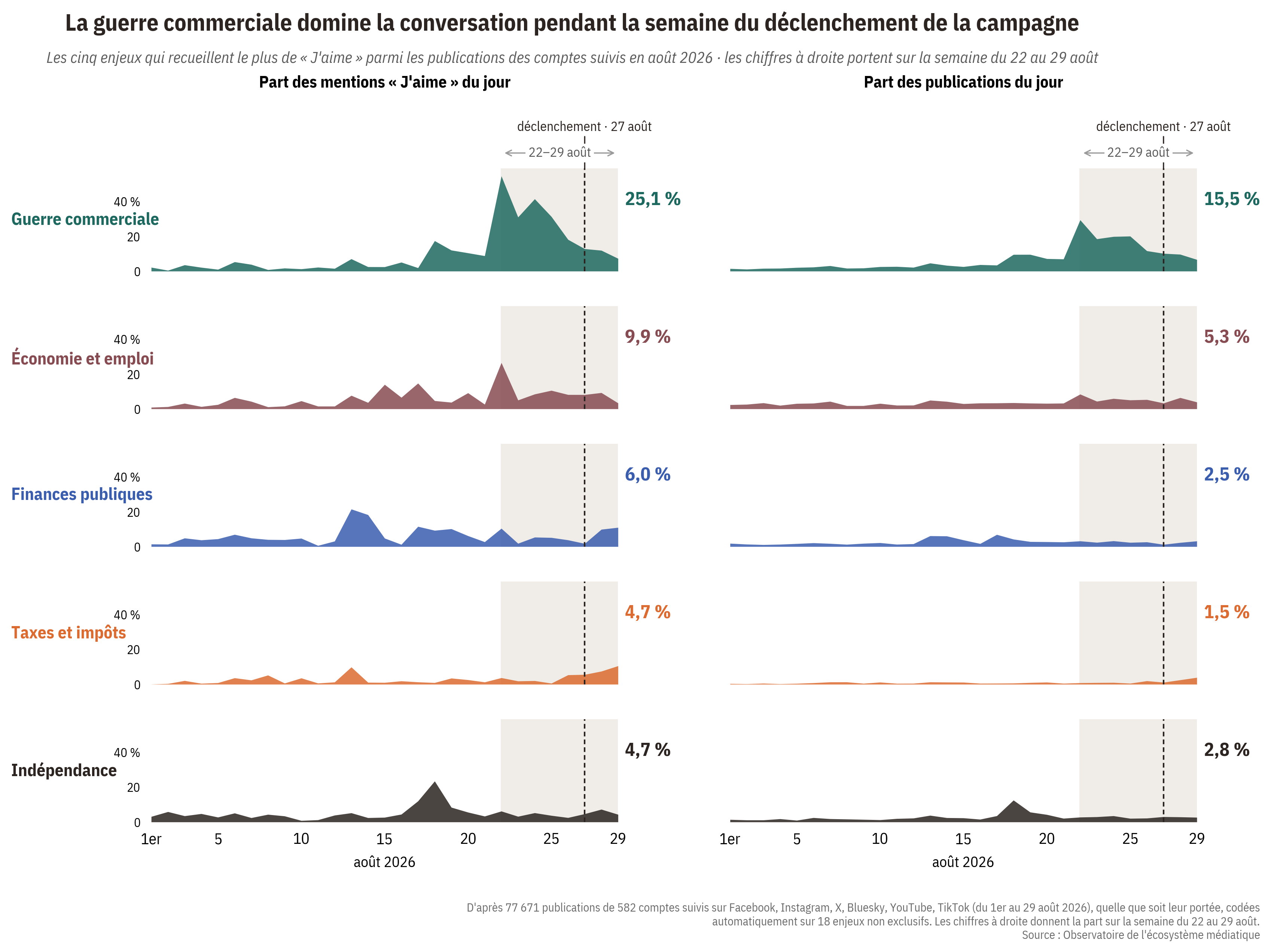
Mise à jour hebdomadaire 1 : la guerre commerciale s'invite dans la campagne électorale québécoise
Le premier d'une série de mises à jour hebdomadaires sur l'écosystème de l'information pendant la campagne électorale québécoise de 2026. Cette édition examine comment la guerre commerciale entre le Canada et les États-Unis est devenue l'enjeu dominant de la campagne — et comment certains acteurs en ligne s'en sont servis pour remettre en question l'intégrité de l'élection — ainsi qu'un sondage sur la confiance des Québécois envers les négociations, et un survol des vidéos de chefs générées par l'IA, des débats sur la neutralité des sondages et des critiques de la Boussole électorale.
septembre 2026Lire la suite
septembre 2026Lire la suite
Un écosystème médiatique numérique indépendant? Le discours en ligne au Canada à l'ombre des États-Unis
Une étude nationale analysant plus de 8,8 millions de publications sur les médias sociaux et un sondage représentatif à l'échelle nationale afin d'évaluer si l'écosystème médiatique numérique du Canada est indépendant de l'influence américaine, révélant que cette indépendance varie selon les sujets et le temps — les Canadiens dominent la conversation lorsqu'une nouvelle nationale survient, mais un sous-groupe d'influenceurs canadiens est étroitement intégré à leurs homologues américains.
septembre 2026Lire la suite
septembre 2026Lire la suite
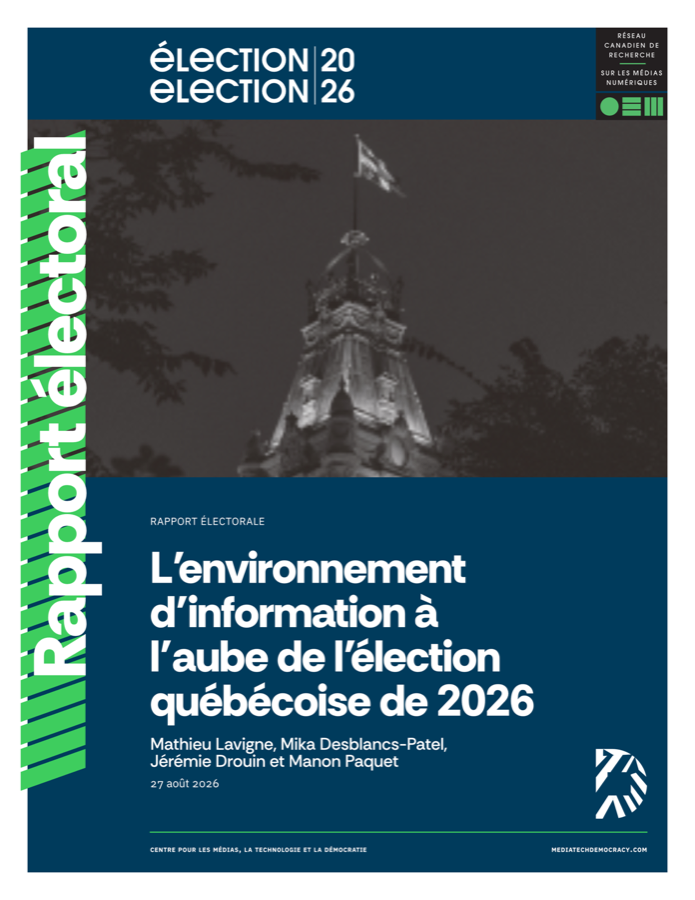
L’environnement d’information à l’aube de l’élection québécoise de 2026
À l'approche de l'élection générale québécoise du 5 octobre 2026, ce rapport dresse un portrait de référence de l'écosystème informationnel québécois. Plusieurs facteurs rendent le contexte particulier : le référendum albertain sur la sécession, la guerre commerciale et les élections américaines de mi-mandat, le blocage des contenus journalistiques sur Facebook et Instagram, et la popularisation de l'IA générative, qui facilite la fabrication de contenus trompeurs. Ce rapport vise à mieux comprendre les types d’informations auxquels les électeurs et électrices seront exposés durant la campagne et les perceptions qu’ils entretiennent déjà à l’égard des institutions et de leur environnement d’information. Il traite notamment des tendances de consommation médiatique, de la confiance envers les institutions et l’environnement d’information, et de l'activité des candidats, médias et du commentariat politique sur les différentes plateformes de réseaux sociaux. Il compte également une synthèse des menaces et vulnérabilités.
août 2026Lire la suite
août 2026Lire la suite
Identity Politicization After the Kirk, Tumbler Ridge, and Montreal Shootings
The online response to the June 2026 shooting in the Côte-des-Neiges neighbourhood of Montreal, which left three people dead, illustrates how information circulates during and after a crisis. As with many tragic events, footage, claims, and speculation began spreading across platforms within minutes. In this incident report, we examine how information moved through the online environment during the incident, in its immediate aftermath, and over the following days — and through that, how breaking news and public safety information reach and are interpreted by the Canadian public.
août 2026Lire la suite
août 2026Lire la suite
AI Unpacked: An Accessible Guide to Engaging Critically with Artificial Intelligence
AI systems increasingly determine what information reaches our screens, structure how we work and learn, and play a role in the decision-making that shapes crucial parts of our lives. Despite this, public understanding of AI is remarkably thin: conversations about it are too often dominated by technical jargon or inflated by hype, leaving people without the tools to critically assess AI's promises and risks. This has profound democratic consequences — it narrows debate, hinders informed decision-making, and allows powerful actors to steer the trajectory of AI with little public accountability.
AI Unpacked demystifies the building blocks of AI: algorithms, data, compute, infrastructure, labour, and the historical evolution of the field. It explores the social, ethical, and political challenges that accompany AI's rapid expansion — from bias and discrimination to mis- and disinformation, labour displacement, market concentration, and mental health impacts. It also introduces readers to emerging approaches to AI governance, including Canada's own regulatory landscape, approaches informed by Indigenous knowledge systems, and participatory models of policymaking that centre public voice and collective responsibility.
Organized in five parts with a glossary of key terms, each section opens with an introductory framing, compiles annotated summaries of foundational texts with every source hyperlinked for further reading, and closes with a set of key takeaways. The aim is not to settle debates but to offer a foundational toolkit: to help readers ask sharper questions, recognize what is at stake in current AI debates, and engage critically and constructively with the future of AI.
AI Unpacked is a collaboration between the Centre for Media, Technology and Democracy at McGill University and the Dialogue on Technology Project, the flagship technology and AI initiative of Simon Fraser University's Morris J. Wosk Centre for Dialogue.
juillet 2026Lire la suite
juillet 2026Lire la suite