The Federal Government’s Proposal to Address Online Harms: Recommendations for Children’s Safety Online
Sonja Solomun, Taylor Owen
Résumé analytique
On July 29, 2021, the federal government announced its proposal to set new rules obliging Online Communication Service Providers (OCSPs) to address five categories of harmful content on their platforms: hate speech, child sexual exploitation content, non-consensual sharing of intimate images, incitement to violence content, and terrorist content. The legislation requires OCSPs to take all reasonable measures, including automated filtering and ISP website blocking as a last resort, to identify and block these categories within 24 hours of being flagged, while providing procedural transparency to users and survivors.
While sharing concerns raised by Canadian and international experts about the proposal's wide scope, 24-hour takedown requirement, proactive monitoring of all harmful content, and website blocking, the authors raise additional concerns about the lack of consideration of children's rights in the upcoming legislation. They highlight Canada's duty of care to protect children from harmful content online, to impose age-specific requirements, and to mandate provisions for special categories of harmful content, including altered sponsored and paid content. Specific recommendations include recognizing a duty of care toward the 'best interest of the child' as the primary consideration when in conflict with commercial interests, drawing on the UN Convention on the Rights of the Child; breaking down the online harms proposal into subject-matter-specific legislation for children's rights, following the UK Online Safety Bill's approach of a children-specific harm category with mandated risk assessments; requiring strict disclosure of manipulated facial and body imagery in paid and sponsored content, given links between such content and self-harm, body image harms, and disordered eating; and ensuring children-specific legislation is proactive, addressing design features rather than only harm after the fact, as in the EU's Digital Services Act and the UK's Age-Appropriate Design Code.
The authors conclude that Canada should introduce legislation to address online harms, but that significant nuance and consultation are needed. If the federal government takes time to consider special categories for the scope and definition of harmful content likely to be encountered by children, and protects both individual and collective children's rights through proactive measures beyond automated filtering, Canada could lead the way in international norm setting.
Publications connexes
Online Harms AI Audit: Policy Memo
Lire la suite
Survey on Canadians' Preference for Social Media Age Verification Policies
Lire la suite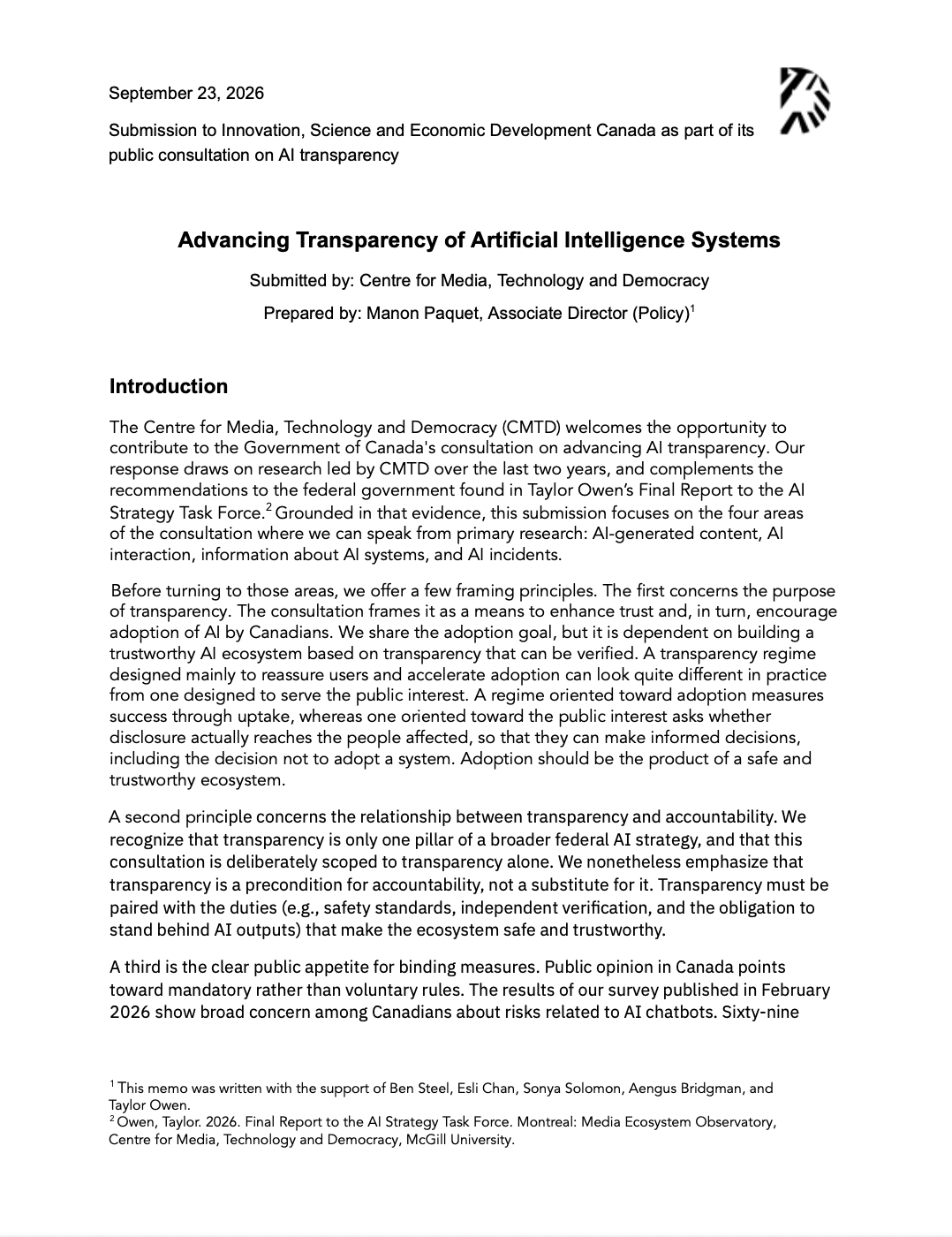
Advancing Transparency of Artificial Intelligence Systems
Lire la suite