Advancing Transparency of Artificial Intelligence Systems
Manon Paquet, Ben Steel, Esli Chan, Sonja Solomun, Aengus Bridgman, Taylor Owen
doi.org/10.66536/ai-transparency-consult_2026Introduction
The Centre for Media, Technology and Democracy (CMTD) welcomes the opportunity to contribute to the Government of Canada's consultation on advancing AI transparency. Our response draws on research led by CMTD over the last two years, and complements the recommendations to the federal government found in Taylor Owen’s Final Report to the AI Strategy Task Force.2 Grounded in that evidence, this submission focuses on the four areas of the consultation where we can speak from primary research: AI-generated content, AI interaction, information about AI systems, and AI incidents.
Before turning to those areas, we offer a few framing principles. The first concerns the purpose of transparency. The consultation frames it as a means to enhance trust and, in turn, encourage adoption of AI by Canadians. We share the adoption goal, but it is dependent on building a trustworthy AI ecosystem based on transparency that can be verified. A transparency regime designed mainly to reassure users and accelerate adoption can look quite different in practice from one designed to serve the public interest. A regime oriented toward adoption measures success through uptake, whereas one oriented toward the public interest asks whether disclosure actually reaches the people affected, so that they can make informed decisions, including the decision not to adopt a system. Adoption should be the product of a safe and trustworthy ecosystem.
A second principle concerns the relationship between transparency and accountability. We recognize that transparency is only one pillar of a broader federal AI strategy, and that this consultation is deliberately scoped to transparency alone. We nonetheless emphasize that transparency is a precondition for accountability, not a substitute for it. Transparency must be paired with the duties (e.g., safety standards, independent verification, and the obligation to stand behind AI outputs) that make the ecosystem safe and trustworthy.
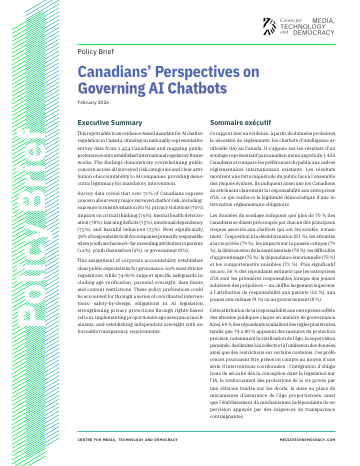
A third is the clear public appetite for binding measures. Public opinion in Canada points toward mandatory rather than voluntary rules. The results of our survey published in February 2026 show broad concern among Canadians about risks related to AI chatbots. Sixty-nine percent want stricter regulation, and 74–80% support specific safeguards including age verification, parental oversight, data limits, and content restrictions.3
A workable regime also depends on who is expected to surface harm, and should draw on two complementary sources. Vendors are often best placed to detect emerging harms in their own systems, and some already engage in valuable unprompted disclosure; the regime should place developers and deployers under clear obligations to surface the risks and incidents they observe, building on the digital safety plans proposed in the Safe Social Media Act as a model for other AI applications. But self-reporting alone is inconsistent and cannot be the whole system; independent researchers play an indispensable role in holding developers and deployers to account — testing systems and surfacing harms that the value chain does not report or cannot see. CMTD's own audits and election monitoring, detailed below, have brought to light safety failures and information-integrity harms that were not otherwise disclosed. A regime built for the public interest should therefore recognize, protect, and adequately resource this independent-oversight function alongside its obligations on vendors.
Finally, we would also like to point to CMTD's Gen(Z)AI: Youth Voices, AI Futures (2026),4 which convened a seven-month Youth Assembly on Artificial Intelligence and produced seventeen recommendations. Several of these recommendations are directly relevant to this consultation, including standardized content labelling, greater transparency in algorithmic recommendation, and authentication of content origins. As Canada designs transparency rules that will shape the information environment young people grow up in, the report models an approach of governing with youth rather than only for them, which we encourage the government to build on. Mandated consultation mechanisms would institutionalize democratic input into the design and oversight of AI policy.5
- This memo was written with the support of Ben Steel, Esli Chan, Sonja Solomun, Aengus Bridgman, and Taylor Owen.
- Owen, Taylor. 2026. Final Report to the AI Strategy Task Force. Montreal: Media Ecosystem Observatory, Centre for Media, Technology and Democracy, McGill University. https://mediatechdemocracy.com/en/publications/ai-strategy-task-force-final-report_2026/.
- Lavigne, Mathieu, Helen A. Hayes, Esli Chan, and Chris Ross. 2026. Canadians' Perspectives on Governing AI Chatbots: A Policy Brief. Montreal: Media Ecosystem Observatory, Centre for Media, Technology and Democracy, McGill University. https://doi.org/10.66536/ai-chatbots-perspectives_2026.
- Hayes, Helen A., Fergus Linley-Mota, Madeleine Case, Julian Lam, Alexander Martin, and Nonso Morah. 2026. Gen(Z)AI: Youth Voices, AI Futures — Policy Recommendations for AI and Online Harms Governance in Canada. Montreal: Media Ecosystem Observatory, Centre for Media, Technology and Democracy, McGill University. https://mediatechdemocracy.com/en/publications/genzai-youth-voices-ai-futures_2026/.
- Owen, Final Report to the AI Strategy Task Force.
Publications connexes

Online Harms AI Audit: Policy Memo
Lire la suite
Survey on Canadians' Preference for Social Media Age Verification Policies
Lire la suite
Scoping AI Chatbots into a revised Online Harms Act: The Case for Immediate Action
Lire la suite