The Future of Conservation Lies in Justice-led Technology
Joycelyn Longdon
Résumé analytique
Drawing on PhD fieldwork with a community on the fringe of the Bosomtwe Range Forest Reserve in Ghana, Joycelyn Longdon argues that the future of biodiversity conservation depends on justice-led technology. Falling hardware costs and advances in AI have made ecoacoustics — combining biology, acoustics and machine learning to analyse environmental recordings — an increasingly important monitoring tool, part of a wider suite of technologies dubbed the "Internet of Trees" (drones, sensor networks, satellite imaging, LIDAR and civic apps). These tools have driven real progress, but they also carry social risks that can perpetuate existing inequalities and conservation's colonial history, in which marginalised tropical communities were treated as flora and fauna and excluded through doctrines such as terra nullius. Longdon warns that adding technology without community agency embeds discriminatory approaches into the very algorithms meant to protect the planet — as with the "human bycatch" of camera traps, where over 90 percent of respondents in one 2018 study reported their projects had unintentionally captured images of people.
The essay positions the emerging field of Conservation Data Justice (CDJ) — built on Data Justice and Environmental Data Justice, and framed by Pritchard et al.'s (2022) five interacting elements of data composition, access, control, processing/use, and consequences — as an essential response. Through participatory design, dynamic consent and collaborative sensor placement, Longdon shows how communities can shape monitoring on their own terms. Featuring case studies from Planet Indonesia, First Nations work in Gitga'at Territory, and Animal Computer Interaction, and looking ahead to the inaugural Conservation Data Justice Symposium of 20-30 researchers in Catalunya, she contends that justice-led, participatory practice is necessary to make conservation technology equitable, pluralistic and mutually beneficial for marginalised communities inextricably intertwined with the ecosystems being conserved.
Publications connexes
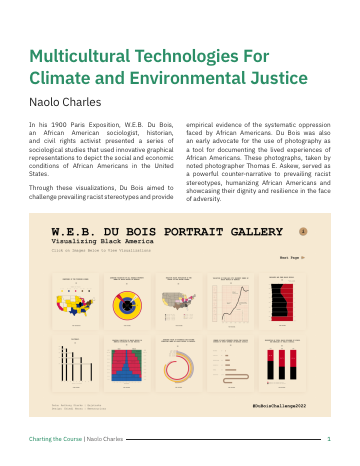
Multicultural Technologies For Climate and Environmental Justice
Lire la suite
Extractive AI
Lire la suite
Resisting Detached Datafication: What Toxic Prisons Teach Us about the Imperative of Restorative/Transformative Data Science for Environmental and Social Justice
Lire la suite