Weekly Update 2: Three Agendas, One Election
Media Ecosystem Observatory
Each week during the 2026 Quebec election, we will publish an update presenting the main trends and dynamics we observe in the information ecosystem. These updates will highlight any information incidents, while outlining items that are On our radar but do not rise to the level of an incident.
All facts and data are drawn from an original survey and social media monitoring conducted by the Media Ecosystem Observatory. The period under study runs to September 9 for the social media monitoring team, from August 28 to September 8 for the survey, and from August 28 to September 5 for the main quantitative analyses of social media data. No major incident was identified this week.
Overview
An election campaign isn't just a competition between parties: it's also a competition between issues. Every party has an interest in having the vote play out on the ground where it is most credible, while the media continue to have some influence over which topics dominate the news. In this weekly update, we shed light on the issues each party is putting forward, the ones voters see as most important, and the ones driving online discussion. In the On Our Radar section, we look at a few items that caught our attention in the information environment, including allegations of interference in the campaign by the federal government and by La France insoumise, as well as discourse about the anglophone vote and older voters.
The Election's Issues: The View from Candidates, Media, and Citizens
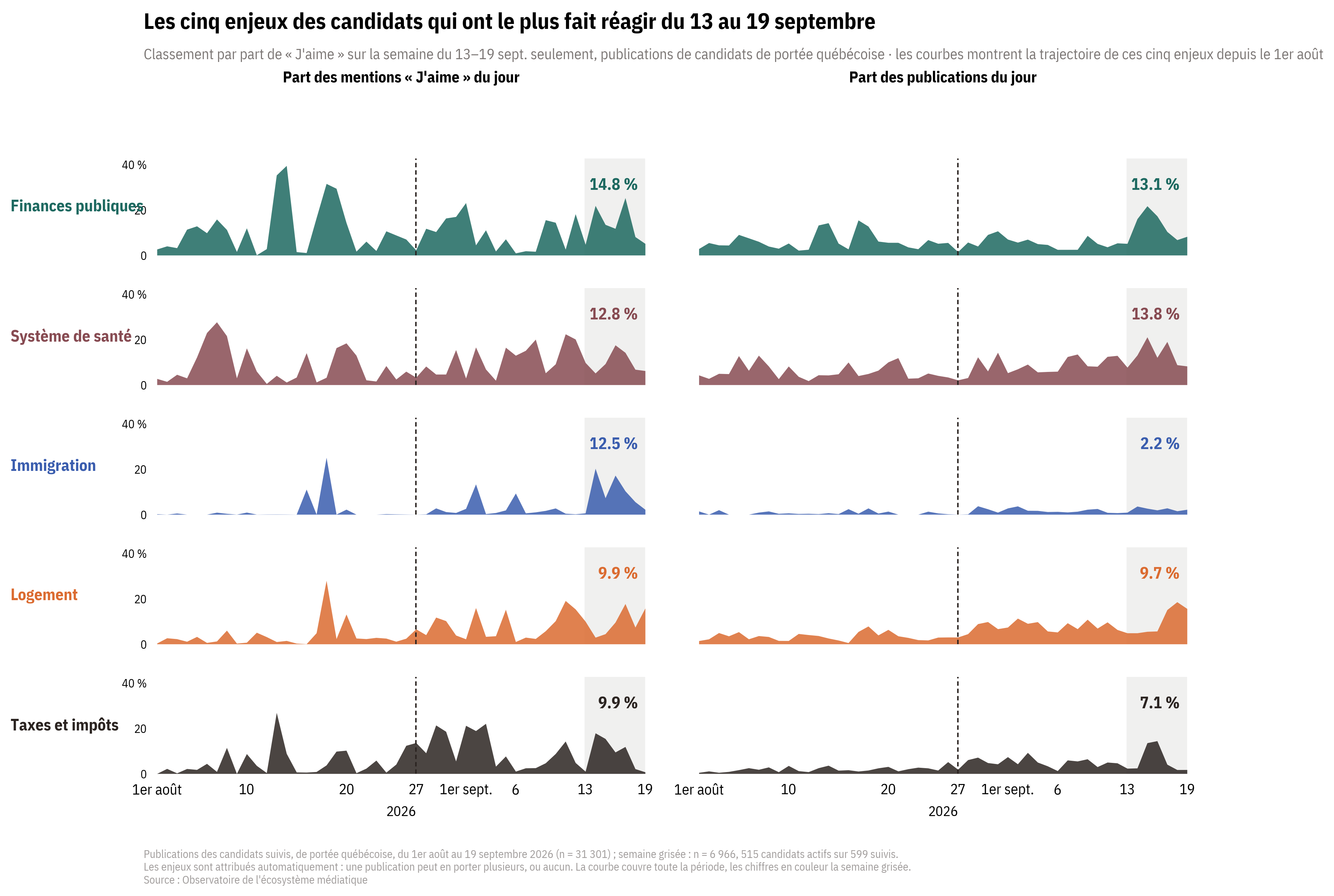
On the candidates' side, the first full week of the campaign marks a shift in attention toward domestic Quebec issues. The trade war, which had dominated the launch week with 16.6% of “likes,” no longer appears among the top five issues generating the most reactions. As Figure 1 shows, the second week of the campaign is instead dominated by economic issues: taxes come out on top (13.0%), followed by public finances (11.0%), education (9.9%), the cost of living (9.4%), and the economy and employment (9.3%).

This shift doesn't just reflect what candidates are talking about, but also what content generates the most engagement. Taxes account for 5.4% of posts but 13.0% of “likes”; public finances, 6.7% of posts for 11.0% of reactions. Attention has thus spread back out across several domestic issues, without any single one standing out the way the trade war did the previous week.
Widespread Participation, but Uneven Attention
More than a week into the campaign, the vast majority of candidates in every party are active on social media. Figure 2 shows that within each party, between 84% and 99% of the candidates we track posted at least once during the first week — many to announce the official start of the campaign — and between 77% and 98% during the second week. The decline is driven mainly by the PCQ and QS, whose share of active candidates falls to 77% and 91% respectively; the CAQ edges up slightly (90% → 92%), while the PQ and PLQ stay stable (98% and 87%).

Posting frequency, meanwhile, rose compared to the previous week for every party, and especially for the PCQ and QS: active PCQ candidates went from 11.5 to 14.7 posts per week, and active QS candidates from 15.8 to 19.9. Active candidates from the other parties post between 15 and 17 times a week (CAQ 16.5, PQ 15.8), except the PLQ, which hovers around 13 posts per active candidate (12.8).
That relative parity in posting frequency across parties, however, does not translate into a comparable parity in the attention received. Since the start of the campaign, the PCQ has been overperforming, capturing 41% of “likes” during the second week, compared with just 20% for the CAQ, the second-best-performing party on this measure. It's worth stressing that this doesn't necessarily reflect greater popularity among Quebec voters, but rather a measure of how active PCQ supporters are on social media. Only the PCQ and QS improved their position relative to the first week, with their share of engagement reaching 41% and 12% respectively, while that share fell for every other party.
Are Parties Talking About What Worries Their Own Voters?
Figure 3 shows substantial variation in the issues that worry Quebecers depending on their partisan identification. Two issues stand out in terms of the daily attention paid by supporters of every party: the economy and tariffs. With the campaign marked by US-imposed tariffs, a significant share of each party's supporters report being worried about the issue, with 51% of PQ and Liberal supporters, 42% of Québec solidaire supporters, and 40% of Conservative supporters saying they think about tariffs every day. This issue appears to weigh particularly heavily on CAQ supporters, though, 67% of whom say they think about it daily.

The economy is another salient issue among supporters of every party, with 56% of PQ, 55% of CAQ, 53% of Liberal, and 44% of Québec solidaire supporters reporting they think about it every day. Conservative supporters stand out, though, with even greater attention to the economy, as 70% say they think about it daily. Unlike supporters of other parties, a larger share of Conservative supporters also report thinking daily about immigration (45%), crime and personal safety (39%), and the ethics and integrity of political leaders (31%). Québec solidaire supporters likewise stand apart from other voters through stronger daily attention to the environment (51%), housing (38%), and the use of AI in everyday life. Finally, unsurprisingly, PQ voters think about Quebec independence daily (33%) in far greater proportion than supporters of other parties. Among voters, no notable partisan differences are observed on issues such as education or health care.
Analyzing candidate posts by party also reveals distinct priorities. QS and the PLQ stand out for the space they give to housing (32% and 30% of their posts respectively), while the PCQ places more emphasis on the economy (74%, particularly taxes and public finances). The CAQ is distinguished by its emphasis on health care (23%), and the PQ by independence (17%). In general, the issues a party addresses disproportionately relative to other parties tend to be the same issues its own supporters prioritize. There are exceptions, though: the environment is a major priority for QS supporters, but doesn't appear to have been among the main issues addressed by the party's candidates since the start of the campaign.
Three Agendas That Only Partly Overlap

The priorities of voters, online discussion, and candidates overlap only partly. The economy holds an important place in all three agendas, but gaps quickly become visible on other issues. As Figure 4 shows, health care ranks among voters' top priorities, while it occupies a more modest place in online discussion and among candidates. Conversely, Quebec's political independence is far more present in online discussion than in the survey or in candidate posts.
Other gaps mainly set candidates apart from online discussion. Housing and education take up more space in candidate posts, while Donald Trump and tariffs loom larger in online discussion and among voters' concerns. Parties don't align the same way across these different agendas. Among the five parties, the PQ's ranking of priorities is closest to that of online discussion (ρ = +0.67), ahead of the PLQ (+0.54), the PCQ (+0.45), QS (+0.44), and the CAQ (+0.22). The PQ's closeness here is largely driven by the weight it gives to independence: once that issue is removed, the PLQ becomes slightly closer to online discussion than the PQ (+0.61 versus +0.60).
The comparison with voters' concerns paints a different picture. The PCQ (+0.72) and the PLQ (+0.66) have the agendas closest to the one measured by the survey, ahead of the CAQ (+0.57) and QS (+0.52), while the PQ stands apart clearly (+0.16). The PQ thus appears much closer to online discussion than to voters' stated concerns, while the PCQ shows the opposite profile. It's important to stress that this analysis focuses on which issues parties choose to address, not on what parties propose regarding those issues. Greater overlap in prioritized issues doesn't necessarily mean voters or the online public agree with a party's proposals.
Overall, these results show that what worries voters, what animates online discussion, and what candidates talk about make up three related, but distinct, agendas.
On Our Radar
Allegations of Interference
The outgoing minister of public security said this week that his department had stepped up its monitoring of foreign interference ahead of the election, but that it had not so far seen any signal of possible foreign interference in the electoral process itself. That said, perceptions of interference, understood more broadly, have occupied a significant place in the discourse since the start of the campaign. Our analysis last week noted perceptions of American interference in the election, particularly in connection with comments by US Trade Secretary Howard Lutnick, who repeated across several platforms that the collapse of trade negotiations was a political maneuver by the Canadian government to prevent the Parti Québécois from forming the next government. This week, we describe two other cases that have drawn allegations: perceptions of federal government interference in the campaign, raised mainly by the Parti Québécois, and the case of a La France insoumise supporter said to have taken part in Québec solidaire campaign activities.
Allegations of federal interference. At a press conference on September 4, Parti Québécois leader Paul St-Pierre Plamondon said there was a possibility we were witnessing “the greatest federal interference in our affairs and our election since 1995,” pointing in particular to recent federal government investment announcements, cooperation between the federal and provincial governments on the tariff war, and paid mandates the CAQ awarded to Mission Leadership Québec, an organization that promotes federalism and Canadian unity in Quebec (St-Pierre Plamondon in fact asked the Chief Electoral Officer to investigate this last point). Christine Fréchette rejected the idea of interference, while Charles Milliard dismissed the theory that Mark Carney is backing Fréchette as “political spin.” In the online information ecosystem, this perceived collaboration between Fréchette and Carney was pushed mainly by influencers and commentators — several on the right of the spectrum or in the sovereigntist orbit — as well as by some media outlets. Among political actors, it was picked up almost exclusively by the Parti Québécois. One political commentator speculated about a possible link between federal minister François-Philippe Champagne having been spotted in the Quebec City region and the cabinet meeting the CAQ held there on September 7.
Allegations of French interference. A Canadian Press article from September 6 drew attention over the course of the week, particularly after it was picked up by the magazine L'Actualité. The journalist reports on the activities of a person affiliated with the French political organization La France insoumise in support of Québec solidaire, including taking part in door-to-door canvassing. In recent years, allegations of foreign interference have tended to stir strong passions in public debate, especially in an electoral context. It is therefore best to approach these questions with caution, taking into account the specific circumstances — including the nature of the activities the foreign entity carries out in Canada, the expenses involved, the Canadian status of the individuals concerned, and whether these activities are conducted openly or covertly.
Discourse on the electoral process. Last week, we noted online discourse about the language in which election information materials would be shared with voters, after Élections Québec announced it could only send that information in French because of Bill 96. The debate continued this week, fuelled in part by a lawsuit filed in the Quebec Superior Court challenging the decision. To better understand how Quebecers perceive this issue, we analyzed 571 posts discussing the language of the documents provided by Élections Québec across all major platforms (drawn both from the list of accounts we track and from our keyword-based collection related to the Quebec election). As Figure 5 shows, the issue provoked particularly strong reactions in anglophone circles, both among citizens and in the media. A majority of posts criticized the decision, framing access to voting as a democratic right that shouldn't be infringed, raising concerns about the difficulty some populations — particularly older people or those without internet access — might have using a QR code, and pointing to possible legal challenges (the share of posts mentioning this topic has likely grown since, as our data ends just before the lawsuit was filed). Most posts assigning blame for the decision targeted the Coalition avenir Québec and Bill 96, rather than Élections Québec. Some posts also questioned Élections Québec's independence, given that the organization has to request an exemption from the government to be able to fulfill its mandate rather than acting autonomously. Accountability and access to voting were the themes that drew the most “likes.” Beyond the posts themselves, the reactions we observed on X and YouTube to these posts (for example, YouTube comments, which we analyzed but do not show in the figure) were more divided, with a comparatively larger share not viewing the situation as problematic and pointing out that French is Quebec's official language.

Beyond the language of the information documents sent to voters, hostility toward older people because of their stronger support for the Coalition avenir Québec continues to draw our attention. Several users who could be described as political influencers posted the exact same message on Facebook and Instagram arguing there should be a maximum voting age. These posts, coming from four accounts and using the exact same text, generated more than 1,000 reactions and 1,000 comments. One of these posts on X drew close to 23,000 views. These posts are the clearest example of this kind of discourse, which we also observed in the post-pandemic context of the 2022 election.
Methodology
Survey
The analysis draws on a bilingual (French and English) pre-election survey conducted from August 28 to September 8, 2026 by the Media Ecosystem Observatory among the Quebec population. The survey was administered on the Qualtrics platform to Léger's online panel (LEO), using quota sampling (region, age group, gender, and language) based on Statistics Canada reference data. Respondents were compensated through Léger's standard panel rewards program. Regional quotas are based on three strata — the Montreal census metropolitan area (CMA), the Quebec City CMA, and the rest of Quebec — built from respondents' reported administrative region and municipality of residence.
The questionnaire was restricted to Canadian citizens aged 18 and older residing in Quebec. The final sample, after removing incomplete responses and respondents who failed the attention check, includes 804 respondents, 682 of whom answered in French and 122 in English. All analyses use weights obtained through raking. Calibration covers five margins: region (Montreal CMA, Quebec City CMA, rest of Quebec), age group (18–24, 25–34, 35–44, 45–54, 55–64, 65 and older), gender, education (high school or less; some postsecondary below a bachelor's degree; bachelor's degree or above), and mother tongue (francophone; anglophone or allophone), based on Statistics Canada population estimates. The method includes a rule to truncate weights falling outside the [0.25, 4] interval; this rule was not triggered, as every weight already fell within that interval (weights in practice range from 0.29 to 2.44). Because the sample is non-probabilistic, the margins of error reported are approximate and assume a simple random sampling design: based on the effective sample size, the margin of error is ±3.8 percentage points, 19 times out of 20 (a conservative estimate, p = 0.5).
Social media
The corpus. The Observatory continuously tracks 870 Quebec accounts across six platforms (X, Facebook, Bluesky, YouTube, Instagram, and TikTok): 471 candidates from the five parties, 106 media accounts, and 293 influencers, including 134 commentators and 104 journalists. Between August 1 and September 5, 2026, these accounts produced 100,142 posts. This is an account-based corpus, not a keyword search: we observe what actors identified as influential in the public sphere are posting, not everything being said in Quebec. Public comments are not part of it.
To build the candidate list, we collected data from the official websites of political parties with at least one sitting member in the National Assembly of Quebec (Coalition avenir Québec, Parti libéral du Québec, Québec solidaire, Parti québécois, and Parti conservateur du Québec), as of September 1, 2026. We continue to update this list for upcoming weekly reports. From the candidates section of each party's website, we extracted: the candidate's name, their electoral riding, and their social media account handles. Accounts were collected across six platforms: Facebook, Instagram, X/Twitter, Bluesky, TikTok, and YouTube. Where a party's website had no dedicated candidates section, we manually reviewed its announcements section and collected the candidate's name and riding from each nomination announcement post. Since the list of social media handles on party websites can be incomplete, we supplemented it by manually checking the handles listed on party websites to see whether they mentioned or linked to other social media accounts (e.g., via Linktree). Where no handle was listed on a party's website for a candidate, we conducted an online search to find any accounts to add. Each account was verified against the following criteria: it officially belongs to the candidate, and it is a public account used as part of their political activities. We did not include any handle that wasn't listed on the party website, mentioned by another verified account belonging to the candidate, or mentioned or followed by another candidate's verified account. We also did not include accounts devoted mainly to personal content.
The public corpus. In addition to the tracked-accounts corpus, which answers the question “what did the actors we follow post,” we maintain a second, “public,” corpus that isn't based on a list of accounts but on a list of keywords. A post enters this corpus because it contains one of these keywords, regardless of who wrote it: a member of the public, an activist, a media outlet, a journalist, or a candidate. The type of account is neither known nor inferred.
Collection covers five platforms: X, Instagram, Bluesky, TikTok, and YouTube. The keyword list covers four families of terms: the parties and their acronyms (e.g., CAQ, PQ, PLQ, PCQ, QS, “Parti Québécois,” etc.) and their official accounts; the leaders, by name, with and without accents, their common nicknames (PSPP), and their accounts; generic electoral vocabulary, in French and English, combined with the word Quebec (e.g., “Québec élection,” “Quebec vote,” “Quebec circonscription,” “QC voters,” “#polqc,” etc.); and information-integrity vocabulary combined with the word Quebec (e.g., “Québec désinformation,” “Québec ingérence,” “Québec complotiste,” “QC disinformation”).
The window used runs from August 25, the day the campaign launched, through September 5, 2026 inclusive. Within this window, the collection returned 163,368 distinct posts, published by 62,043 different accounts: 104,847 on X, 42,536 on Instagram, 7,042 on Bluesky, 5,162 on TikTok, and 3,781 on YouTube.
Coding. Every post is run through a language model (Qwen3.8-27b) that determines, without chain-of-thought reasoning, which issues it addresses, from eighteen non-exclusive categories: cost of living, taxes, economy and employment, public finances, trade war and tariffs, health, education, housing, transportation, environment, immigration, the French language, secularism, independence, crime, ethics and integrity, artificial intelligence, and social issues. A post can touch on several of these, or none. Two-thirds of August's posts (68%) touch on none of these issues — field activities, thank-yous, links without commentary, replies within a thread. Among those that do, they touch on 1.3 issues on average.
For the analysis of Élections Québec's inability to send documents in English because of Bill 96, we used a detailed keyword list to identify posts on the topic (571 posts), then coded all of the posts using Claude Opus 5 based on the post's topic (to filter out posts not actually about this subject), whether or not each identified theme was mentioned, and which entity, if any, was assigned blame.
Engagement. Our engagement analysis relies on ‘likes,’ the only metric available across all platforms. Using likes isn't necessarily comparable from one platform to another, but it is the best available measure of public engagement with the content.
Related Publications
A Striking Lack of Evidence: Did Ukraine’s Bombing of Russian Data Centres Wipe Out Kremlin Bots?
Read more
Alberta’s Referendum, Online: Election Fraud Claims Ahead of the October 19 Vote
Read more
Weekly Update 5: Narratives and Perceptions of Electoral Integrity
Read more