Weekly Update 4: An Election Without News Media on Facebook
Media Ecosystem Observatory
Each week during the Quebec election, we present the main trends and dynamics we observe in the information ecosystem, highlight the information incidents we've identified, and give an overview of items that are On our radar but do not rise to the level of an incident. All facts and data are drawn from an original survey, human monitoring of the online information environment, and social media monitoring conducted by the Media Ecosystem Observatory.
Overview
With Facebook the social media platform Quebecers use most to get information about politics and current events, and with media organizations no longer able to publish on the platform, the main section of this weekly update presents an overview of the information environment there. After our usual weekly look at the issues candidates discussed across all platforms, we focus specifically on how information circulates generally, and within political groups in particular, on Facebook, as well as on advertising about social and political issues bought before and since the start of the campaign. In the On Our Radar section, we present developments following the publication of our audit of the responses AI tools give to election-related queries, then discuss three items that caught our attention this week: growing polarization in the immigration debate, some issues related to the integrity of the electoral process, and a statement from Amnesty International Canada Francophone accusing the Parti Québécois of using intimidation and harassment tactics.
The Election's Issues: The Candidates' Perspective
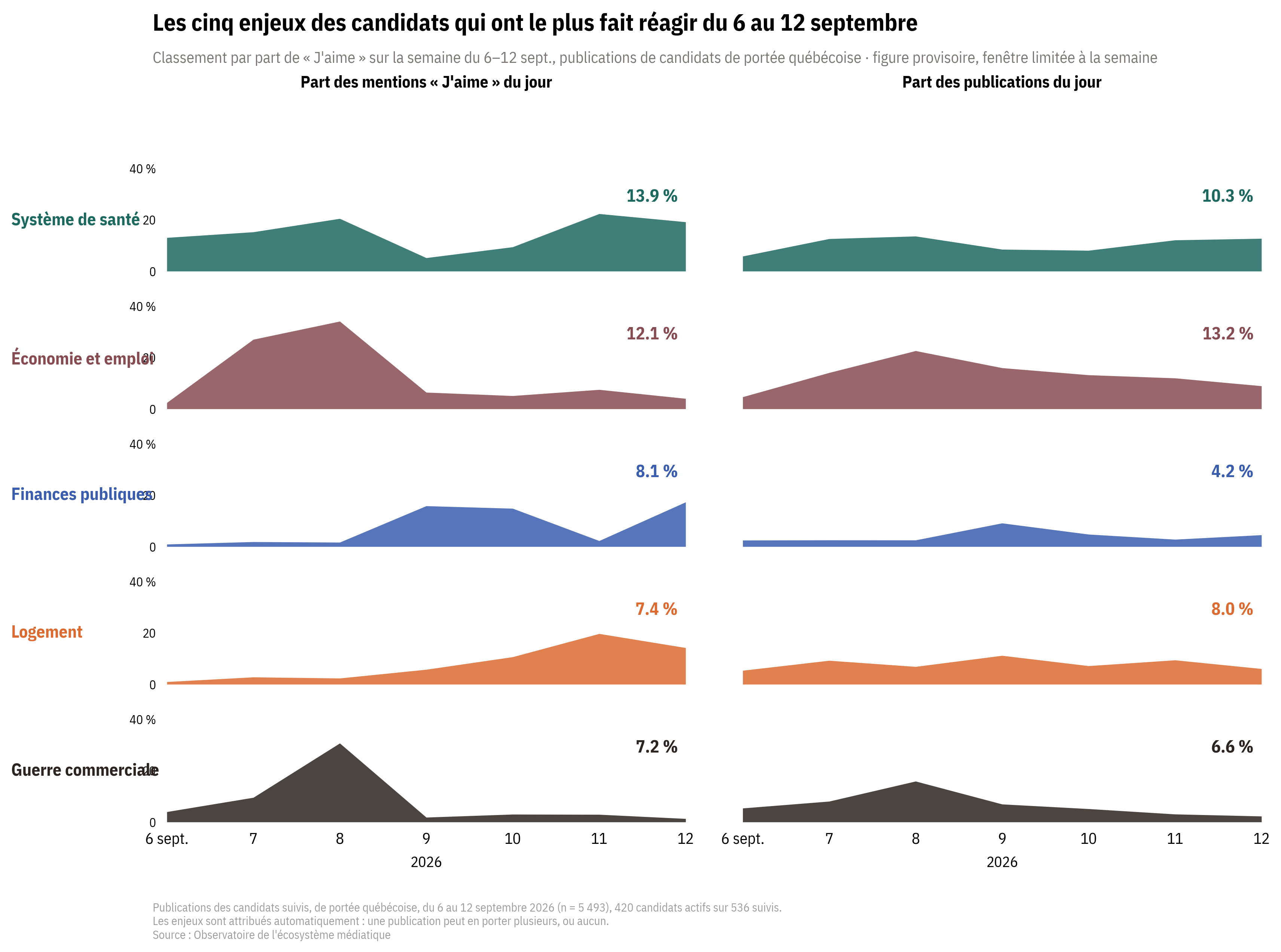
As every week during the campaign, we classified candidates' posts from each of the five main parties on Facebook, Instagram, X, YouTube, TikTok, and Bluesky according to whether they mention different political issues from a list of 18 (see Methodology). We observe that public finances, the healthcare system, and housing remained among the top 5 issues receiving the most engagement in candidates' posts. Posts touching on these issues received 14.8%, 12.8%, and 9.9% of “likes” on candidates' posts across all platforms, respectively. Discussion of taxes, absent last week, is back, having received 9.9% of “likes”.
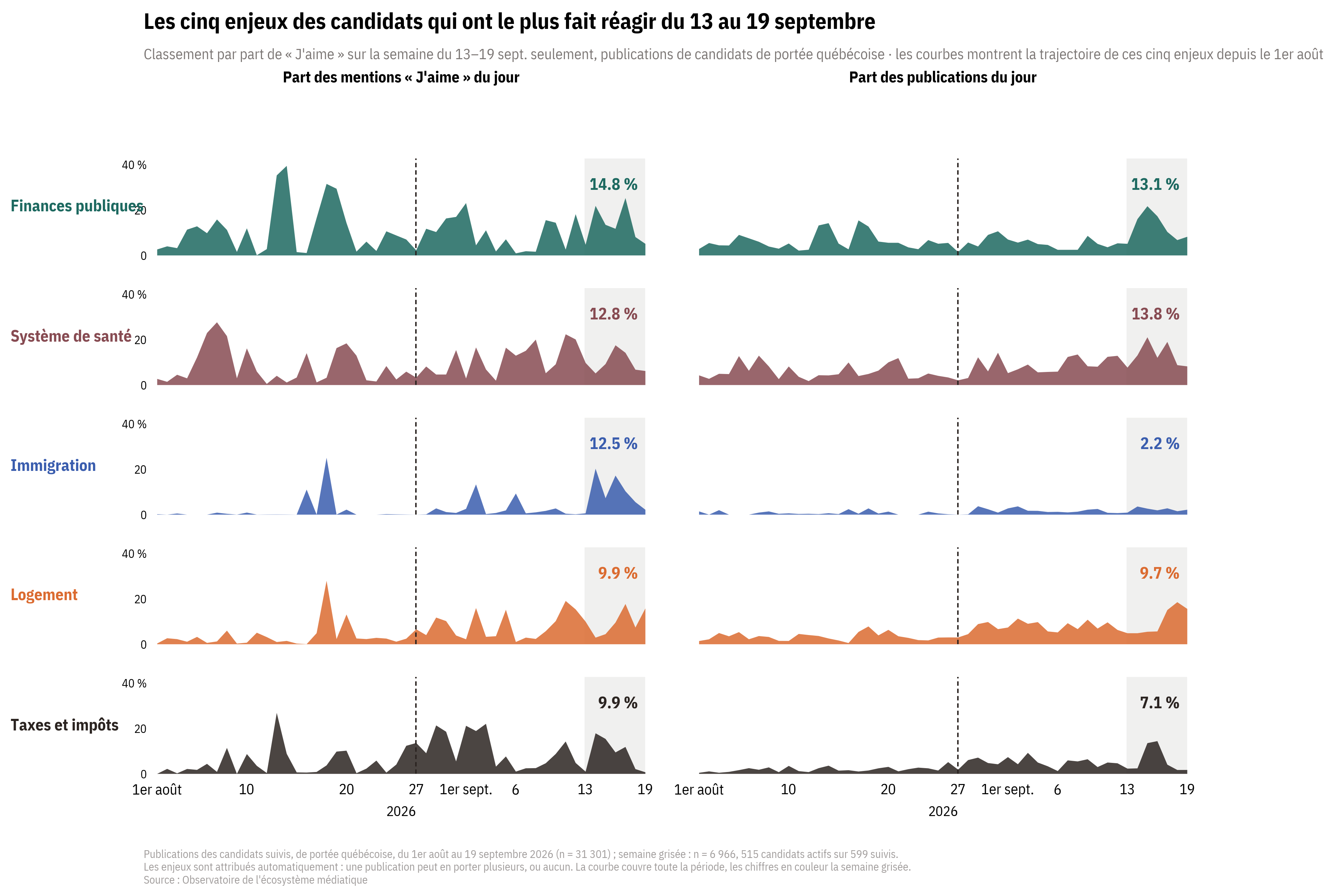
For the first time, immigration ranks among the major issues of this fourth week of the campaign, collecting 12.5% of “likes” for just 2.2% of posts. This points to strong interest among Quebecers in the issue of immigration and, above all, in the discussions surrounding it among candidates on these platforms. Compared with other issues, posts about immigration receive proportionally much higher engagement than their posting volume, with a ratio of 5.7, versus 1.98 for secularism (the second-highest ratio among the 18 issues).
The Election on Facebook
Political Advertising: Spending and Targeting
Advertising on Facebook and Instagram offers another angle for observing the information environment on the platform during the provincial campaign. Since July 1, we have catalogued 2,615 ads in Meta's Ad Library — all ads Meta classifies as political, electoral, or social in nature and run predominantly in Quebec. Ad volume has increased over the past week compared with the start of the campaign.
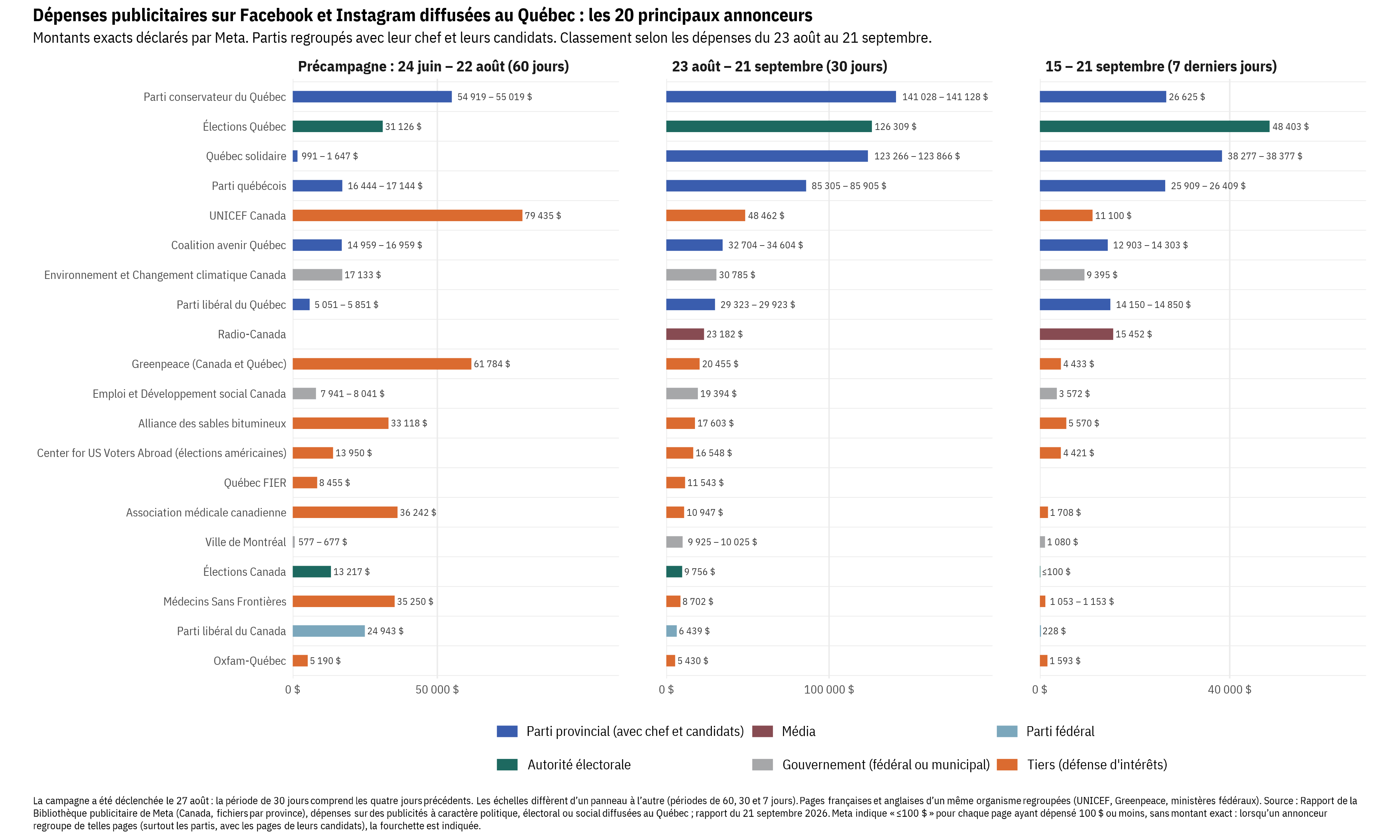
Figure 2 presents the 20 leading advertisers running ads in Quebec, based on spending disclosed by Meta. Unsurprisingly, Élections Québec is the largest advertiser not affiliated with a political party. The PCQ is the party that has spent the most on Facebook and Instagram ads over the past 30 days, while Québec solidaire is the party that spent the most over the past week. The Parti Québécois, and especially the Liberal Party and Coalition Avenir Québec, spent comparatively smaller amounts. Among the parties, two broad strategies emerge: some rely on a large number of ads, while others concentrate comparable budgets on just a few ads.
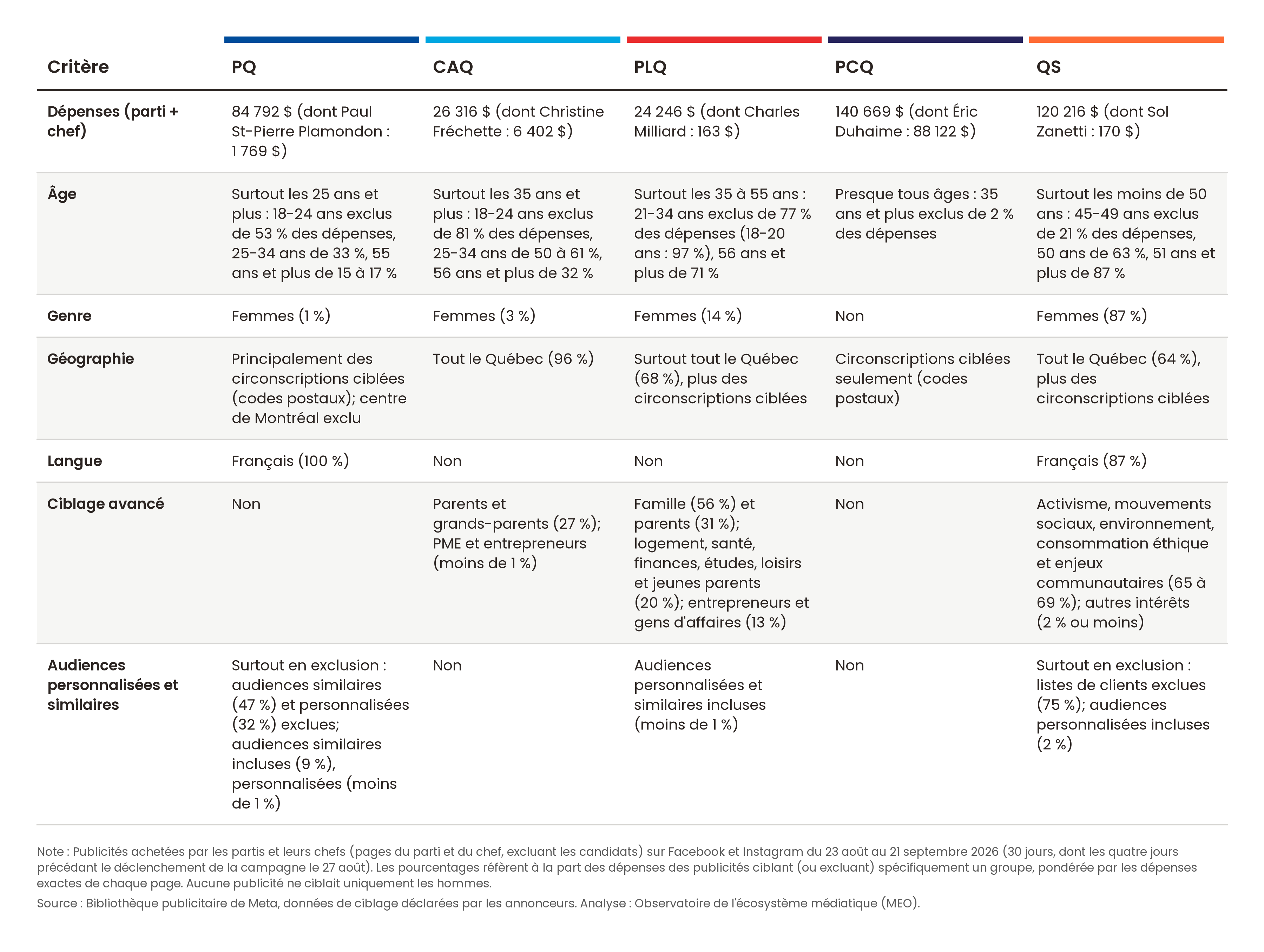
To better understand their strategies, we assessed the criteria each political party used to target its ads over the past 30 days, from August 23 to September 21 (Meta's Ad Library only makes data available for the last 7, 30, and 90 days). The analysis focuses on ad purchases by the parties and their leaders, to illustrate decisions made at the national campaign level. The data are summarized in Figure 3. All parties targeted specific ridings, though to varying degrees (the CAQ often targets all of Quebec), mainly ridings considered key or where they have the best chances of winning. Beyond geographic targeting, common to all parties, strategies vary significantly from one party to another. The PQ mainly targets those 25 and older, the CAQ those 35 and older, and the PLQ those 35 to 55. QS is the only party prioritizing the youngest age group, with 18–44-year-olds included in the selected age group for 100% of its ad spending and 45–49-year-olds for 79% of its spending. On gender, no ad targeted men exclusively, while 87% of QS's ad spending, 14% of the PLQ's, 3% of the CAQ's, and 1% of the PQ's went to ads targeting women. The PQ and QS are the only parties that targeted by language, both targeting francophone voters. Finally, we observe uneven use of advanced targeting criteria (demographic characteristics, interests, and behaviours as measured by Meta), which were used only by the CAQ, the PLQ, and QS. Specifically, 27% of the CAQ's ad spending directly targeted parents and grandparents, and less than 1% targeted entrepreneurs and business people. The Liberal Party used a range of criteria, including an interest in family (56%), an interest in specific issues such as health (20%), and entrepreneurs and business people (13%). The majority of Québec solidaire's spending (more than 65%) went to ads targeting those with an interest in social movements, community issues, the environment, and ethical consumption.
Beyond Élections Québec and the political parties, one of the leading advertisers was Radio-Canada, mainly for ads promoting the leaders' debate and debates among local candidates. Rules on third-party spending during an election period are particularly strict in Quebec, so spending levels after the campaign's launch are low, and the vast majority of ads identified as touching on a social, electoral, or political issue on Meta's platforms don't directly concern the election. Since the election began, ads targeting Quebec appear to come mainly from non-profit campaigns on international issues, or from sector-specific or pan-Canadian issues such as energy and pharmaceutical policy. Ads related to the energy sector stand out, notably those from the Pathways Alliance (Alliance des sables bitumineux), which had spent, at the time of extraction, more than $10,500 on two French-language ads bought on September 8, targeting Quebec and promoting Canadian oil sands (by comparison, the same organization spent between $37,000 and $43,000 on ads with identical text that ran between July 2 and September 1). Overall, this picture differs markedly from what is observed in contexts where third parties can participate much more actively in the campaign, notably in federal elections.
The Spread of Partisan Narratives
Facebook is a particularly useful space for observing not only the topics discussed during the campaign, but also how similar narratives circulate between accounts. Candidates from different parties campaign in an environment where many of the same issues and events command attention simultaneously. We therefore compared the content candidates and the political influencers tracked by the Observatory (see Methodology) posted on Facebook between August 27 and September 16, to examine which accounts post about similar topics, using similar language, during the campaign.
Figure 4 groups accounts together based on the content of their posts over this entire period. Each account is represented by the average profile of its posts and linked to the ten accounts whose content is most similar. Identical or near-identical text reused by several candidates from the same party is excluded, so that the sharing of standardized partisan material alone does not determine the network's structure.
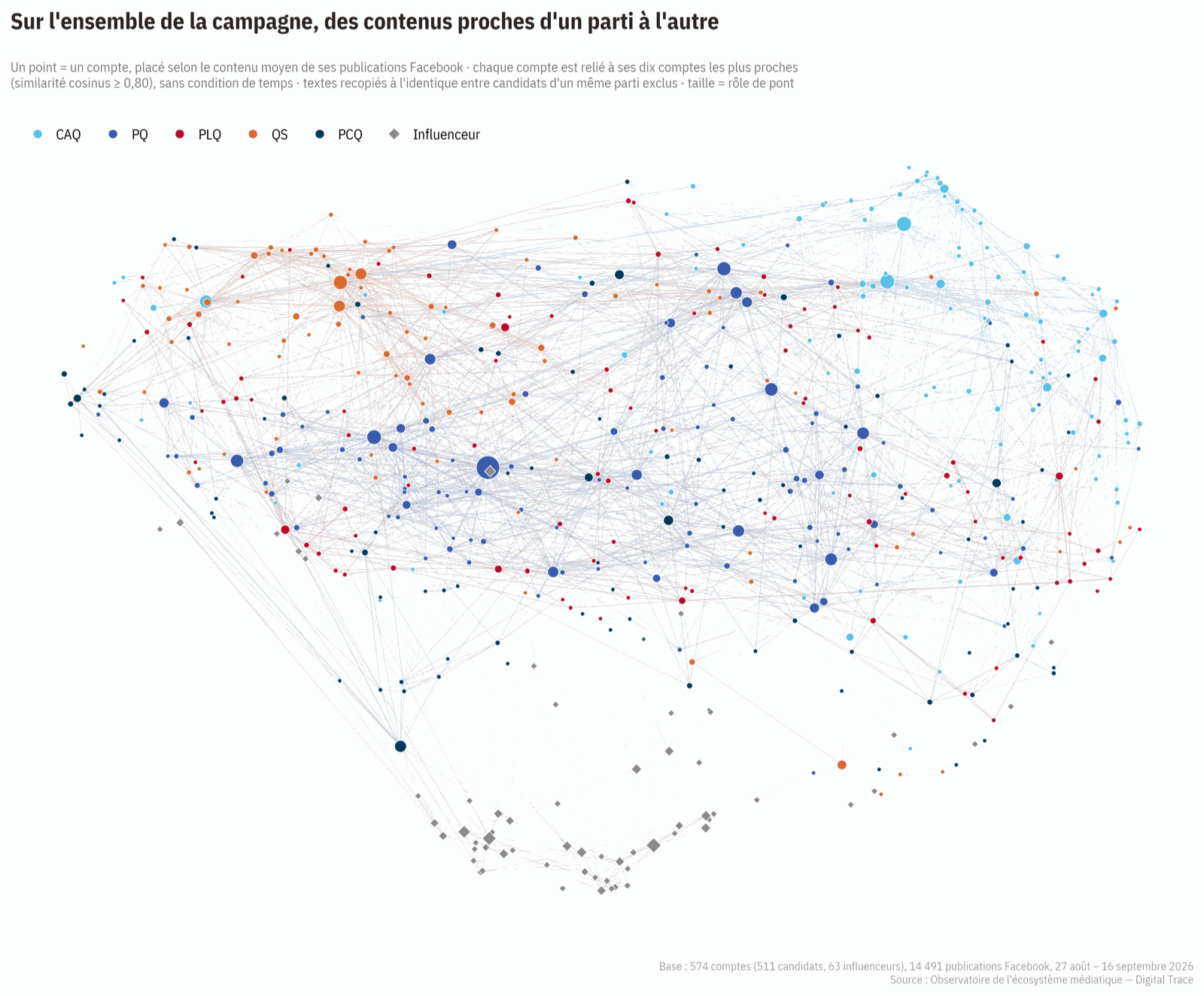
The map shows that the different parties' discussion spaces overlap substantially. Partisan clusters remain visible, but candidates do not form five distinct content spaces: many links cross partisan lines. In other words, candidates from different parties often talk about the same topics and events, even when they approach them from different positions.
Influencers occupy contrasting positions within the network. A majority of them (70%) cluster mainly among themselves: their posts resemble those of other influencers more than those of candidates. Conversely, about one in four influencers (27%) is found within candidate clusters. Influencers therefore do not form a homogeneous space: while a majority concentrate in a more distinct content space, a significant portion instead shares more of the candidates' informational space. This could notably be the case for influencers who more directly promote a specific party's positions.
Facebook Groups as a Space for Political Discussion
On Facebook, the flow of information doesn't happen only through candidates' posts. There are also many Quebec groups whose main purpose is to serve as a space for discussing provincial politics. For this report, we compiled a non-exhaustive list of 51 public groups focused on Quebec politics, for which we collected every post between August 15 and September 22, 2026. In total, these groups comprise 54,513 posts, received 1,783,437 interactions (reactions, comments, and shares), and are followed by 430,568 users. It's important to note that we do not count the number of unique users who are members of each group, and that a user is likely a member of several.
Structure
Our list of groups ranges from 264 to 42,720 members, with a median of 4,000 members per group. Of the 51 groups, 47 receive at least one post per day, with a median of 12 posts per day that ranges from 0 to 237 depending on the group. Engagement also fluctuates enormously: over the period from August 15 to September 22, the groups accumulate anywhere from 0 to 365,195 interactions, or 0 to 727 interactions per post, for a median of 457 posts per group. Five groups have fewer than 50 posts over the period. While the purpose of a Facebook page is to publish content for an audience that follows it, groups are meant to offer a space for discussion. We observe that groups display very different levels of discussion.
The analysis distinguishes four types of groups based on two criteria: the share of posts written by the five most active authors and the share of posts that receive at least one comment (see Methodology). The 13 broadcast groups rely on a handful of authors, but generate a lot of discussion: the five most active authors write 77% of posts, 55% of posts receive comments, and each post gets an average of 20.5 reactions and 7 comments. The 10 discussion groups are much more open: the five most active authors write only 28% of posts there, which receive an average of 26.2 reactions and 8.2 comments. Although these groups have a comparable number of members to broadcast groups (141,379 versus 149,754 in total), they generate 221 interactions per day per 1,000 members, compared with 38 for broadcast groups. The 16 hybrid groups fall in between: 63% of posts are written by the five most active authors, and 43% receive comments. Finally, the 12 so-called “spam” groups are almost entirely fuelled by a handful of accounts: the five most active authors write 81% of posts there, and only 9% of posts receive comments. In addition, 78% of posts are reshares, 35% of which are authors resharing their own posts, and each post receives an average of 0.5 reactions.
Although we only collected the two comments Facebook highlights per post, a striking similarity across all groups is that, among the commenters we collected, between 87% and 100% never posted in the group where they comment during the period studied. Groups are therefore spaces where most of the content is posted by a small share of members. The intensity of this concentration varies but generally remains quite unequal. The main difference between groups, then, lies rather in their capacity to generate discussion in the form of comments, often accompanied by reactions.
Content
For each group in our list, a member of our team performed manual coding based on the group's content and description. Among the 51 groups collected, 27 have a sovereigntist orientation, 13 are mainly local and provincial news groups, 6 are groups advocating various political interests (e.g., Quebec's annexation by the United States, information on protests), 4 are groups supporting political parties in Quebec (2 for Éric Duhaime and the PCQ, one for the PQ, and one for QS; note that private groups supporting parties also exist, though we did not analyze them), and one is federalist. This distribution reflects the groups we found and analyzed, and does not necessarily represent an exhaustive portrait of all Quebec groups on the platform. While there is no strong pattern between the different categories of groups and the type of ideas they promote, we can note that groups supporting political parties are exclusively discussion groups or a mix of broadcast and discussion.
The Impact of the Election on Different Groups
The election has had an impact on nearly all groups. Across all group categories, we observe a 20% to 43% increase in posting volume. News groups, meanwhile, saw a slight decline. However, only the four party-support groups saw a marked increase in interactions per post after the campaign began: engagement per post rose from 59 to 80 reactions, from 14 to 17 comments, and from 10.9 to 15.3 shares.
Information Sharing
Across all groups, we observe that sharing content makes up the majority of group posts. In all, 59% of posts are reshares of a post from another page, group, or user. In terms of format, 16% of posts are reels (short videos) and 8% contain photos. Posts with photos are also the ones that draw the most engagement, with an average of 126.4 per post, compared with 13.7 for posts including a reel and 47% for those including only text. Facebook groups are therefore mainly places for resharing content published elsewhere, which serves to support discussions that mostly take place in the comments.
One of the major distinguishing features of this campaign is that, although Facebook is the most-used platform for political information, media outlets can no longer publish there and it's impossible to share links to their articles since the Online News Act came into effect. This is reflected when we analyze the links shared in group posts: not a single link points to an established Canadian or Quebec media outlet's site, and the most-shared links go to other social networks such as YouTube, Instagram, or TikTok. However, this doesn't mean news articles aren't being discussed. Like most Canadians, Quebecers share screenshots of news articles. We estimate that between 12% and 27% of original posts containing photos are screenshots of news articles. In total, 3,646 posts contain explicit mentions of news organizations in their text or in the image they include. Media content is therefore not entirely absent from Facebook groups. Even though it's impossible to directly share a link to it, members have simply found other ways to comment on news articles.
On Our Radar
AI Chatbot Audit. Last week we presented the first results of our audit of AI chatbots, including their voting recommendations and the sources of information they draw on to make them. Our study found, notably, that the website lequebecvote.ca, registered on August 21 and built with AI, was among the sources ChatGPT relies on most heavily for voting recommendations. The Décrypteurs team conducted an investigation into this website, which has also undergone significant revisions since we published last week's update. The website's author is now identified by name and several of the parties' positions have been updated, although the Radio-Canada article notes that some incorrect party positions remain on the site. This week, we repeated the same queries and found that ChatGPT now relies on this site even more heavily. It's now cited in 63% of ChatGPT's responses to voting-recommendation questions (compared with 39% in our first audit and 42% last week). It's now the source ChatGPT cites most on these questions, ahead of the parties' own websites. The increase holds in both French and English, whether ChatGPT is asked who to vote for or which party best represents our views. Across all of our questions, nearly one in five of ChatGPT's citations (18%) now points to lequebecvote.ca. The site's party-comparison pages, the ones that were revised, remain the most cited. This increase comes in the very week the site was overhauled and received media coverage. Google's AI Mode, for its part, cites the site only very rarely (twice since the audit began, and not at all this week).
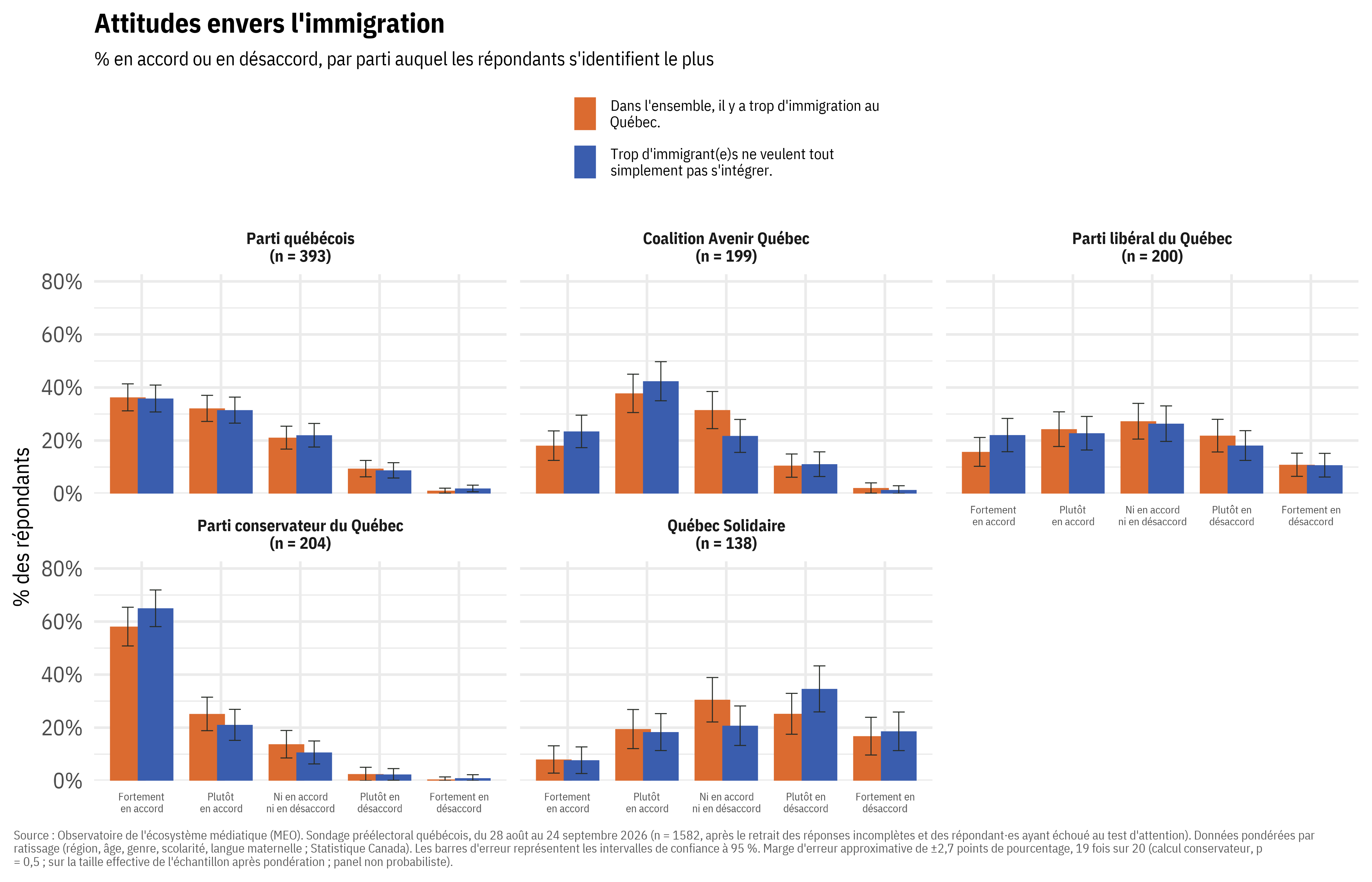
Immigration Debate. Over the past week, immigration has grown in importance as an issue, both in debates between and within parties and online. As Figure 1 shows, although it isn't the issue candidates discussed most (2.2% of posts), candidates' posts on this issue generated a disproportionate volume of reactions from online audiences this week (12.5% of “likes”). During the campaign, different visions clash over capacity to welcome newcomers, protecting the French language, integration, and Quebec identity. Certain statements by candidates since the start of the campaign have caused significant divisions online and have been used to justify rhetoric more radical than the positions parties themselves hold, particularly around belonging to Quebec society. This climate notably led comedian Anas Hassouna to make a video, viewed more than 200,000 times, denouncing the practice of blaming immigrants for the problems of Quebec society and reassuring immigrants that Quebec society needs them. Among the more radical narratives that circulated, some suggest immigrants receive everything upon arrival, while many Quebecers experience homelessness. Others also openly echo the “great replacement” conspiracy theory, as seen in the campaign signs of a far-right activist running as an independent candidate in Drummondville. Data from our survey, conducted between August 28 and September 24 (see Methodology), shows the electorate is fairly sharply divided on the issue of immigration. As Figure 5 shows, 83% of those identifying with the PCQ believe there is too much immigration in Quebec, compared with 68% of those identifying with the PQ, 56% with the CAQ, 40% with the PLQ, and 27% with QS.
Integrity of the Electoral Process. Several narratives related to election administration are also circulating on social media. The controversy surrounding a Coalition Avenir Québec candidate who handed out cash to bingo winners — an act his opponents likened to vote-buying — notably fuelled discussions about compliance with electoral rules. Voting in seniors' residences, meanwhile, is drawing opposing concerns online. On one hand, some lament the lack of accessible voting for these electors. One private-residence owner posted a video on Facebook expressing concern over what she describes as a procedural change now requiring every resident to register by phone in advance to vote in private seniors' residences, which she calls a form of vote control by Élections Québec. To our knowledge, there has been no change in procedure: whether a polling station is set up depends on the number of residents, and if that number is insufficient, on-site voting remains possible if even a single resident requests it. On the other hand, some believe that measures meant to facilitate their participation would make them more vulnerable to pressure. A video that garnered more than 12,000 views on X compares voting in long-term care homes (CHSLDs) to footage of armed Russian soldiers entering polling booths. Similar narratives about CHSLD voting circulated during the 2022 election. Other posts urge voters to remove themselves from the electoral list or raise concerns about certain voting locations, notably the installation of a mail-in voting station in an Islamic community centre, which some argue could discourage voters from voting. In 2022, we observed a rise in narratives about the integrity of the electoral process around the opening of advance voting, a trend we will continue to monitor.
Amnesty International Canada Francophone Statement Accusing the Parti Québécois of Intimidation. On September 23, Amnesty International Canada Francophone (AICF) published a statement in which the organization says the Parti Québécois engaged in harassment and intimidation against Dr. Marie-Ève Cotton, after several people associated with the party, closely or loosely, filed complaints with the Collège des médecins over remarks the physician made about the party's leader, certain positions on gender, or the party's direction. The Collège des médecins concluded there had been no professional misconduct with respect to these complaints, which concerned Facebook posts whose tone was deemed “[accusatory, polarizing, and inconsistent with the high standards the public is entitled to expect [sic] of a member of the Collège des médecins](https://www.ledevoir.com/politique/quebec/1009643/pq-denonce-psychiatre-college-medecins-propos-juges-hostiles).” A separate complaint filed by a colleague of the physician's raised concern that the psychiatrist's posts could be seen as making a diagnosis or clinical assessment — for instance, by describing Paul St-Pierre Plamondon as “too fragile” to be head of state. AICF's executive director stated: “We find it troubling that a party on the verge of power appears to have used intimidation tactics. Criticism of members of the political class must be able to be voiced without fear of reprisal.” The Parti Québécois's leader considers his party's complaint legitimate and accused Amnesty International of interference in the election campaign. Several political commentators have weighed in on the issue, with some posts drawing thousands of reactions.
Methodology
Survey
The analysis draws on a bilingual (French and English) pre-election survey conducted from August 28 to September 24, 2026 by the Media Ecosystem Observatory among the Quebec population. The survey was administered on the Qualtrics platform to Léger's online panel (LEO), using quota sampling (region, age group, gender, and language) based on Statistics Canada reference data. Respondents were compensated through Léger's standard panel rewards program. Regional quotas are based on three strata — the Montreal census metropolitan area (CMA), the Quebec City CMA, and the rest of Quebec — built from respondents' reported administrative region and municipality of residence.
The questionnaire was restricted to Canadian citizens aged 18 and older residing in Quebec. The final sample, after removing incomplete responses and respondents who failed the attention check, includes 1,582 respondents, 1,364 of whom answered in French and 218 in English. All analyses use weights obtained through raking. Calibration covers five margins: region (Montreal CMA, Quebec City CMA, rest of Quebec), age group (18–24, 25–34, 35–44, 45–54, 55–64, 65 and older), gender, education (high school or less; some postsecondary below a bachelor's degree; bachelor's degree or above), and mother tongue (francophone; anglophone or allophone), based on Statistics Canada population estimates. The method includes a rule to truncate weights falling outside the [0.25, 4] interval; this rule was not triggered, as every weight already fell within that interval (weights in practice range from 0.32 to 2.18). Because the sample is non-probabilistic, the margins of error reported are approximate and assume a simple random sampling design: based on the effective sample size, the margin of error is ±2.7 percentage points, 19 times out of 20 (a conservative estimate, p = 0.5).
AI Tools Audit
The audit covers the two AI tools Quebecers use most to get information: ChatGPT and Google's AI Mode. The Observatory's team drafted 66 questions across four areas: the electoral process, voting advice, questions built on a dubious premise or rumor, and campaign news. Four questions include a variable (postal code, riding, or party) with several versions each, such as a Montreal postal code and a rural one. This yields 75 questions, each asked in French and in English.
Each question exists in three phrasings adapted to the tool. ChatGPT receives a formal version, written in complete sentences (e.g., My postal code is H2X 1Y4. Where is my polling place for the Quebec provincial election?), and a casual version (e.g., where do i vote for the quebec election? my postal code is H2X 1Y4), closer to how a large share of users actually write when using these tools. Google's AI Mode receives a short, keyword-style version, as in a search engine (e.g., polling place H2X 1Y4 quebec election). Each phrasing is repeated in separate conversations, three times for ChatGPT and six times for Google's AI Mode. This lets us measure the variation in responses to an identical question before comparing across languages, phrasings, or tools. One wave consists of 900 queries to ChatGPT and 660 to Google's AI Mode (110 unique queries, since some questions collapse to the same keyword search). The same, unchanged question bank is submitted every week until October 14. This report is based on the first three waves, collected on September 10, 16, and 23, 2026.
Queries are submitted automatically within each tool's app, from smartphones, with one new conversation per query. For each response, we keep the full text, every link cited, and, for ChatGPT, the model indicated by the app. About half of responses come from the “gpt-5-6” model and the other half from its “gpt-5-6-mini” version, which we account for in comparisons. The model behind Google's AI Mode is not known. In total, the three waves comprise 4,909 queries (2,691 to ChatGPT and 2,218 to Google's AI Mode), of which 4,642 received a response (2,428 from ChatGPT and 2,214 from Google's AI Mode). During the first wave, a partial follow-up to the collection brought the number of queries to Google's AI Mode to 898 rather than 660. The 267 queries that went unanswered are excluded from the analyses.
Responses about the electoral process were rule-coded against information published by Élections Québec, then verified by reading. The coding covers the accuracy of each factual element, the presence of fabricated information, and whether the assistant corrected the false premise. Voting-advice responses were coded according to whether the tool explicitly recommends a party, steers the user without an explicit recommendation, or declines, and according to how many parties' positions are presented. Each cited link was classified by domain and source type (official body, party, media outlet, etc.). Blocking of OAI-SearchBot, OpenAI's search crawler, was checked on September 16, 2026, in each site's robots.txt file.
The audit measures what these tools answer to a fixed set of questions at a given point in time. It does not reproduce the full range of questions voters actually ask, and answers could change from one week to the next depending on changes made to the models or additional guardrails put in place by AI companies — for example, ahead of the U.S. midterm elections.
Social Media
The Corpus. The Observatory continuously tracks 1,121 Quebec accounts across six platforms (X, Facebook, Bluesky, YouTube, Instagram, and TikTok): 598 candidates from the five parties, 109 media accounts, and 413 influencers, including 204 commentators and 135 journalists. Between August 1 and September 19, 2026, these accounts produced 222,653 posts. This is an account-based corpus, not a keyword search: we observe what actors identified as influential in the public sphere are posting, not everything being said in Quebec. Public comments are not part of it.
To build the candidate list, we collected data from the official websites of political parties with at least one sitting member in the National Assembly of Quebec (Coalition avenir Québec, Parti libéral du Québec, Québec solidaire, Parti québécois, and Parti conservateur du Québec), as of September 1, 2026. We continue to update this list for upcoming weekly reports. From the candidates section of each party's website, we extracted: the candidate's name, their electoral riding, and their social media account handles. Accounts were collected across six platforms: Facebook, Instagram, X/Twitter, Bluesky, TikTok, and YouTube. Where a party's website had no dedicated candidates section, we manually reviewed its announcements section and collected the candidate's name and riding from each nomination announcement post. Since the list of social media handles on party websites can be incomplete, we supplemented it by manually checking the handles listed on party websites to see whether they mentioned or linked to other social media accounts (e.g., via Linktree). Where no handle was listed on a party's website for a candidate, we conducted an online search to find any accounts to add. Each account was verified against the following criteria: it officially belongs to the candidate, and it is a public account used as part of their political activities. We did not include any handle that wasn't listed on the party website, mentioned by another verified account belonging to the candidate, or mentioned or followed by another candidate's verified account. We also did not include accounts devoted mainly to personal content.
Coding. Every post is run through a language model (Qwen3.8-27b) that determines, without chain-of-thought reasoning, which issues it addresses, from eighteen non-exclusive categories: cost of living, taxes, economy and employment, public finances, trade war and tariffs, health, education, housing, transportation, environment, immigration, the French language, secularism, independence, crime, ethics and integrity, artificial intelligence, and social issues. A post can touch on several of these, or none (e.g., field activities, thank-yous, links without commentary, replies within a thread).
Engagement. Our engagement analysis relies on “likes,” the only metric available across all platforms. Using likes isn't necessarily comparable from one platform to another, but it is the best available measure of public engagement with the content.
Facebook Similarity Analysis. The analysis covers text-based Facebook posts published between August 27 and September 16, 2026 by the candidates and influencers tracked by the Observatory. In total, 14,491 posts were retained. Each post is represented numerically based on its text content, and the proximity between two posts is measured by their cosine similarity. To prevent the reuse of standardized partisan material from determining the results, 634 identical or near-identical posts (similarity ≥ 0.95) published by multiple candidates from the same party were excluded.
For each account, we calculate the average profile of its posts over the entire period, then link it to its ten most similar accounts when their similarity reaches at least 0.80. The timing of posts is not a factor in this analysis. The position of the 574 accounts on the map reflects the proximity of their content, while the size of the points represents their bridging role in the network.
Building and Classifying the List of Facebook Groups. We identified relevant Facebook groups by combining automated and manual searches. First, keyword queries (e.g., “Québec,” “politique,” and their variants) surfaced public groups whose name, description, or content related to Quebec politics. We then manually reviewed these results to screen out groups that were off-topic, inactive, or unrelated to Quebec. This review also helped surface additional groups from the ones already selected. This approach nonetheless has limitations. The resulting corpus does not claim to be exhaustive and does not represent the full range of political opinion in Quebec. Only public groups are included. The results should therefore be read as a look at certain online discussion spaces, not as a representative portrait of Quebec public opinion.
Groups were classified by their structure, regardless of content, based on two measures calculated for each group over the entire period (August 15 to September 22, 2026): posting concentration, meaning the share of a group's posts written by its five most active accounts, and the response rate, meaning the share of posts that received at least one comment. A group is considered a discussion group when its five most active accounts write less than 50% of posts and at least 25% of posts are commented on. It is a broadcast group when its five most active accounts write at least 70% of posts and at least 40% of posts are commented on, and a “spam” group when those five accounts write at least 70% of posts and less than 15% of posts are commented on. Groups that meet none of these conditions are classified as hybrid.
Related Publications
Weekly Update 3: Quebec's First Election in the Age of AI
Read more
Weekly Update 2: Three Agendas, One Election
Read more
Weekly Update 1: The Trade War Enters the Quebec Election Campaign
Read more