
Alberta’s Referendum, Online: Election Fraud Claims Ahead of the October 19 Vote
Chris Ross, Ben Steel, David Hobson, Saewon Park, Esli Chan, Bradley Wood-MacLean, Mika Desblancs-Patel, Samuel Goertz, Danielle Bohonos, Aengus Bridgman
Key Takeaways
- With less than two weeks to go before Alberta’s October 19 referendum, posts raising concerns about special (mail-in) ballots have risen sharply since September, as Elections Alberta approved more than 652,000 special (mail-in) ballots.
- Confidence in a hard-pressed Elections Alberta has fallen 18 percentage points since 2023 after a contentious 18-month process marked by multiple petitions and court battles over question phrasing, controversial interpretations of advertising rules, a voter-list data breach, and accusations of foreign interference.
- After the Calgary-Shaw by-election, a doctored "vote flip" chart — a recoloured copy of the 2020 Presidential Election Wisconsin results — was passed off as Alberta data and posts repeating the claim drew about 260,000 views. This case study provides a template for how fraud claims will likely circulate immediately after the referendum.
- We expect fraud claims over Alberta’s referendum results to be pulled into the American online ecosystem. While some organizers in the independence movement are pushing back against special (mail-in) ballot fraud claims, other online accounts demonstrate a pattern of appealing to U.S. figures for amplification on social media.
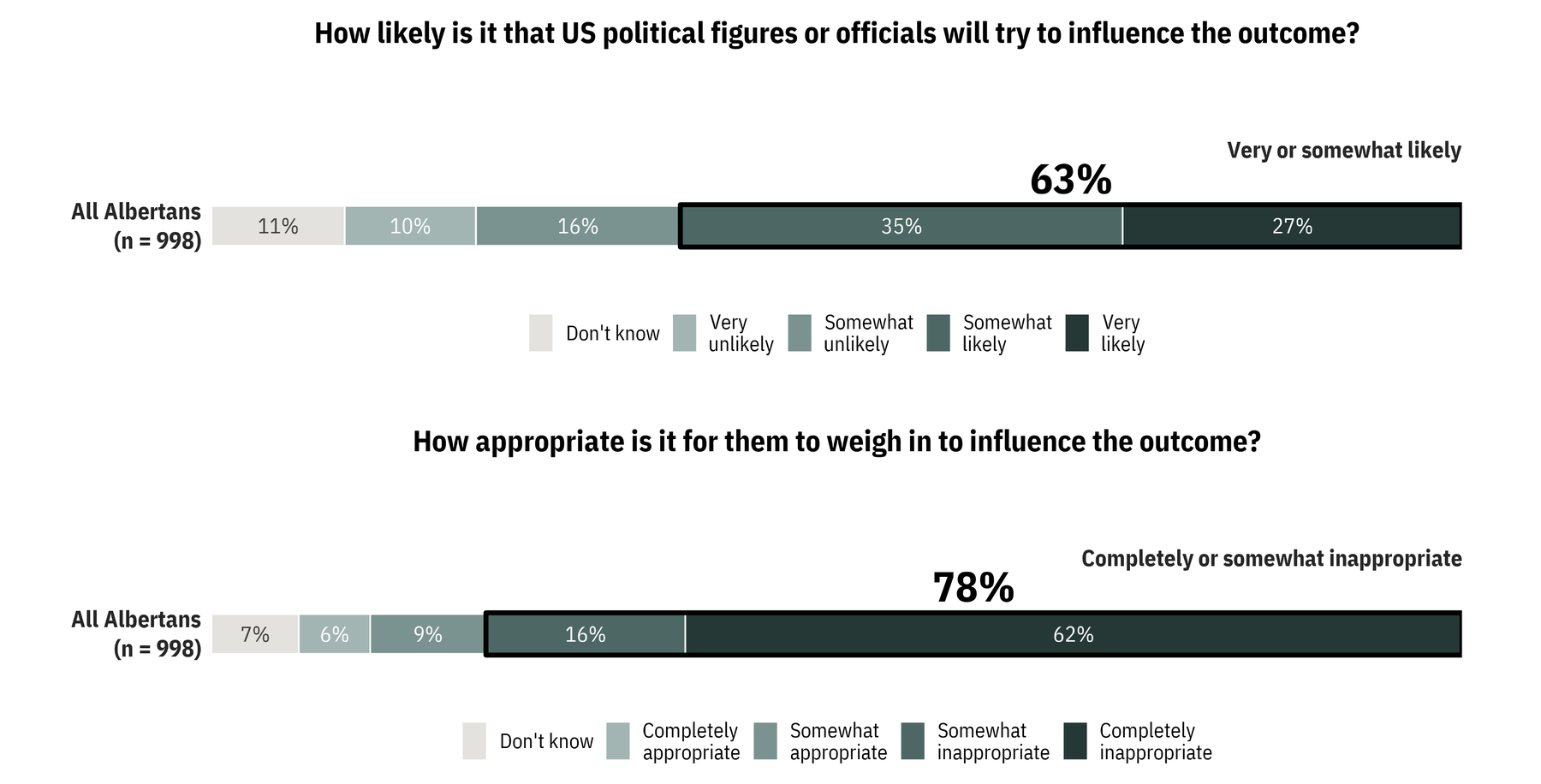
- 63% of Albertans expect American political figures to weigh in on the referendum to influence the outcome and 78% consider it inappropriate for US figures to try to influence the outcome.
Introduction
This report focuses on the online conversation in advance of the October 19 referendum. A series of contentious events and decisions over the past 18 months are culminating in an important vote on Alberta’s future, coinciding with a sharp drop in confidence to a hard-pressed Elections Alberta — across the political spectrum. The following section details major sticking points over the integrity of the process, with social media data showing the corresponding volume of discussion on each topic. We then proceed to show how election fraud narratives are circulating online in advance of the vote, using the Calgary-Shaw by-election as a case study for how referendum night may play out on social media.
Frustration Over the Process and a Drop in Trust
Albertans have voted in province-wide referendums before, on topics such as prohibition, electricity, daylight saving time, and equalization payments. However, the October 19 referendum questions are the first to follow citizen petition legislation introduced in 2021. Through analysis of social media data of those passionate about the potential separation question, we observe widespread frustration over the process that produced the upcoming referendum.
Among those who support Alberta remaining in Canada, frustrations have been primarily aimed at the provincial government for introducing and amending legislation to ease the requirements for citizen initiatives to trigger a referendum on separation. Further, a large electors-list data breach prompted an investigation from Elections Alberta, prompting questions over data privacy. Critics have also raised concerns over the potential for foreign interference and particularly the ability of Elections Alberta to monitor, investigate, and respond to these efforts.
Independence advocates have expressed frustration with provincial courts after the initial referendum proposal put forth by Stay Free Alberta was determined to be unconstitutional, and the second, signature-verified, petition was paused by legal processes due to unsatisfactory consultations with First Nations. As well, leaders in the movement have criticised Elections Alberta for failing to enforce advertising law evenly, arguing that the Forever Canadian campaign violated election rules by failing to disclose their financial records required by third-party advertiser regulations.
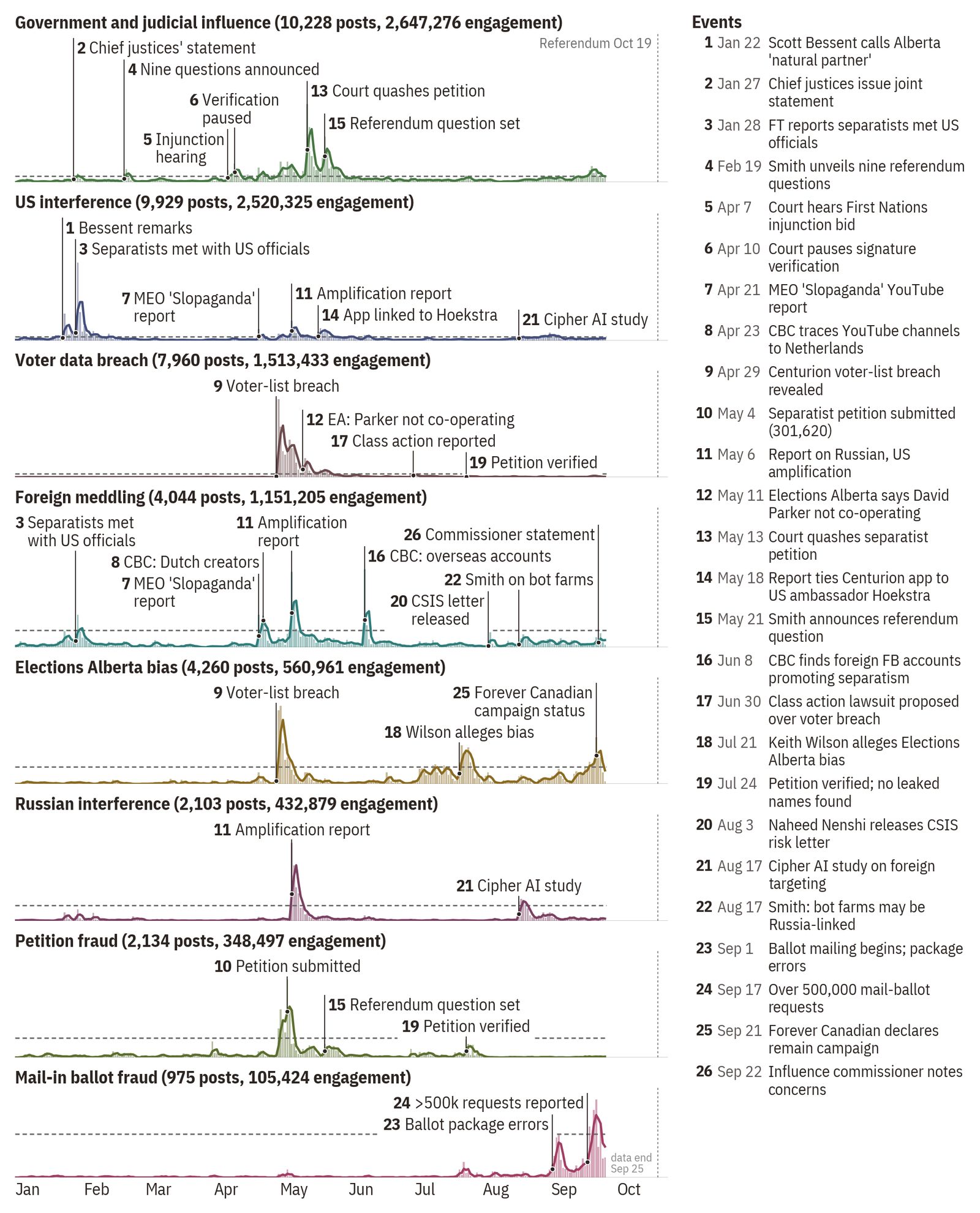
Figure 1 shows this online conversation and major events that have been discussed since January 2026 across X, Bluesky, YouTube, TikTok, Instagram and Truth Social, plus Facebook for influencer accounts only. Panels are ordered by total engagement (likes, replies, and shares). Each panel is scaled to its own busiest day, so bar heights are not comparable across panels.
These events and ongoing conversations coincide with a dramatic drop of confidence in Elections Alberta. Figure 2 compares confidence in Elections Alberta and Elections Canada, by Albertans, in May 2023, during the last provincial election, with September 2026. While confidence in Elections Canada has remained roughly constant, there has been a distinct drop in confidence in Elections Alberta. This shows that concern over electoral institutions is not necessarily a Canada-wide issue, but focuses on provincial politics in the Alberta context. Figure 2 shows an 18-point drop in Albertans who have ‘quite a lot’ or ‘a great deal’ of confidence in Elections Alberta.
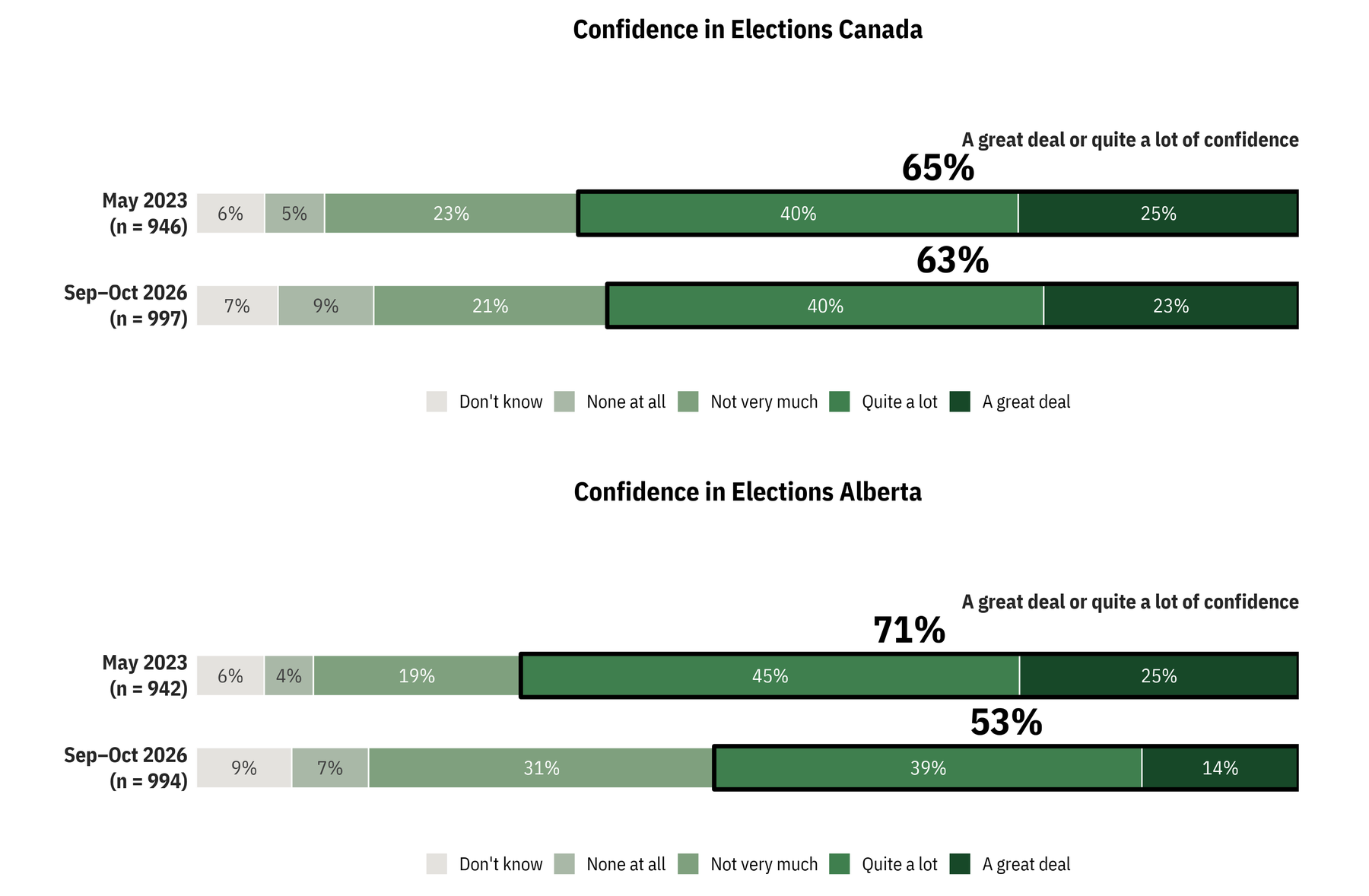
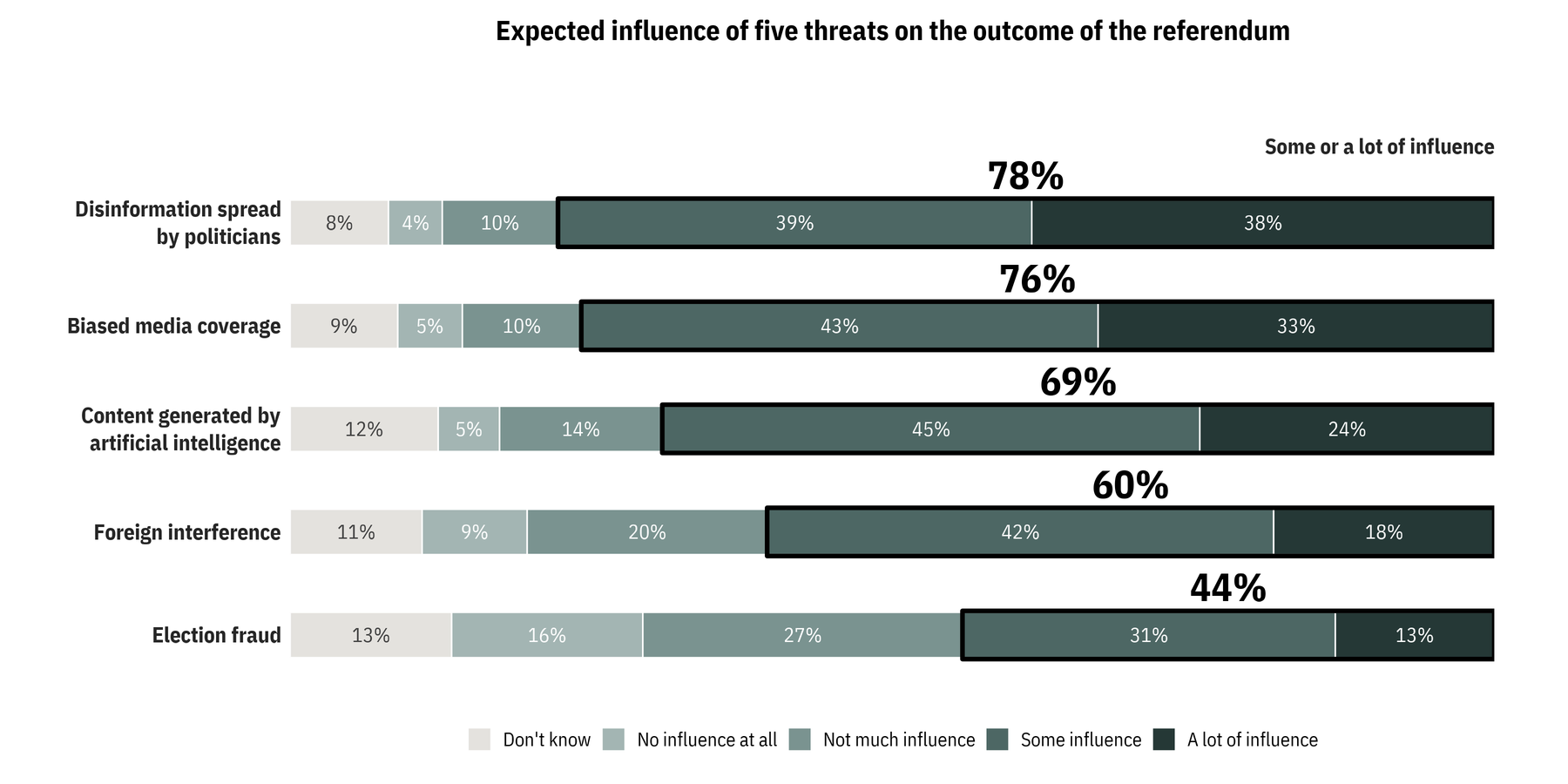
Unlike broader trends in the decline of trust in election administration bodies, we find that this drop in trust spans the political spectrum in Alberta. Confidence in Elections Alberta fell from 71% in May 2023 to 53% in October 2026, a drop of 18 points. It fell by 19 points among those voting to remain and 20 among those voting to start separation, and by 18 points among UCP voters and 24 among NDP voters. Electoral fraud is a concern (44% expect it to have some or a lot of influence on the result), but Albertans see disinformation from politicians (78%) and biased media (76%) as the most likely to sway the result, ahead of AI-generated content (69%) and foreign interference (60%).
Concerns about special (mail-in) ballots
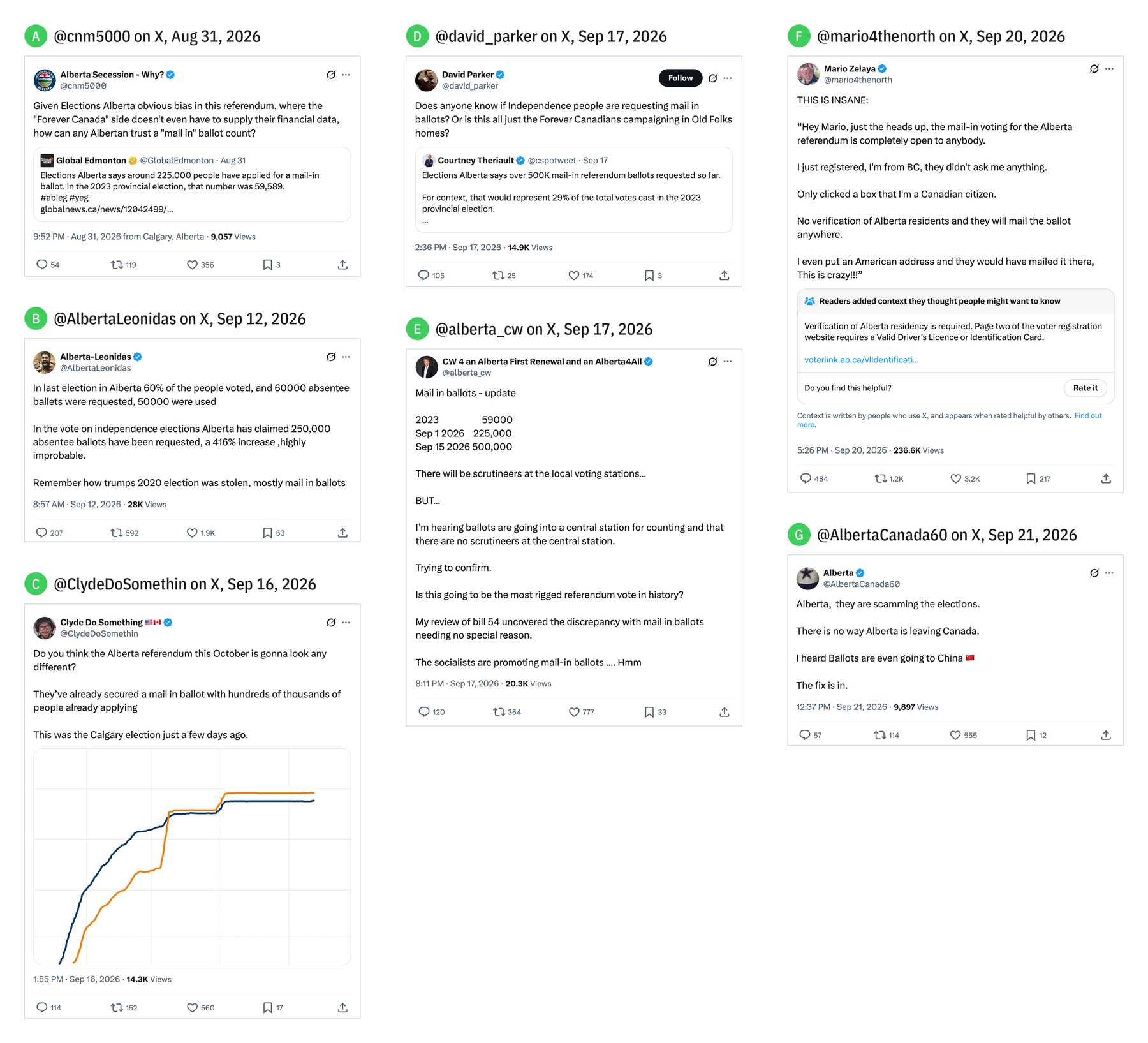
Figure 1 highlights a sharp rise in concern about special (mail-in) ballots in the last panel: 729 posts in the last 30 days of data (August 27th to September 25th), against 70 in the 30 days before. First, the Calgary Shaw By-Election on September 14 contributed to this discourse. UCP’s Mike Derry lost a UCP-held seat to the NDP’s Kyle Campbell, when the in-person advance vote, reported last, overturned a late UCP lead. Special (mail) ballots were, in fact, counted first and shaped initial predictions, but were also used as a reference point for doubts about how votes are counted and the possibility of fraud. Second, the use of special (mail-in) ballot voting has grown sharply, with major campaign organizations by both remainers and leavers encouraging their supporters to register for special (mail-in) ballot voting to avoid long lines on election day and Bill 54 which removed the requirement to give a reason for voting by special ballot. Elections Alberta reported on September 29 that it had received just over 658,000 special ballot requests and approved and mailed more than 652,000, against 59,589 requests in the 2023 general election, about 11 times more. Exhibit 1 shows several prominent examples of concern over special (mail-in) ballots on X over the past several weeks.
Recycled Fraud Narratives: The Calgary Shaw By-Election
Election fraud claims about mail-in ballots are not new. When a batch of votes from advance or mail-in methods is counted, there are frequent claims that these new vote counts are evidence of rigging the election. Most notably, this was a widespread claim during the 2020 U.S. presidential election (and still today). In this section, we focus more on how recycled narratives of voter fraud were used to cast doubt on the 2026 Calgary-Shaw by-election results. In particular, an anonymous social media account shared a doctored image from the Wisconsin 2020 U.S. presidential election with Alberta NDP and UCP colours to evoke voter fraud.
On September 14th, a constituency in southern Calgary held a by-election to replace a seat in the provincial legislature previously held by UCP cabinet minister Rebecca Schulz. As unofficial results were updated throughout the evening, the results were close, with the leading candidate switching back and forth throughout the evening. Towards the end of counting, after all but advance voting ballots were counted, the UCP held a small lead. However, when the advance votes were subsequently counted, the NDP took the lead by about 600 votes. Official results released on September 24th showed the difference to be 591 votes. Throughout the evening of September 14th, accounts on social media, mostly X, were posting updated numbers showing these results as they came in. After advance ballots were counted, various accounts began posting visualizations of the final results.
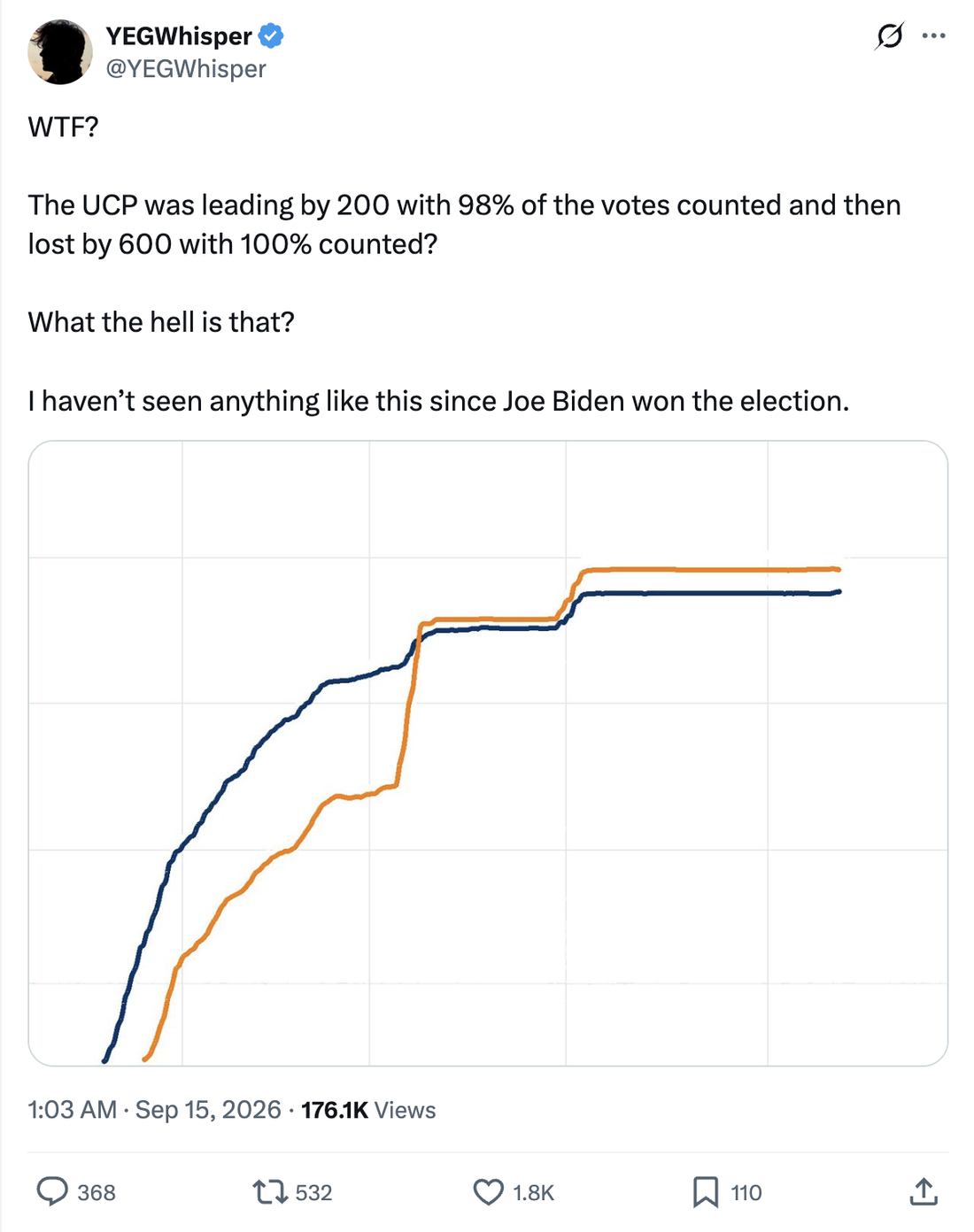
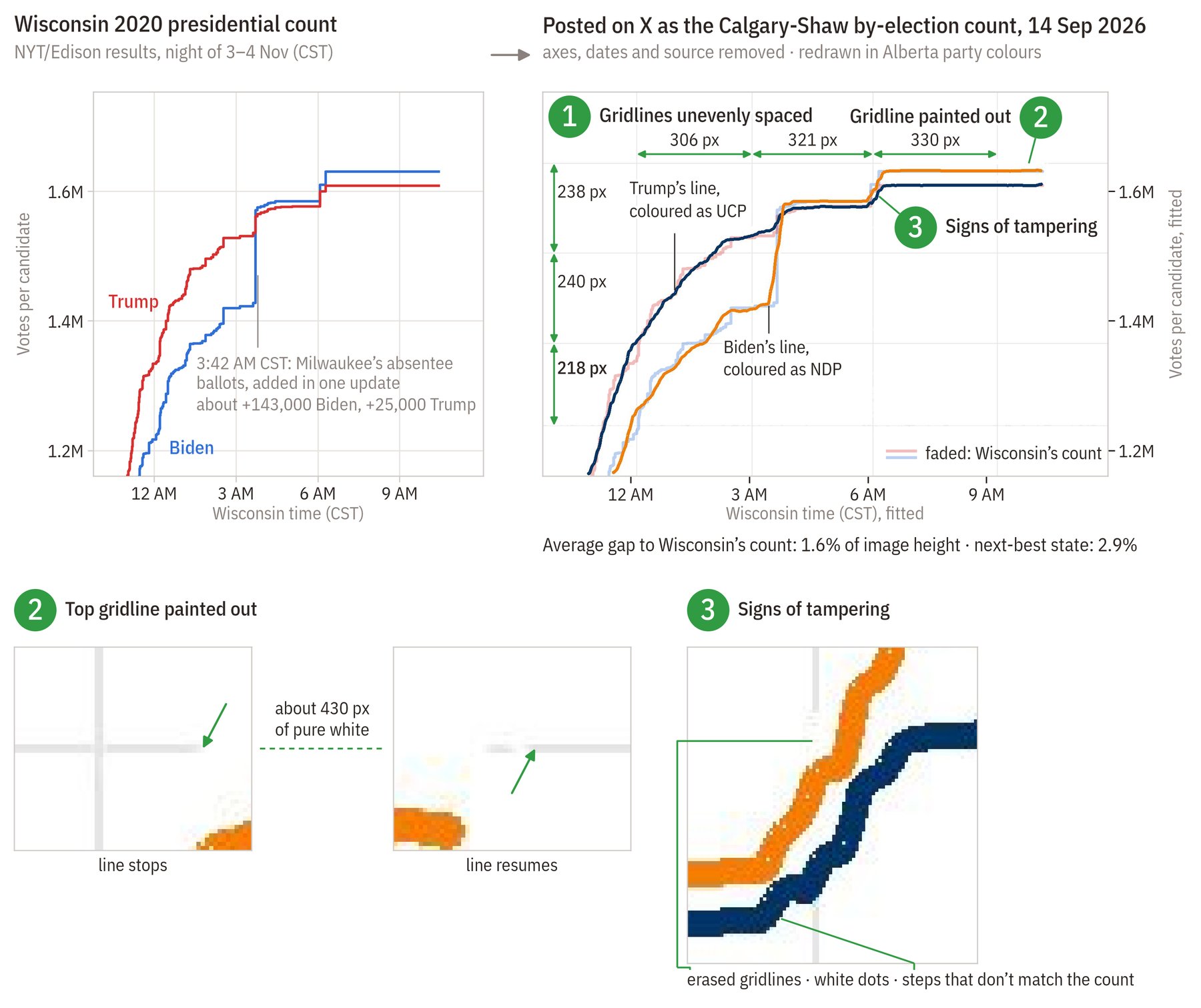
The graph posted by @YEGWhisper 20 minutes after the advance votes were added to the Calgary-Shaw by-election results page, is actually a doctored image of different electoral results. It is the 2020 U.S. presidential vote count in Wisconsin, recoloured to look like an Alberta result. This specific plot has a history of being used in election results from different places to evoke fraud concerns. The same curve lines were posted to Facebook on June 5, 2026, by American commentator David J Harris Jr. and falsely captioned as a Los Angeles count. We compared the two vote count lines against those from the 2020 overnight counts from eight US battleground states. Wisconsin's curves fit with an average gap of 1.6% compared to the total image's height. The version posted to X in the context of the Alberta by-election appears to derive from Harris's image, with lines recoloured to UCP blue and NDP orange.
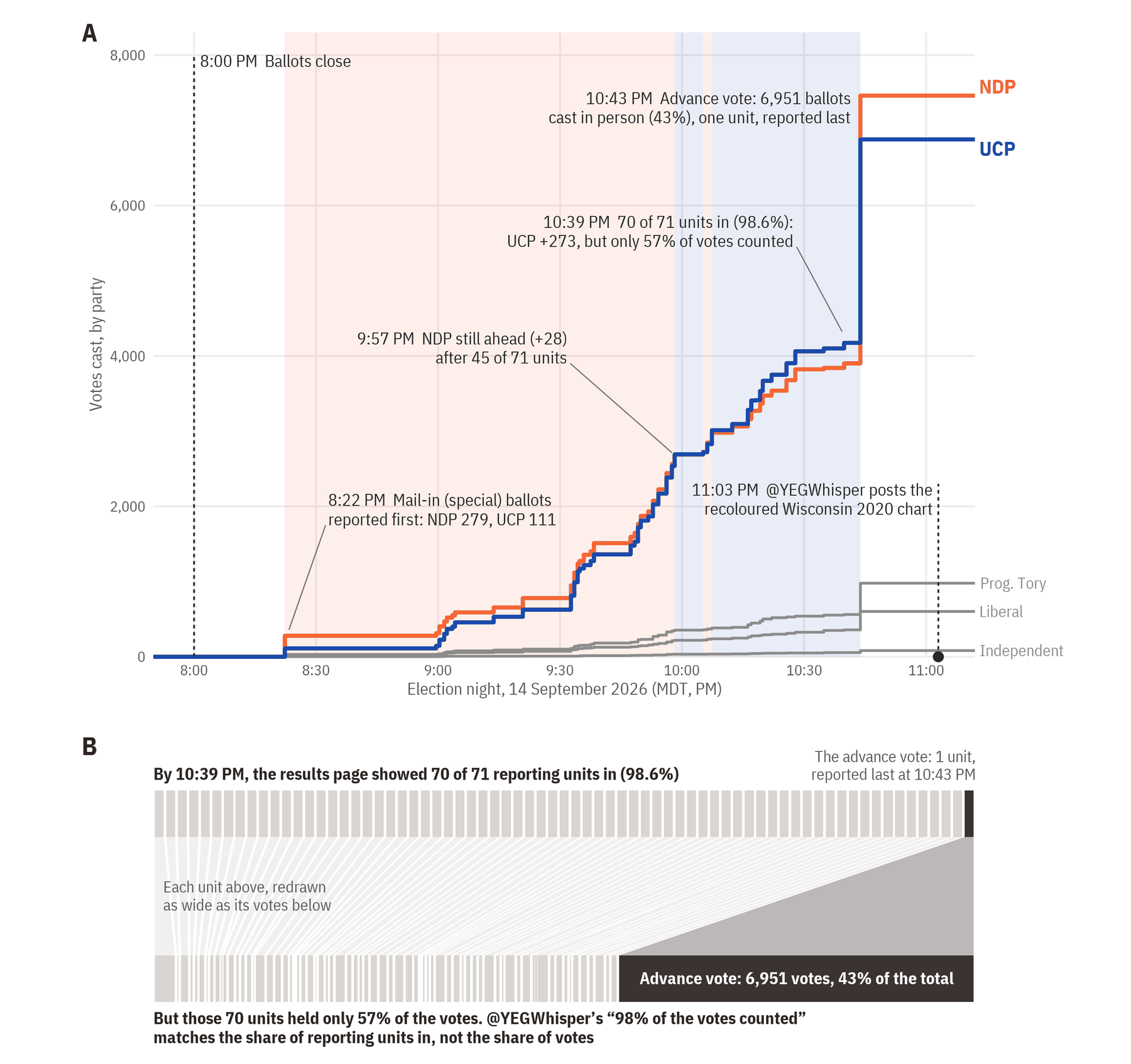
In addition to the result graph for the Calgary-Shaw by-election being based on different data, @YEGWhisper’s post claimed that the UCP "was leading by 200 with 98% of the votes counted" which is also misleading. While 70 of 71 of the reporting poll units were counted, this was only 57% of the votes. The last poll unit was the advance vote count: 6,951 ballots cast in person over five days before September 14th. Figure 4 shows how you visualize the results can impact public interpretation.
Pushback and pre-bunking by the independence community
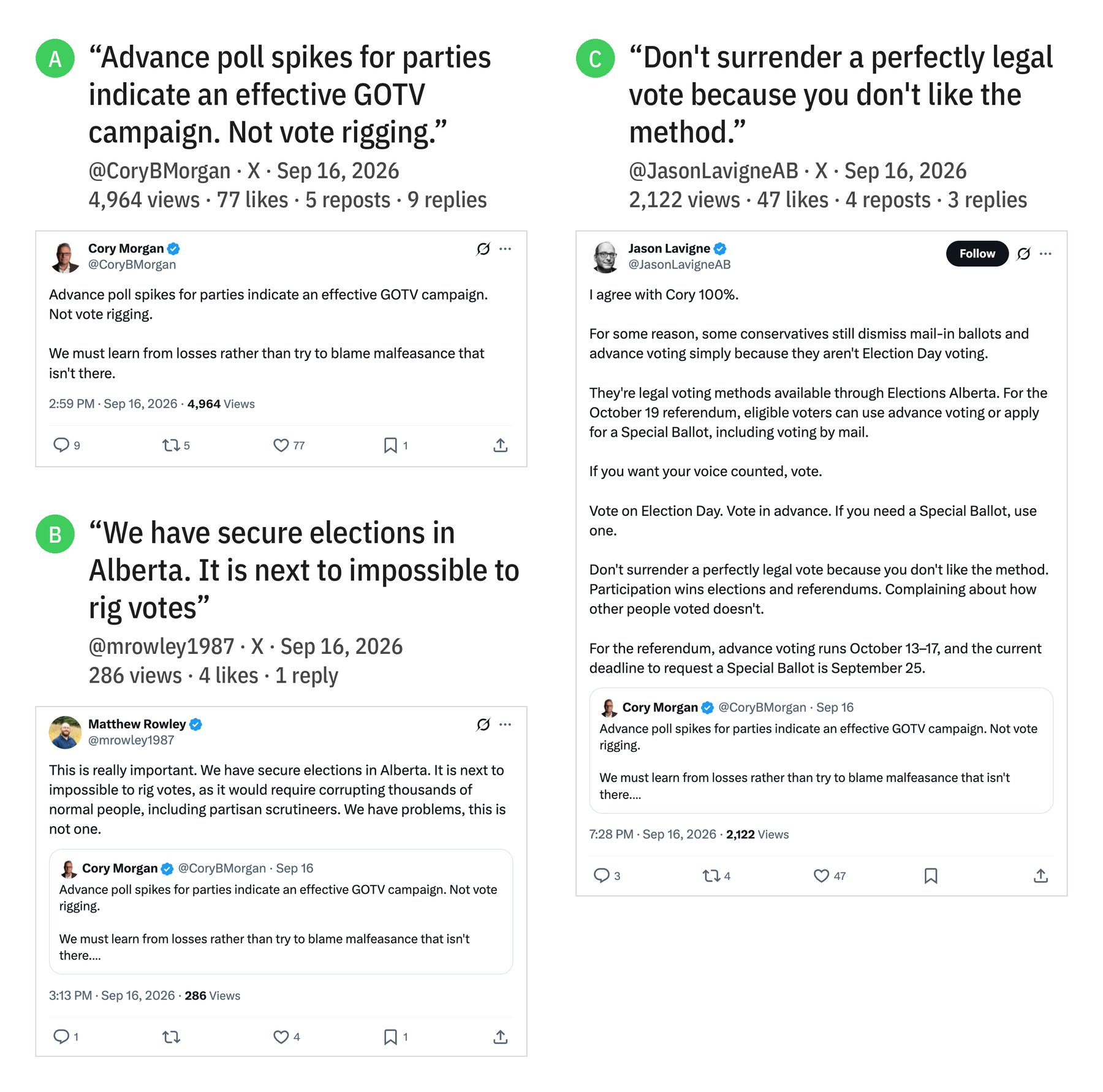
While discussion about election fraud is increasing, some of the volume is from accounts pushing back on the claims. Many of these voices are leaders in the independence movement who are organizing actual offline campaigns through third-party advertisers or other activist groups. Exhibit 4 shows a sample of posts made in the days following the Calgary-Shaw by-election. As well, many of these same individuals regularly host online forums discussing the process, where they provide grounded and first-hand information about how Elections Alberta is planning for the upcoming referendum.
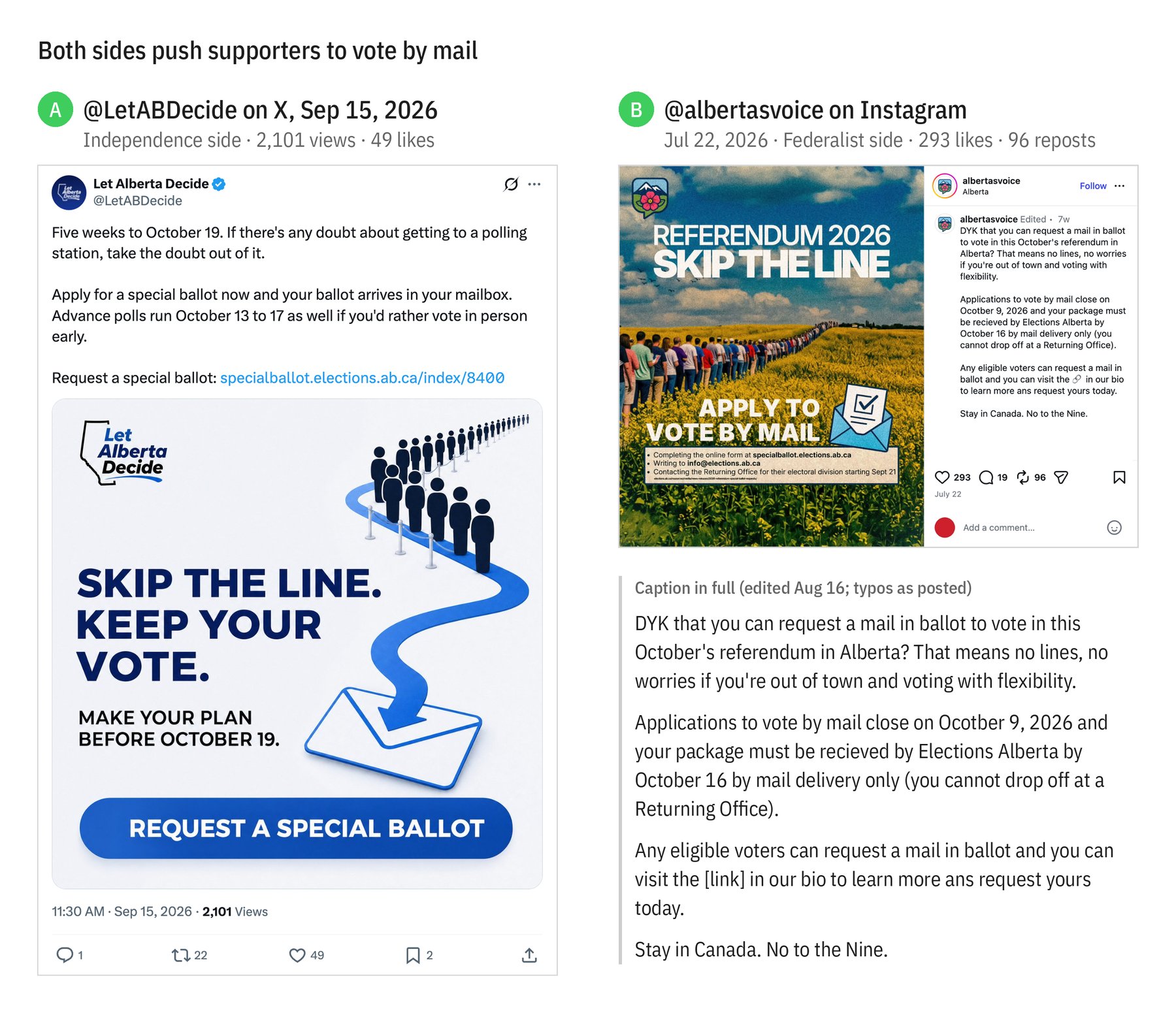
It is worth noting that campaigns on both sides of the separation question have been heavily campaigning for Albertans to vote by mail using special ballots. There are widespread expectations of long lines to vote in person on October 19th. Voting by special (mail-in) ballots has been framed as a way to skip the line by third-party advertisers on either side of the separation question. So while both campaign sides are recommending voting in advance by special (mail-in) ballots, major political influencers in the referendum space are simultaneously casting doubt on the process.
Narrative Spread Patterns and Expectations for October 19th
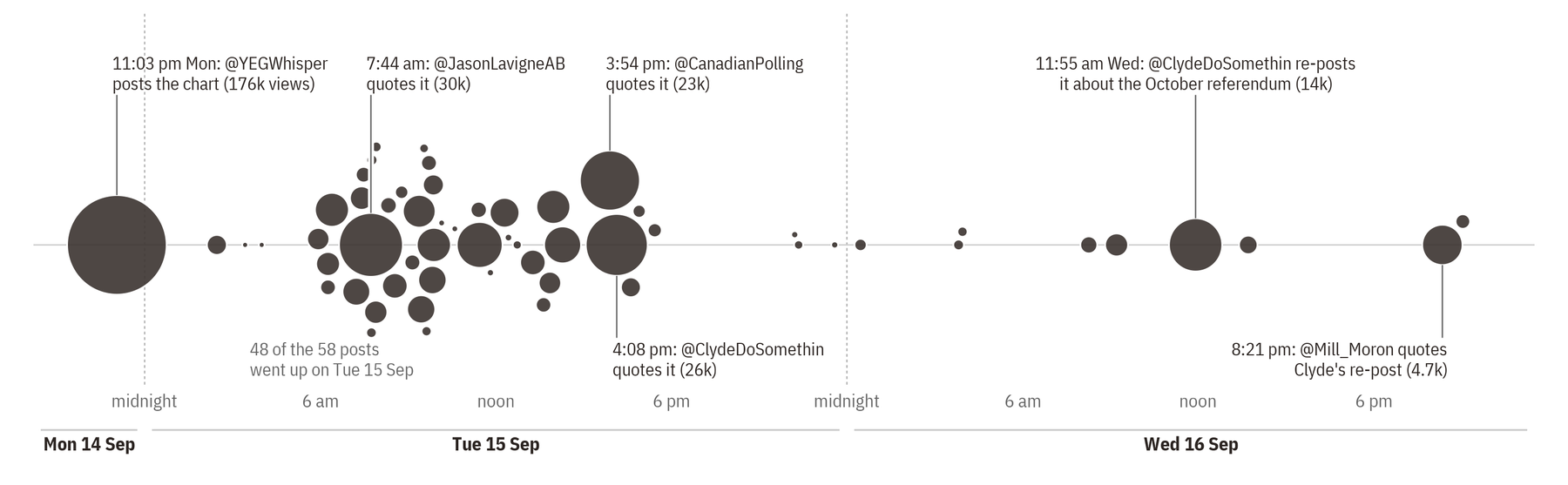
While the original post by @YEGWhisper attracted moderate attention within the most active accounts following the by-election results, primarily on X, attention to this fraud frame burned out within two days, as a single by-election drew little interest beyond Alberta, as shown in Figure 5. Of the 58 posts we identified which shared the identical or near-identical version of the image, 48 occurred within 24 hours. One account with significant cross-Canadian-US audiences, @ClydedoSomethin, notably shared the edited image twice on September 15th and 16th, while also appearing on Tim Pool’s Timcast on September 16th. Information on social media is often spread by larger accounts sharing the content of smaller ones. The specific by-election in Calgary was not discussed but easily could have, resulting in significant attention by online American audiences.
A single by-election may not interest major influencers in the US, but the results of Alberta's referendum will certainly result in a larger volume of discussion. While @YEGWhisper’s post did not get picked up by major US political influencers, there is a risk this may occur on the evening of the actual referendum. Narratives of electoral fraud, because of the large number of special ballots, will likely elicit the recycled narrative of voter fraud, reminiscent of the 2020 U.S. presidential election.
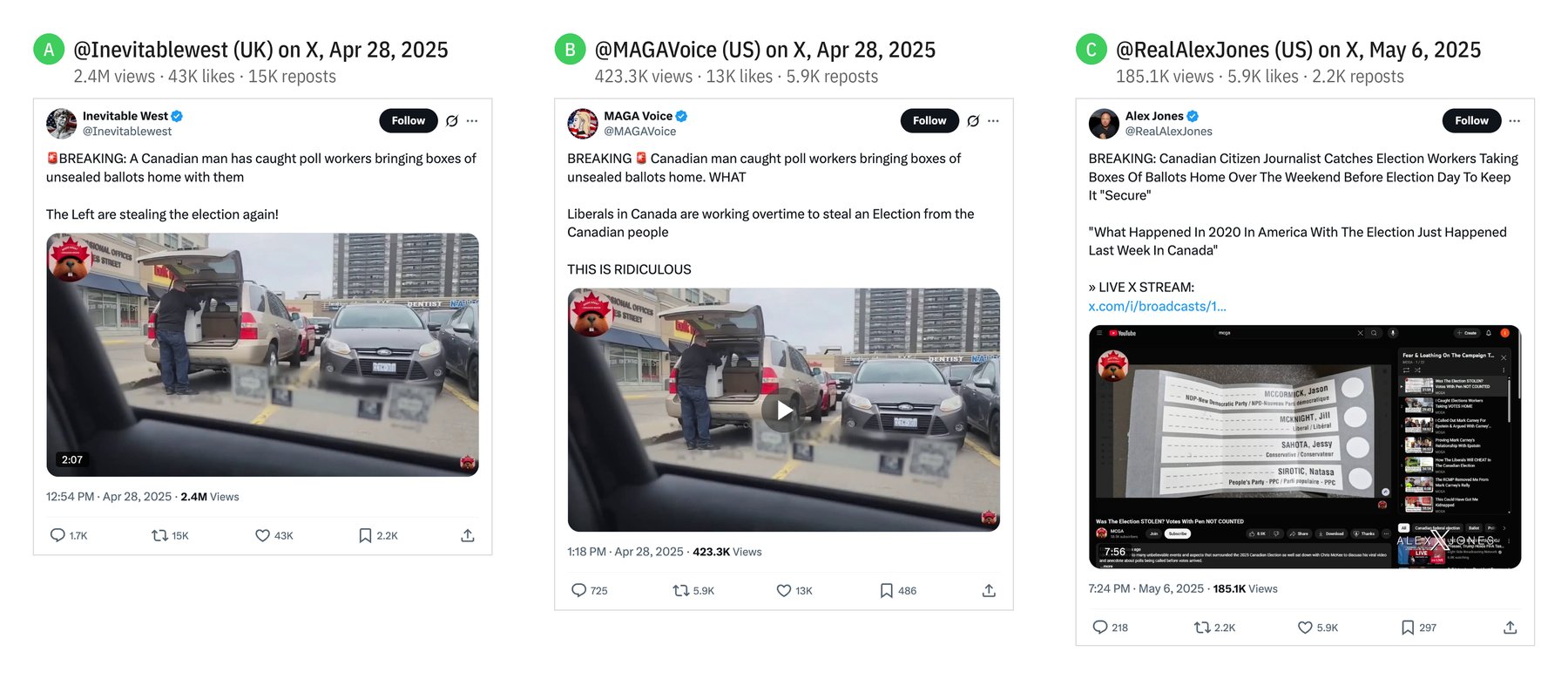
This expectation is grounded in our monitoring of the two previous Canadian elections. After the 2024 British Columbia provincial election, fraud claims surged in the days following the vote, and a (slim) majority of engagement with those claims came from accounts outside the province, mostly elsewhere in Canada and the United States. In the2025 federal election, fraud claims were driven mainly by Canadian influencers, but a handful of non-Canadian posts reached very large audiences (see exhibit 6). On election day, the UK-based account@Inevitablewest posted a video of poll workers "bringing boxes of unsealed ballots home," which drew 2.4 million views. The American account@MAGAVoice posted the same video 24 minutes later. Eight days after the vote,Alex Jones told his audience that "What Happened In 2020 In America With The Election Just Happened Last Week In Canada."
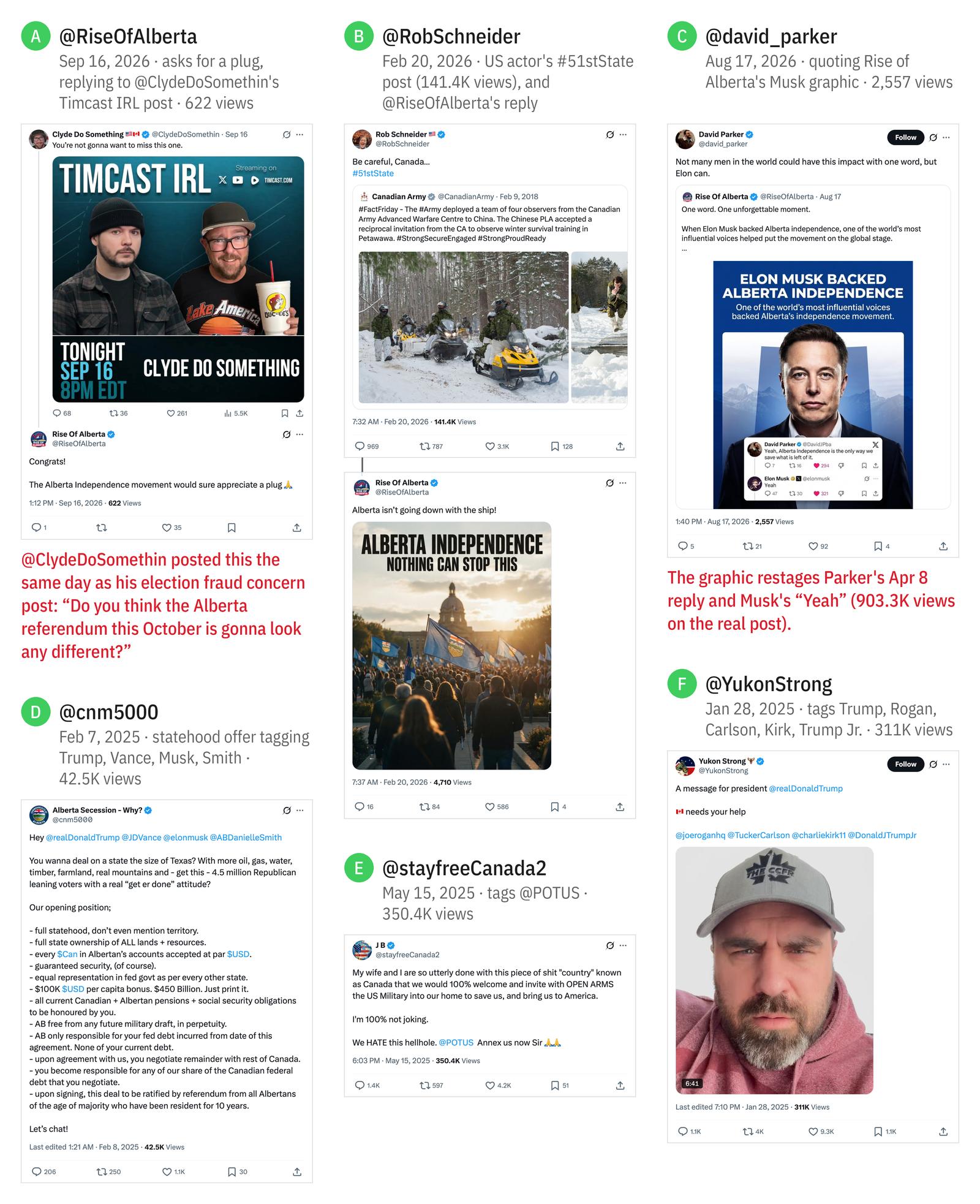
There is also a demonstrated pattern of major social media accounts which support the independence movement tagging American officials and influencers in their posts, appealing to them for amplification. Exhibit 7 shows examples of this behaviour from major accounts identified in our previous report.
While we expect referendum night to attract attention from international audiences such as the U.S., so too does the general public in Alberta. Our survey data shows Albertans expect US officials to weigh in on the referendum process, in an attempt to influence the outcome, with 63% thinking it is ‘somewhat’ or ‘very’ likely and 78% thinking it is ‘somewhat’ or ‘completely’ inappropriate.
Conclusions
In under two weeks, Albertans will vote on whether Alberta should remain in Canada or begin the legal process toward a binding referendum on separation. At the same time, the Alberta public is losing confidence in Elections Alberta to fairly run the referendum after a contentious past year and a half of legal battles, data leaks, and accusations of foreign interference.
We anticipate a large volume of election fraud claims in the lead up to and immediately after the October 19 vote. These claims will likely be amplified by major political figures outside of Canada, despite Albertans broadly considering any attempt at foreign interference to be inappropriate. Albertans looking for factual information should consult Elections Alberta’s website for accurate information about referendum results. With a high percentage of votes anticipated through the special, mail-in ballot process, we should expect jumps in vote numbers throughout the counting process.
As political events and the online response evolve, we will continue to monitor how discussions are being shaped, which voices are the loudest, attention from outside actors, and potential attempts at coordinated inauthentic activity.
Methodology
This report contains three analyses:
- Post timelines and trends across seven platforms related to election integrity.
- Elections Alberta's results for the Calgary-Shaw by-election, together with a recording of its results page on election night.
- MEO's 2026 Pre-Referendum Survey of Albertans, compared with MEO's 2023 Alberta Election Study.
This section describes the methodology used in each. Code, data and figure inputs are available upon request.
1. Scope and windows
The social media posts span January 1st 2025 to September 25th 2026. The Calgary-Shaw analysis covers election night, September 14th 2026, and the spread of the chart on X from September 14th-16th. The search of MEO's American influencer panel for Exhibit 6 covered three windows: October 5 to November 16, 2024; April 7 to May 19, 2025; and September 7 to 28, 2026. The survey was fielded from September 24th to October 5th 2026; the 2023 comparison survey from May 25th-29th 2023.
2. Data sources
Social media posts consisted of two sources:
- Keyword search collections of public posts were gathered across seven platforms (X, Bluesky, YouTube, TikTok, Instagram, Facebook and Truth Social) that matched referendum terms between January 1st 2025 and September 25th 2026. These included searches for the terms “Alberta” plus “separation,” “independence,” “separatist,” “secession,” “referendum,” “sovereignty,” “51st state,” and “Elections Alberta”, plus additional terms naming people, campaigns, hashtags and accounts. This returned 679,958 posts. For X, we also fetched the opening post of every thread in which a reply had been collected (200,345 further posts). Facebook's keyword collection ran only from January to August 2026, so its 100 posts from non-influencer accounts were removed from the integrity-post set (see section 3.1).
- User timelines for the 113 approved accounts on the referendum influencer list described in our September report were collected on every platform in the same date window. This was done for X, Bluesky, YouTube, TikTok, Instagram, and also Facebook (1,060,598 posts). Truth Social was excluded since the influencers do not have a presence there.
These bulk posts were then filtered by relevance to election integrity concerning the Alberta referendum (see section 3 below).
Elections Alberta results were obtained through the official poll-by-poll results for Calgary-Shaw (the September 14th 2026 by-election and the 2023 general election as a baseline). These were downloaded from Elections Alberta's official results site, archived copies of its election-night results feed, and a public YouTube livestream that kept Elections Alberta's results page on screen throughout election night.
The 2020 Wisconsin count was from the New York Times/Edison race-page feed for Wisconsin's 2020 presidential election, which records the running statewide total after each update.
For the surveys, this used MEO's 2026 Pre-Referendum Survey of Alberta residents who are Canadian citizens, and MEO's 2023 Alberta Election Study (Section 5).
3. Identifying election-integrity posts and topics
3.1 Post classifications
Posts from the keyword search and influencer timelines were filtered by relevance to election integrity concerning the Alberta referendum. These were classified by an LLM following a three-question setup: Was the post about Alberta? Was it about the referendum or Alberta separatism? If a post answered yes to either, then: Did it raise a concern about the integrity of the vote? This integrity question was asked of posts about Alberta as well as posts about separatism since posts about the vote as a process (the Calgary-Shaw count, voter-list rules, Elections Alberta's rulings) are often not about leaving Canada. In a trial of 10,000 posts, a quarter of integrity posts would have been missed by asking only the posts about separatism. Furthermore, a post counted as raising an integrity concern when the model assigned it at least one integrity category (unrelated to the topic categories in Figure 1): foreign interference, petition fraud, vote-count fraud, bias by the election administrator, unfair rules, campaign finance or disclosure, inauthentic activity, or voter suppression and misinformation.
Of the 349,816 keyword-collected posts and thread openers that passed the gate questions, 43,143 (12.3%) raised an integrity concern. Adding the influencers' own posts, and removing the 100 Facebook keyword-collected posts, gave 53,566 integrity posts.
The 50,481 integrity posts in an earlier release were topic modelled using the Toponymy Python library to identify the six major topic categories used for Figure 1. They were defined as follows and a second LLM classifier was used to classify all integrity-relevant posts into one of these six categories (including a 7th “Other” category). Posts could belong to multiple categories. The model also recorded blame (for example the United States or Russia for foreign interference) as well as its stance: alleges, refutes, or neither. In Figure 1, foreign interference is split by the accused foreign entity: the United States, Russia, or other foreign actors.
- Foreign interference: a foreign state, official or foreign-funded actor influencing voters, campaigns or the vote.
- Voter data breach: unauthorised access to, sharing or misuse of voter data or the list of electors.
- Elections Alberta bias: criticism of Elections Alberta's own integrity or fairness in running the vote and the petitions. Merely naming Elections Alberta does not count.
- Petition fraud: fake, duplicate, forged or improperly collected petition signatures.
- Referendum manipulation and handling: a government or court unfairly shaping whether, or on what terms, the referendum happens (question wording, Bill 54, signature thresholds, timing, counting rules, court rulings).
- Mail-in ballot fraud: fraud or integrity concerns about mail-in (special) ballots.
3.2 Model and setup
Integrity-relevance classification was done using Qwen3.8-27B (FP8), served with vLLM on GPUs at the Digital Research Alliance of Canada, using temperature 0, reasoning off, and one post per call. The model was given the platform and the post together with the post it replies to, any quoted post and the title of any linked article; handles and URLs were masked.
Integrity-topic classification was done with a different model, Qwen3.5-27B (FP8), also on vLLM, with temperature 0, reasoning off, one post per call, reading the post's own text with handles and URLs removed.
3.3 Prompt selection and classification validation
Each question's prompt was chosen by comparing several variants on about 200 posts coded in advance, blind to the model's answers. On held-out posts, the Alberta question scored F1 = 0.945 and the separatism question F1 = 0.989. The integrity prompt scored F1 = 0.84 on its original test set and 1.00 on a set of 161 September posts. The reference labels were coded by a single coder (a language model) and were not checked by a human.
For integrity-topic classification, a member of the research team evaluated 60 randomly drawn classifications, deeming topics correct in 90% of cases, and the blamed party and stance in 80% of cases. About one fifth of integrity posts fit none of the six topics (21.9%), mostly posts about campaign finance, domestic bots, voter ID or other elections.
3.4 Figure 1
Figure 1 counts the 35,748 integrity posts that carry at least one of the six topic categories, from 9,848 accounts. Among these, 22,308 posts were for X, 10,365 for Bluesky, 1,115 for Instagram, 1,005 for YouTube, 516 for TikTok, 229 for Facebook (influencer accounts only) and 210 for Truth Social.
3.5 Exhibits
Exhibit 1 (special (mail-in) ballots) was selected in the following way. From the special (mail-in) ballot topic posts in September 2026 that allege a problem (577), reposts and duplicate texts were removed (498 posts from 332 accounts), and only those with at least 250 likes, shares, replies and quotes combined (54) were kept. Each was read and coded as making, or not making, a claim that the referendum's special (mail-in) ballot vote is rigged or open to fraud. Errors in ballot packages were coded no unless the post framed them as fraud. 25 posts made such a claim, all on X, falling into seven types: ineligible voters, implausible volume, no oversight of the count, a biased Elections Alberta, ballots in outside hands, a parallel with Calgary-Shaw, and ballot harvesting. The exhibit shows the most-engaged post of each type, at most one per account. Coding was done by one coder.
Exhibits 2, 4, 5, 6 and 7 were chosen by the research team to illustrate a pattern described in the text. Exhibit 2 is the post that introduced the Calgary-Shaw chart. Exhibit 4 shows prominent pro-independence voices disputing the fraud reading of the by-election. Exhibit 5 shows one organisation from each side encouraging special (mail-in) ballot voting. Exhibit 7 is drawn from a search of the influencer accounts' posts on X (January 1st 2025 to August 10th 2026) for posts that tag Donald Trump's accounts, plus later posts found in monitoring. Of 481 such tags, 294 came from pro-independence accounts, and 77 of those read as appeals (the tag opens the post, or sits next to words such as please, help, take or annex). These tag and appeal counts come from keyword searches, not from a classifier.
4. The Calgary-Shaw by-election
4.1 The count on election night (Figure 4)
Elections Alberta's official results report each of the 71 counting units separately: 68 election-day polls, the mobile poll, the special (mail) ballots and the advance vote, which was counted as a single unit of 6,951 votes. The official results do not record when each unit was reported. To recover the order, we read the results page from the election-night livestream by optical character recognition, one frame every ten seconds, keeping a frame only when every party's total was legible and no total went down. This gave 41 distinct states of the count. Clock times were calibrated from 424 live-chat messages that carry both the video position and the wall-clock time. Where Elections Alberta's own "last updated" stamp is visible, the page changed 0.3 to 1.2 minutes after it, so each time reads as "posted about a minute earlier".
Each change in the on-screen totals was then matched to the unique set of polls whose official results add up to it. All 68 election-day polls were placed, in 40 steps; 35 steps match the official results exactly and five differ by 1 to 6 votes, where the official count later corrected those polls. The order was checked against an archived copy of Elections Alberta's election-night feed, captured with 10 of 71 units reported, which lists the same polls. Panel A shows the running totals from the livestream. Panel B uses the official results to show what share of units, and of votes, had been counted before the advance vote was reported. The two sources differ by up to nine votes, so the text names its source for each number.
4.2 Exhibits 2 and 3
We digitised the two vote-count lines in the chart posted on X and fit them, by least squares, against the running totals of eight 2020 battleground states (Wisconsin, Michigan, North Carolina, Georgia, Arizona, Minnesota, Pennsylvania and Nevada). Each fit had a linear time axis and a linear vote axis, and was tried with each line assigned to each candidate. Wisconsin fit best, with an average root mean square error (between the curves) of 1.6% relative to the overall image’s height. The next best state was Michigan at 2.9% average RMS error. The steps in the posted lines match the Wisconsin updates of 3:42 AM and about 6 AM Central time on 4 November 2020. An earlier copy of the same chart, in American party colours, was posted on Facebook in June 2026 with a caption describing it as a Los Angeles count. We have not identified who first made the chart nor who edited it.
The edits marked in Exhibit 3 were measured in the posted image file. The gridlines are unevenly spaced (238, 240 and 218 pixels apart horizontally; 306, 321 and 330 vertically), although the fitted axes are linear. The top gridline has been painted out for about 430 pixels. At the second jump, the posted lines rise in the opposite order to the count. The smooth shape of the lines is not evidence of editing: a smoothed plot of the Wisconsin count fits them nearly as well.
4.3 How the chart spread (Figure 5)
Figure 5 shows the 58 posts on X, from 39 accounts, that uploaded, quoted or reposted the chart image between 23:03 Alberta time on September 14th and 21:03 on September 16th. Together they drew 305,248 views, 261,422 of them on the 40 posts making the fraud claim (175,865 on the original). Of the 58, 21 uploaded the image (including the original post), 31 quoted the original post, and 6 reposted or quoted someone else's post. Only posts that carry the image are counted, so text-only replies disputing the chart are not in the set. Views are as recorded at collection. Each circle's area grows with the square root of a post's views, so that every post stays visible.
5. Survey data
Public-opinion figures come from MEO's 2026 Pre-Referendum Survey, an online non-probability survey of Alberta residents who are Canadian citizens, fielded through Qualtrics from September 24th to October 5th 2026 (n = 998). The online survey was conducted using the Leger Opinion (LEO) online panel. As a non-probability online panel, no margin of error can be calculated; for comparison purposes, a probability sample of 998 respondents would have a margin of error of ±3.1 percentage points, 19 times out of 20. Respondents were screened for consent, age, citizenship and residence, and excluded if they failed both of two attention checks or finished in 400 seconds or less. Responses are raked to Statistics Canada 2021 Census margins for Alberta on age (18–34, 35–54, 55+) gender and region, with weights trimmed and scaled to a mean of 1 (range 0.59 to 2.84; effective sample size 824). Percentages are weighted, "Don't know" is kept in every base, and sample sizes are unweighted.
As a robustness check, we re-weighted the 2026 sample by education (2021 Census) and by provincial vote intention matched to the 2023 result. The report's estimates moved by at most three percentage points, and the decline in confidence in Elections Alberta since 2023 ranged from 17 to 20 points.
Figure 2 compares the 2026 survey with MEO's 2023 Alberta Election Study, fielded during the last five days of the 2023 provincial campaign (25–29 May 2023, n = 947 Alberta citizens), and is weighted the same way. The confidence question was worded identically in both surveys, but the two are different samples, not a panel, and the institutions were rated in different contexts: an election campaign in 2023, and the run-up to a referendum in 2026.
Question phrasing (answer options are displayed in the plots):
Figure 2: "Please indicate how much confidence you have in the following:" Elections Canada; Elections Alberta.
Figure 3: "How much of an influence do you think the following will have on the outcome of the 2026 Alberta referendum?" Disinformation spread by politicians; Biased media coverage; Content generated by artificial intelligence; Foreign interference; Election fraud.
Figure 6, top: "How likely do you think it is that U.S. political figures or government officials will try to influence the outcome of Alberta's referendum?"
Figure 6, bottom: "How appropriate do you think it is for U.S. political figures or government officials to weigh in on Alberta's referendum in an effort to influence the outcome?"
Related Publications
Weekly Update 5: Narratives and Perceptions of Electoral Integrity
Read more
Weekly Update 4: An Election Without News Media on Facebook
Read more
Weekly Update 3: Quebec's First Election in the Age of AI
Read more