Weekly Update 1: The Trade War Enters the Quebec Election Campaign
Media Ecosystem Observatory
Each week during the 2026 Quebec election, we will publish an update presenting the main trends and dynamics we observe in the information ecosystem. These updates will highlight any information incidents, while outlining items that are On our radar but do not rise to the level of an incident.
All facts and data are drawn from an original survey and social media monitoring conducted by the Media Ecosystem Observatory. The period under study runs to September 2 for the social media monitoring team, to September 1 for the survey, and to August 29 for the quantitative analysis of social media data. No major incident was identified this week.
Overview
The campaign is officially underway. The buses have hit the road, and with them the familiar rhythm of a campaign has set in: daily announcements, press scrums, and clashes between leaders. Given how much space the trade war with the United States has occupied in public debate, this weekly update focuses mainly on how that conflict made its way into the campaign, into public opinion, and into the parties' positioning on the issue — as well as how certain online actors have instrumentalized it to question the integrity of the election. Then, in the On Our Radar section, we look at a few trends worth watching: the proliferation of degrading AI-generated videos of party leaders, questions about the neutrality of polls, debates around the Boussole électorale (Electoral Compass), and discourse about the electoral process itself (including Élections Québec's inability to send English-language information materials to voters).
How the Trade War Has Shaped the Quebec Election
The collapse of trade negotiations between Canada and the United States on August 21, along with the debate over why they failed, dominated a large share of political discussion at the start of the campaign. To better understand how much this issue has grown and the nature of the discussion around it, we collected all the posts from 746 entities with influence in Quebec's political information ecosystem and used a large language model to identify posts discussing the main issues from a list of 18.
As Figure 1 shows, the trade war was the most-discussed issue in the information ecosystem in the week following the collapse of negotiations. From August 22 to 29, the trade war accounted for 15.5% of posts and drew 25.1% of likes — more than twice the share of the next issues, the economy and public finances, a gap that points to particularly high engagement around this issue.
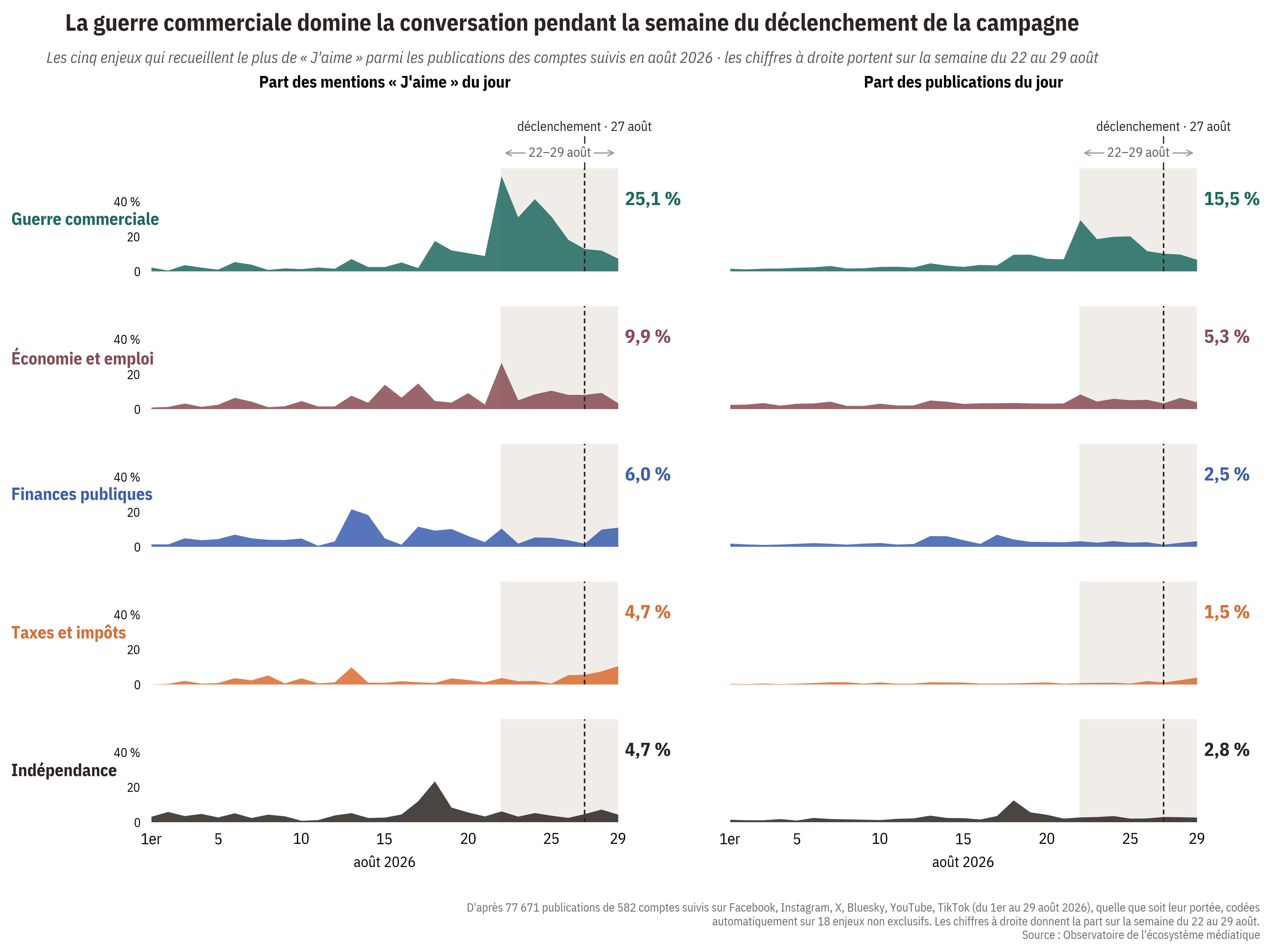
The main conversation spike came on August 22, the day after Canada's decision to suspend its trade negotiations with the United States. Media, influencers, and political officials reacted simultaneously. By the time the campaign officially began on August 27, volume had already receded, though candidates still devoted a significant share of their attention to the issue on August 28.
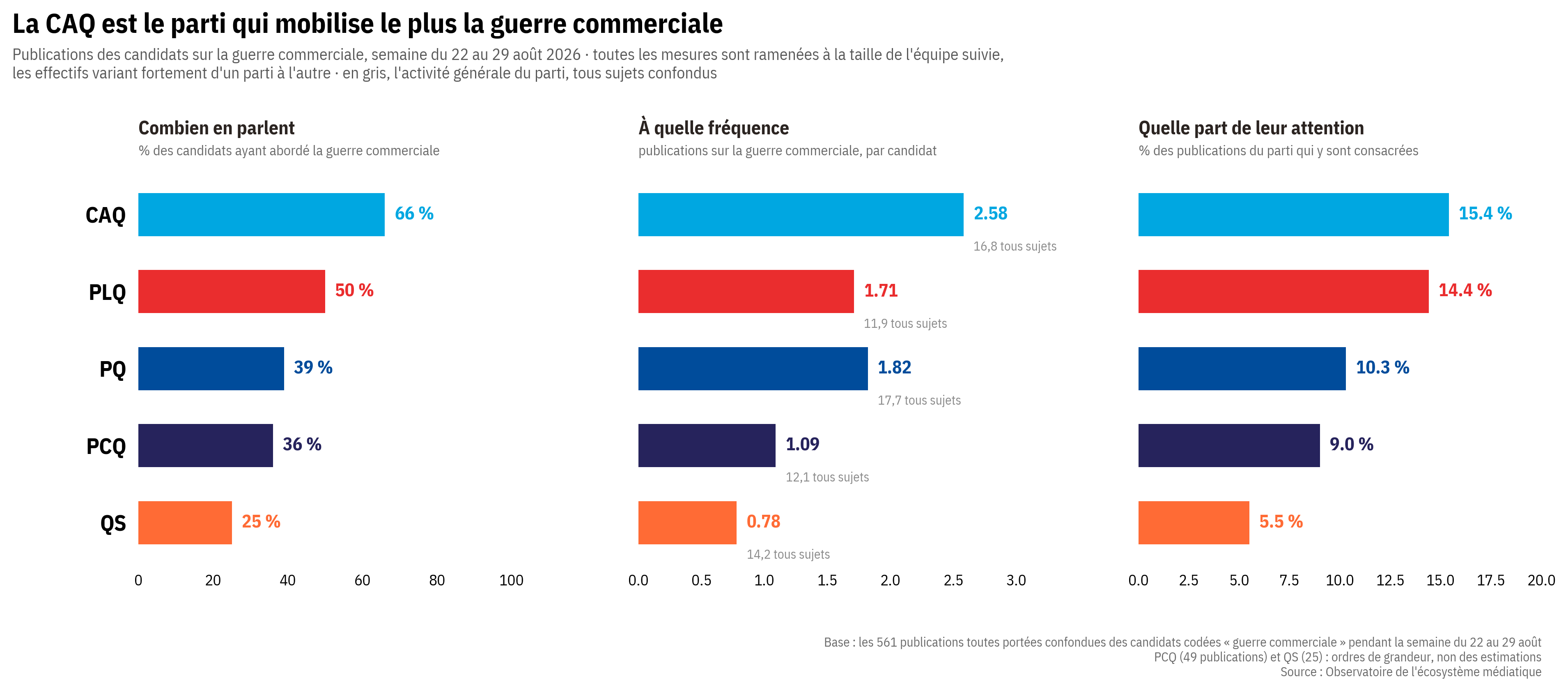
The Coalition avenir Québec (CAQ) is the party whose candidates talked about the trade war most on social media. As Figure 2 shows, this mobilization of the issue by the party shows up whether you look at the share of candidates who addressed it, the frequency of posts on the topic per candidate, or the share of the party's candidates' posts devoted to the issue.
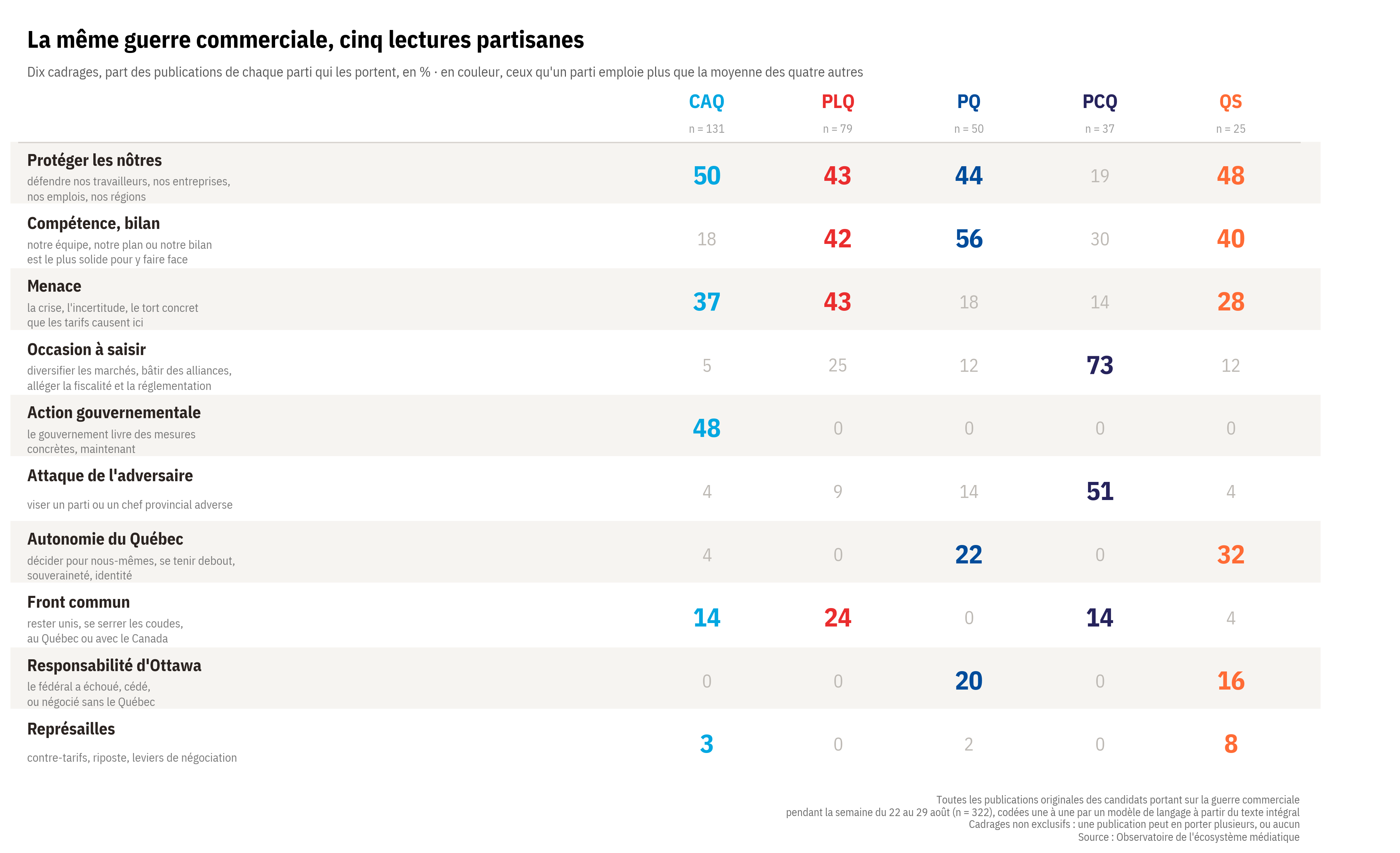
To better understand how the parties talked about it, we coded the content of every candidate post about the tariff war. We identified ten non-mutually-exclusive frames, then used a large language model to code, for each post, the presence or absence of each frame (a post can include more than one frame). The results are summarized in Figure 3.
Three frames dominated the discussion and were used to a meaningful degree (though at varying levels) by every party: 1) the desire to protect our workers, our businesses, and our regions; 2) each party presenting itself as having the best team and the best plan to deal with the crisis (for the Parti Québécois, this category also includes posts arguing that the trade war shouldn't distract from the CAQ's record); and 3) the uncertainty and threat posed by the collapse of negotiations and the tariffs. Beyond these three shared frames, framing choices diverged along party lines. The Conservative Party published more content presenting the trade war as an opportunity to seize — to diversify our markets, build alliances, and ease taxation and regulation. The CAQ, for its part, emphasized the measures its government has put in place to deal with the tariffs. The Parti Québécois and Québec solidaire published more posts stressing the importance of Quebec being able to decide for itself, and the idea that the federal government negotiates without Quebec and doesn't always look out for its interests. Several parties, including the CAQ, the Liberal Party, and the Conservative Party, also stressed the need to stay united and present a common front, whether within Quebec or in working with the federal government.
Beyond the tariffs' economic impact, two main reasons explain why the trade war became so central to the Quebec election. First, among the reasons cited for the collapse of negotiations, Prime Minister Mark Carney pointed to restrictions the United States allegedly tried to impose on Canada's ability to strike trade deals with other countries, as well as pushback against measures protecting Canada's cultural sectors and the French language. Second, US Trade Secretary Howard Lutnick inserted himself into the Quebec campaign by blaming the Canadian government for the collapse of talks, accusing Mark Carney of manufacturing the situation to prevent the Parti Québécois from winning the election. President Donald Trump also posted on Truth Social that he would “never interfere with the fact that Canadians speak French” and that he “loves French Canadians.” Quebec's Bill 109, which imposes requirements on digital platforms around the presence and discoverability of French-language content, is reportedly one of the elements the American administration targeted in the final stretch of negotiations. The bill was in fact cited in the most recent annual report of the US Trade Representative as a point of grievance.
These statements from the US administration were nonetheless picked up by certain well-known online influencers and political commentators to question the integrity of the electoral process. The main narratives suggest that the collapse of negotiations was a conspiracy between Mark Carney and Christine Fréchette to benefit the CAQ; that the government is manufacturing a false sense of crisis to get re-elected, as it allegedly did during the 2025 federal election or the COVID-19 pandemic; that “the Quebec establishment” has seized control of democracy; and even — in a post we took, given the context, to be referring to the trade war — that if a similar situation had happened in another country, it would be considered an “attempted coup.”

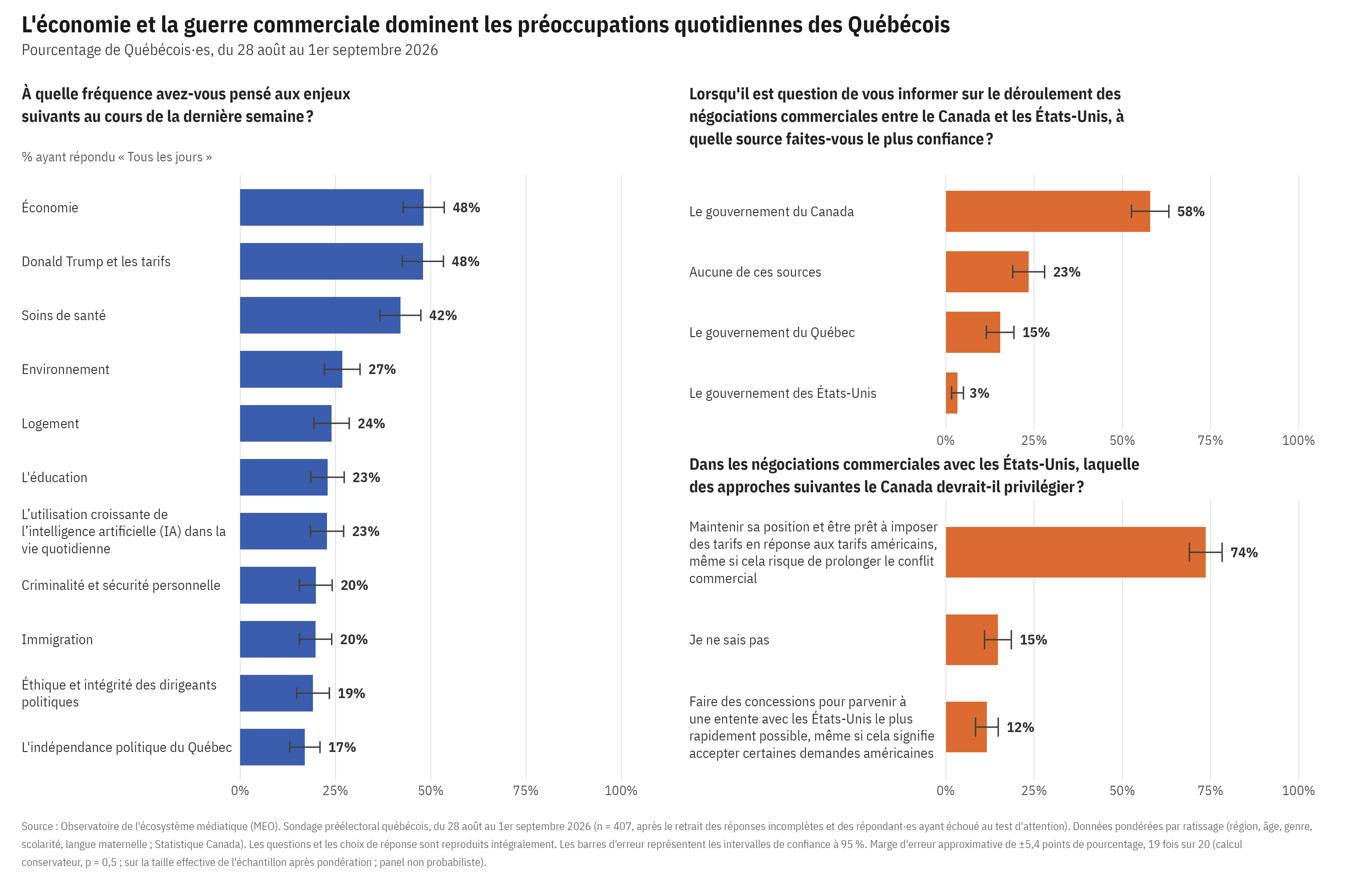
Despite the visibility and engagement this type of discourse gets in certain online communities, such views remain marginal within the general population. In our weekly survey, we asked Quebecers who they trust most for information on how the trade negotiations between Canada and the United States are unfolding. Figure 4 shows that nearly three-quarters of voters (73%) said they trust the Canadian government (58%) or the Quebec government (15%) more, close to a quarter (23%) said they don't trust any government source, and only 3% said they trust the US government more. A similarly sized majority (74%) also said Canada's approach should be to “hold its position and be ready to impose tariffs in response to US tariffs, even if that risks prolonging the trade conflict,” rather than “make concessions to reach a deal with the United States as quickly as possible, even if that means accepting some US demands” (12%).
On Our Radar
AI-generated videos of party leaders. The creation of AI-generated videos of party leaders appears to be gaining popularity since the start of the campaign. Christine Fréchette has been a particular target of degrading videos. Echoing the conspiracy allegations some perceive between Christine Fréchette and Mark Carney in the context of the trade war, several AI-generated videos — in both realistic and cartoon formats — have circulated showing the two of them kissing passionately, including one video by a person hoping to run as an independent candidate in the election, which has been viewed more than 130,000 times. Other videos have been created showing her kissing other people, presenting her as a man, or depicting her as an animal that obeys orders. We will continue to monitor the progression of this phenomenon, its gendered dimension, and the involvement of candidates in producing and circulating this content.
Perceived neutrality of polls. As in every election, the release of new polls generated plenty of controversy at the start of this campaign — especially the Synopsis-La Presse poll, which found the Parti Québécois and the CAQ in a statistical tie in voting intentions. On LCN, columnist Mathieu Bock-Côté described the poll as “an attempt to manipulate” the electorate by La Presse, “an outlet that openly campaigns against sovereignists and the Parti Québécois,” to which Patrick Lagacé replied by noting, among other things, that the poll “didn't radically depart from the week's other polls.” Another narrative that circulated across several platforms and gained significant visibility (one post on X received about 35,000 views and more than 200 shares) suggested that the results favourable to Christine Fréchette could be explained by a relationship between Synopsis's lead shareholder and the chief of staff to the minister responsible for Housing. Finally, the breakdown of voting intentions by age group led to hostile comments in certain online ecosystems targeting people aged 50 and older, among whom the CAQ ranks first in voting intentions. Some posts described this age group as “a problem” or said they were going to “sink Quebec.”
Debates over the Electoral Compass. The Boussole électorale (Electoral Compass) drew several criticisms on social media this week, mainly around the gap between the positioning it assigns to parties and how some voters perceive those parties. A recurring criticism is that Québec solidaire is placed markedly further left of centre on the socioeconomic axis than the Conservative Party is placed right of centre. Conversely, several users questioned why the Parti Québécois is placed at the extreme on the identity axis. Other reactions concerned the choice and wording of the questions — particularly those on relations with Indigenous peoples, supervised consumption sites, and identity issues — which, according to some users, could have an outsized influence on the final positioning, or even nudge voters toward some parties over others. Finally, an important source of dissonance came from individual results: some users reported getting a party that barely matched their own sense of their positions, noticed gaps between their percentage agreement with a party and their apparent proximity to it on the map, or said they landed in an “ideological void,” with no party clearly representing their positions on the grid. These reactions point to unease with reducing complex political positions to two axes, and to the difficulty of deciding which positions should count as “centrist.”
Discourse on the electoral process. Because of Bill 96 and the fact that the government did not grant it an exemption, Élections Québec announced that, for the first time in a general election, information materials sent to voters would be in French only, and that voters would need to use a QR code to access the information in English. Several voices raised concerns about the impact of this measure on anglophone voter turnout, with some describing it as an attempt at voter suppression, as creating second-class citizens, or as contrary to the Canadian Charter of Rights and Freedoms. The premier said she was reviewing the situation.
These concerns about voter turnout stand in contrast to other, much more marginal, discourse calling for civic disengagement. Some right-wing influencers are urging voters to remove themselves from the electoral list, refuse to vote, or even tear up their voter card or ballot, on the grounds that elections are supposedly systematically stolen or manipulated. These narratives appear to have gained some visibility and engagement within the circles of users following these accounts, but do not appear to have spread beyond those online ecosystems. We mention it as a trend worth watching, though, as our pre-election report noted, a very large majority of Quebecers trust the electoral process.
Methodology
Survey
The analysis draws on a bilingual (French and English) pre-election survey conducted from August 28 to September 1, 2026 by the Media Ecosystem Observatory among the Quebec population. The survey was administered on the Qualtrics platform to Léger's online panel (LEO), using quota sampling (region, age group, gender, and language) based on Statistics Canada reference data. Respondents were compensated through Léger's standard panel rewards program. Regional quotas are based on three strata — the Montreal census metropolitan area (CMA), the Quebec City CMA, and the rest of Quebec — built from respondents' reported administrative region and municipality of residence.
The questionnaire was restricted to Canadian citizens aged 18 and older residing in Quebec. The final sample includes 407 respondents, 333 of whom answered in French and 74 in English. All analyses use weights obtained through raking. Calibration covers five margins: region (Montreal CMA, Quebec City CMA, rest of Quebec), age group (18–24, 25–34, 35–44, 45–54, 55–64, 65 and older), gender, education (high school or less; some postsecondary below a bachelor's degree; bachelor's degree or above), and mother tongue (francophone; anglophone or allophone), based on Statistics Canada population estimates. The method includes a rule to truncate weights falling outside the [0.25, 4] interval; this rule was not triggered, as every weight already fell within that interval (weights in practice range from 0.29 to 2.76). Because the sample is non-probabilistic, the margins of error reported are approximate and assume a simple random sampling design: based on the effective sample size, the margin of error is ±5.4 percentage points, 19 times out of 20 (a conservative estimate, p = 0.5).
Social media
The corpus. The Observatory continuously tracks 746 Quebec accounts across six platforms — X, Facebook, Bluesky, YouTube, Instagram, and TikTok: 346 candidates from the five parties, 107 media accounts, and 293 influencers, including 134 commentators and 104 journalists. Between August 1 and August 29, 2026, these accounts produced 77,671 posts. This is an account-based corpus, not a keyword search: we observe what actors identified as influential in the public sphere are posting, not everything being said in Quebec. Public comments are not part of it.
To build the candidate list, we collected data from the official websites of political parties with at least one sitting member in the National Assembly of Quebec (Coalition avenir Québec, Parti libéral du Québec, Québec solidaire, Parti québécois, and Parti conservateur du Québec), as of August 17, 2026. We are currently updating this list for upcoming weekly reports. From the candidates section of each party's website, we extracted: the candidate's name, their electoral riding, and their social media account handles. Accounts were collected across six platforms: Facebook, Instagram, X/Twitter, Bluesky, TikTok, and YouTube. Where a party's website had no dedicated candidates section, we manually reviewed its announcements section and collected the candidate's name and riding from each nomination announcement post. Since the list of social media handles on party websites can be incomplete, we supplemented it by manually checking the handles listed on party websites to see whether they mentioned or linked to other social media accounts (e.g., via Linktree). Where no handle was listed on a party's website for a candidate, we conducted an online search to find any accounts to add. Each account was verified against the following criteria: it officially belongs to the candidate, and it is a public account used as part of their political activities. We did not include any handle that wasn't listed on the party website, mentioned by another verified account belonging to the candidate, or mentioned or followed by another candidate's verified account. We also did not include accounts devoted mainly to personal content.
Coding. Every post is run through a language model (Qwen3.8-27b) that determines, without chain-of-thought reasoning, which issues it addresses, from eighteen non-exclusive categories: cost of living, taxes, economy and employment, public finances, trade war and tariffs, health, education, housing, transportation, environment, immigration, the French language, secularism, independence, crime, ethics and integrity, artificial intelligence, and social issues. A post can touch on several of these, or none. Two-thirds of August's posts (68%) touch on none of these issues — field activities, thank-yous, links without commentary, replies within a thread. Among those that do, they touch on 1.3 issues on average.
During the week of August 22 to 29, candidates published 561 posts about the trade war. Of those 561 posts, 239 are shares: the candidate reshared another account's post — most often their leader's — without adding their own commentary. The framing analysis therefore covers the 322 original posts. A share reflects the framing of its original author, not necessarily that of the candidate sharing it; including it would mean attributing to the candidate a statement they never made themselves. We identified ten non-mutually-exclusive frames, then each post was read and coded individually by a language model (Claude Opus 5) from the full text. We spot-checked the classification to confirm it looked defensible, but we did not manually code every post and therefore cannot report an inter-coder agreement rate.
Engagement. Our engagement analysis relies on ‘likes,’ the only metric available across all platforms. Using likes isn't necessarily comparable from one platform to another, but it is the best available measure of public engagement with the content.
Related Publications

Alberta’s Referendum, Online: Election Fraud Claims Ahead of the October 19 Vote
Read more
Weekly Update 5: Narratives and Perceptions of Electoral Integrity
Read more
Weekly Update 4: An Election Without News Media on Facebook
Read more