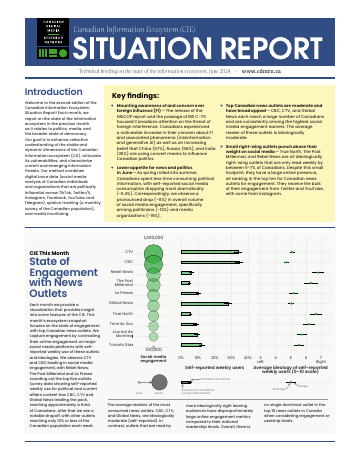
May 2024: Canadian Information Ecosystem Snapshot
Aengus Bridgman, Sara Parker, Chris Ross, Jennie Phillips
Résumé analytique
This is the first Canadian Information Ecosystem Situation Report, a monthly technical briefing on the state of the information ecosystem as it relates to politics, media, and the broader state of democracy. The method combines digital trace data (social media analysis of politically influential Canadian individuals and organizations across TikTok, Twitter/X, Instagram, Facebook, YouTube, and Telegram), monthly opinion tracking of the Canadian population, and media monitoring, with the goal of characterising the ecosystem's vulnerabilities and emerging information threats.
Ecosystem influence is highly concentrated in a small number of voices, with a small number of accounts receiving a supermajority of engagement. This inequality is even more extreme for media outlets: the top five media organizations (CTV, Global News, CBC, The Post Millennial, and Rebel News) receive approximately 65% of all news engagement across social media platforms, while local news accounts for only 25% of all news engagement. Canadians have low trust in information providers, with fewer than 1 in 3 trusting big tech companies like Meta and Google or trusting politicians; journalists and media organizations are more trusted, but close to half of Canadians still have little to no trust in them.
While the overall volume of misinformation content is low, there is high engagement with content linking to known misinformation-producing websites, and although foreign influence observed in May was very low, close to half of Canadians are concerned about misinformation and foreign influence. Conservative voices dominate the online Canadian conversation, with elected Conservative officials receiving more engagement and being more central to the conversation than other major party families, a centrality that extends to right-wing media organizations as well.
Publications connexes
Changement de pouvoir : l'ascension des influenceurs politiques au Canada
Lire la suite
Pour le meilleur et pour le pire : l'évolution de l'écosystème canadien de l'information
Lire la suite
Vieilles nouvelles, nouvelle réalité : un an de blocage des nouvelles de Meta au Canada
Lire la suite