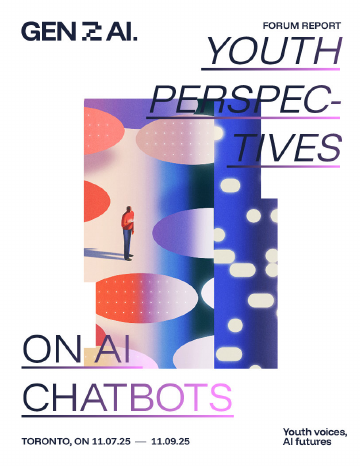
Gen(Z)AI : La voix des jeunes, l'avenir de l'IA - Recommandations politiques pour la gouvernance de l'IA et des préjudices en ligne au Canada
Helen A. Hayes, Fergus Linley-Mota, Madeleine Case, Julian Lam, Alexander Martin, Nonso Morah
Résumé analytique
Ce rapport présente les conclusions de Gen(Z)AI : l'Assemblée de la jeunesse canadienne sur l'intelligence artificielle, une nouvelle assemblée citoyenne de jeunes tenue sur sept mois dans quatre villes (Toronto, Montréal, Vancouver et Halifax), réunissant cent participant.e.s en présentiel âgé.e.s de 17 à 23 ans, aux côtés de milliers de jeunes Canadien.ne.s mobilisé.e.s à l'échelle nationale par un processus d'engagement numérique. L'assemblée a allié une journée d'apprentissage virtuelle, une délibération en présentiel et une forme hybride de recherche de consensus afin de traduire l'expérience vécue des participant.e.s en matière d'IA et de préjudices en ligne en propositions concrètes de gouvernance.
Le rapport situe ce travail dans le paysage fragmenté de la gouvernance numérique du Canada, rappelant qu'en janvier 2025, lorsque le Parlement a été prorogé à la suite de l'annonce de la démission du premier ministre Justin Trudeau, le projet de loi C-63 (la Loi sur les préjudices en ligne) et le projet de loi C-27 (qui jumelait la réforme fédérale de la protection de la vie privée à la Loi sur l'intelligence artificielle et les données) ont tous deux échoué sans obtenir la sanction royale, laissant le pays sans cadre juridique contraignant pour réglementer les systèmes d'IA ou les plateformes en ligne. Les participant.e.s ont formulé 17 recommandations politiques, chacune ayant atteint un seuil minimal de consensus de 90 %, réparties en quatre domaines : cinq recommandations sur les agents conversationnels d'IA (portant sur la conception addictive, les mécanismes de signalement, le droit de désactivation, le financement de la littératie critique en IA, et un nouvel organisme d'application indépendant), cinq sur l'IA et l'intégrité de l'information (l'étiquetage du contenu, le droit d'auteur et le contenu non consenti, la transparence en matière de mésinformation et de désinformation, les normes pour les systèmes de recommandation, et l'authentification du contenu), trois sur l'IA et la protection des données personnelles (le consentement éclairé, la protection de la vie privée par défaut, et des normes exécutoires de gestion des données), et quatre sur l'IA et la vérification de l'âge (la vérification de l'âge normalisée, la réglementation des données sensibles de vérification de l'âge, les protocoles de sécurité dès la conception, et des mesures pour réduire l'exposition nuisible et la flagornerie dans la conception de l'IA).
Le rapport conclut en plaidant pour un passage d'une gouvernance pour la jeunesse à une gouvernance avec la jeunesse, en présentant ces recommandations rédigées par les participant.e.s, en grande partie dans leurs propres mots, accompagnées d'une analyse contextuelle de la manière dont elles pourraient être opérationnalisées dans le paysage législatif actuel du Canada.
Publications connexes
Gen(Z)AI: Digital Engagement Companion Report
Lire la suite
Gen(Z)AI | Forum Report: AI & Age Assurance
Lire la suite
Gen(Z)AI | Forum Report: AI & Data Privacy
Lire la suite