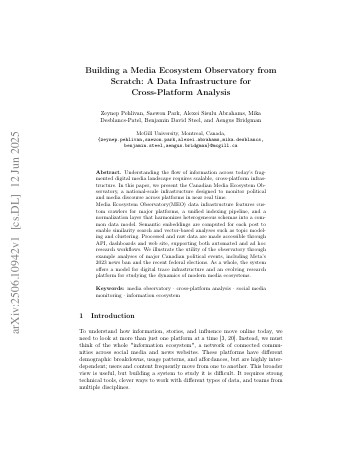
Anti-intellectualism and Information Preferences during the COVID-19 Pandemic
Eric Merkley, Peter Loewen
doi.org/10.1038/s41562-021-01112-wRésumé analytique
Anti-intellectualism, the generalized distrust of experts and intellectuals, is an important concept in explaining the public's engagement with advice from scientists and experts. This study asks whether it has shaped the mass public's response to COVID-19, providing evidence of a consistent connection between anti-intellectualism and COVID-19 risk perceptions, social distancing, mask usage, misperceptions, and information acquisition using a representative survey of 27,615 Canadians conducted from March to July 2020.
The study exploits a panel component of the design (N=4,910) to strongly link anti-intellectualism and within-respondent change in mask usage, and provides experimental evidence of anti-intellectualism's importance in information search behaviour with two conjoint studies (N~2,500) showing that respondents' preferences for COVID-19 news and COVID-19 information from experts dissipate among those with higher levels of anti-intellectual sentiment.
Anti-intellectualism poses a fundamental challenge in maintaining and increasing public compliance with expert-guided COVID-19 health directives.
Points saillants
- Anti-intellectualism consistently predicted lower COVID-19 risk perception, reduced social distancing compliance, lower mask usage, more misperceptions, and less consumption of expert-sourced pandemic information across 11 survey waves (N=27,615).
- Panel analysis (N=4,910) links anti-intellectualism to within-respondent declines in mask usage, providing stronger causal evidence by accounting for stable individual differences.
- Two conjoint experiments (~2,500 respondents each) show that preferences for COVID-19 news and expert-featured pandemic information dissipate significantly among respondents with higher anti-intellectual sentiment.
- Anti-intellectualism predicts COVID-19 attitudes above and beyond ideological conservatism, demonstrating it captures a conceptually distinct pathway to pandemic non-compliance.
- Expert-fronted public health campaigns may not only fail to persuade the anti-intellectual audience but may actively repel them.
Citation suggérée
Eric Merkley, Peter Loewen (2020). Anti-intellectualism and Information Preferences during the COVID-19 Pandemic. Media Ecosystem Observatory. https://doi.org/10.1038/s41562-021-01112-w
Publications connexes
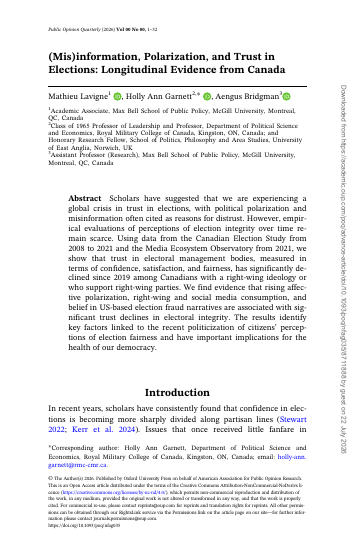
(Mis)information, Polarization, and Trust in Elections: Longitudinal Evidence from Canada
Lire la suite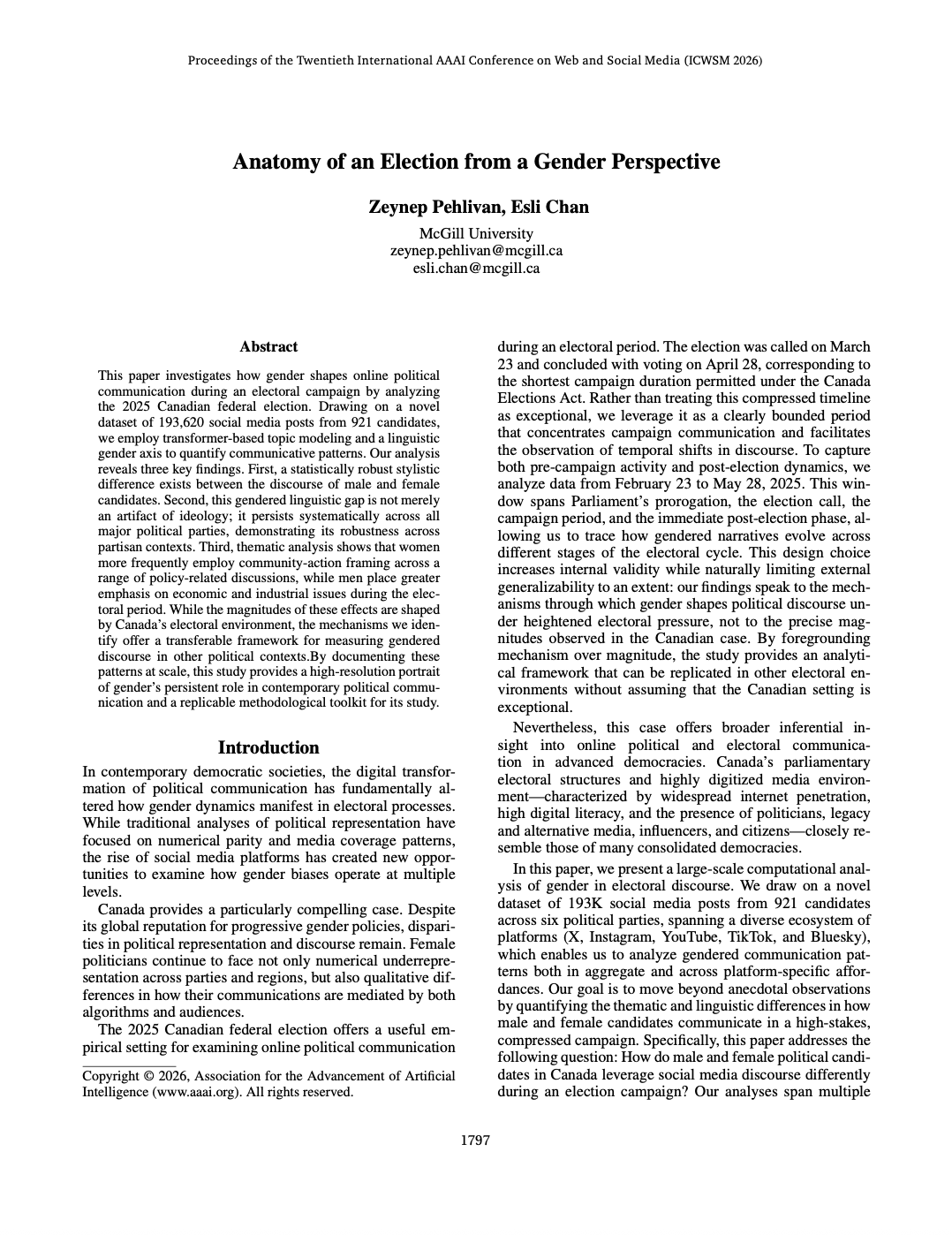
Anatomy of an Election from a Gender Perspective
Lire la suite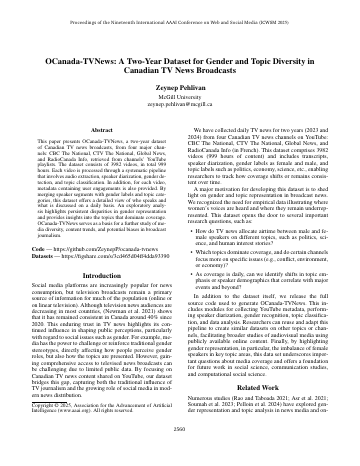
OCanada-TVNews: A Two-Year Dataset for Gender and Topic Diversity in Canadian TV News Broadcasts
Lire la suite