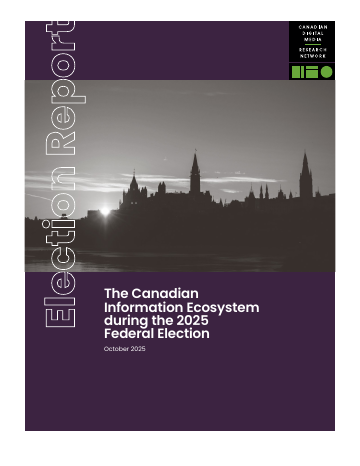
Indistinct Information Habitats: Information and Attitudes in the 2023 Alberta Election
Aengus Bridgman, Blake Lee-Whiting, Thomas Bergeron, Thomas Galipeau, Alexei Abrahams, Saewon Park, Sara Parker, Taylor Owen, Peter Loewen
doi.org/10.66536/alberta-election_2023Executive Summary
Amidst concerns of rising polarization and increasing information environment segregation, the Media Ecosystem Observatory (MEO) conducted a two-pronged study during the 2023 Alberta provincial election to evaluate the possibility of increasing ideological and affective polarization. MEO's study set out to examine the presence of distinct information environments or "habitats" among Alberta New Democratic Party (NDP) and United Conservative Party (UCP) supporters by surveying 948 Albertans to understand their media consumption habits and collecting digital trace data on Instagram and Facebook to understand social media information networks. The analysis was guided by three questions: what was the news media landscape in Alberta during the election; do NDP voters and UCP supporters consume different media; and what attitudes are those patterns of consumption associated with.
The study finds that the information ecosystem is not heavily divided in terms of media consumption within the province along party lines: NDP and UCP voters do not exist in vastly different information habitats. Voters from both parties have similar news media consumption preferences and generally obtain their news from similar outlets, with the notable exceptions of CBC being favoured by NDP voters and Rebel News being favoured by UCP voters. Voters from both parties also use similar social media platforms.
However, the digital trace data hints at the presence of distinct information habitats on social media platforms along party lines. Using a social media engagement network from comments on candidate and media outlet posts, the study finds suggestive evidence that a small number of Albertans — those most heavily interested in politics — do help produce a divided social online discourse. This divergence in information environments online is an important consideration, given the study also revealed that, despite commonalities in media consumption, there are large differences in attitudes related to trust in politicians and political institutions, the importance given to particular political issues, and opinions about how to best respond to the democratic threat of misinformation.
Key Takeaways
- NDP and UCP voters consume news from largely similar outlets, with CBC favored by NDP voters and Rebel News by UCP voters as the main exceptions.
- Instagram engagement network analysis shows UCP and NDP candidate nodes cluster separately, forming distinct online communities despite overlapping offline news diets.
- Rebel News and True North News garnered 74.1% of all comments and 78% of all likes in Instagram data, despite few survey respondents reporting regular use of these outlets.
- 47% of UCP voters distrust mainstream media, and UCP voters are significantly less trusting of Elections Canada than Elections Alberta.
- 72% of Albertans agree misinformation threatens Canadian democracy, but only 34% of UCP vs 60% of NDP voters support government monitoring of misinformation online.
Related Publications
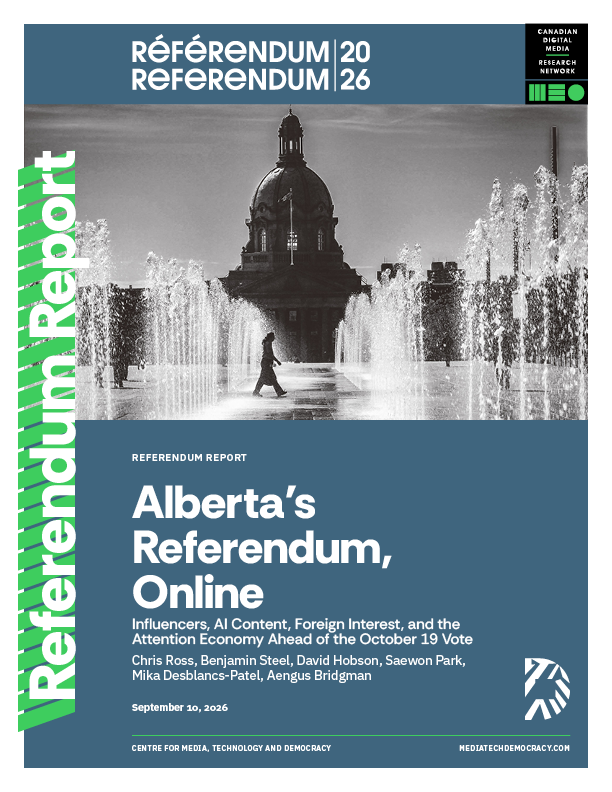
Alberta’s Referendum, Online: Influencers, AI Content, Foreign Interest, and the Attention Economy Ahead of the October 19 Vote
Read more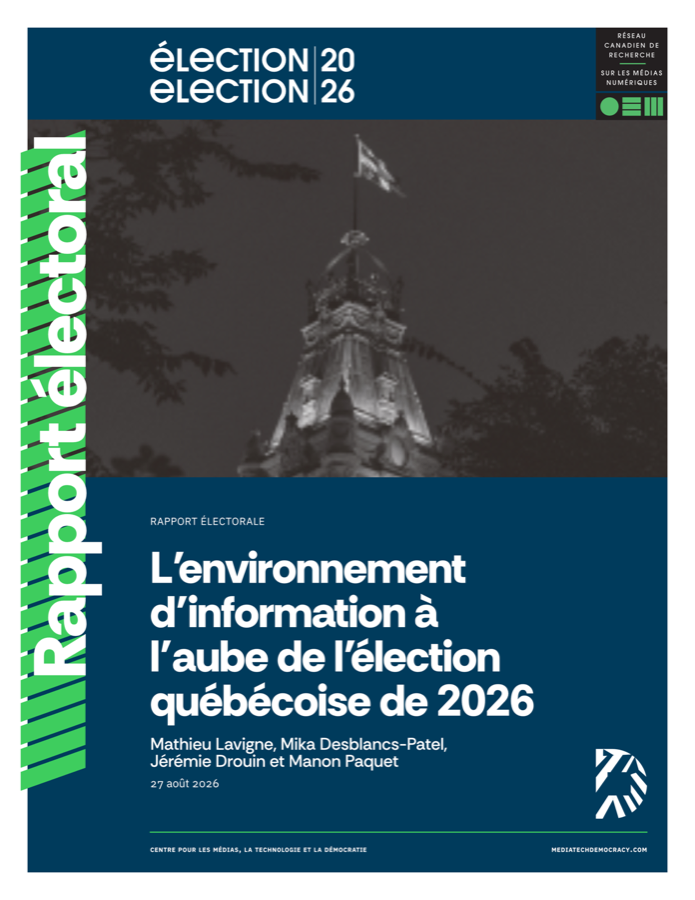
The Information Environment on the Eve of the 2026 Quebec Election
Read more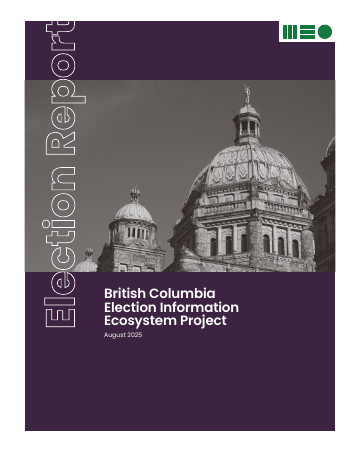
British Columbia Election Information Ecosystem Project: Final Report
Read more