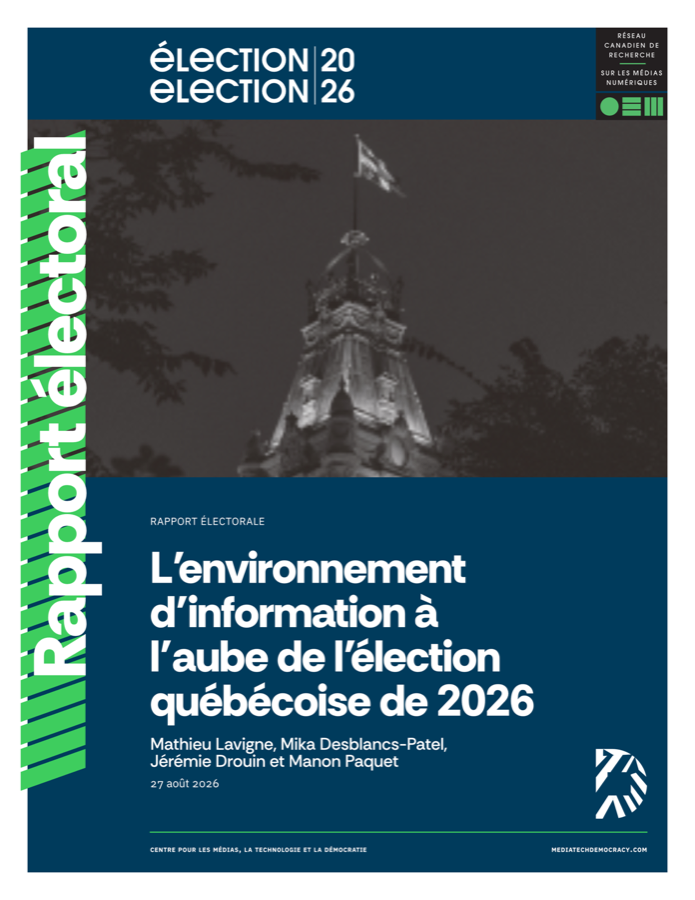
The Canadian Information Ecosystem during the 2025 Federal Election
Aengus Bridgman, Jennie Phillips, Alexei Abrahams, Isabelle Corriveau, Alexandra Stanghellini, Ashley Vu, Auxane Bussac, Ben Steel, Chris Ross, David Hobson, Dinara Karimova, Diya Jiang, Emma Frattasio, Esli Chan, Fakhreddine Riahi, Daniel Nikoula, Hana Allal, Junyan Zhu, Kathia Légaré, Kiran Gill, Liam Murphy, Luke Pindera, Mahnan Omar, Mathieu Lavigne, Mika Desblancs-Patel, Nader Hedfi, Nishtha Gupta, Olivia Melanson, Saewon Park, Sara Parker, Sarah Tran, Spencer Izen, Victoria Forte, Zeynep Pehlivan, Taylor Owen
doi.org/10.66536/federal-election_2025Executive Summary
This report presents the findings of monitoring the 2025 Canadian federal election. The central judgment is that the integrity and outcome of the election were not compromised: no evidence of material covert foreign interference was found. However, both the United States and China are assessed to have impacted the Canadian information and political environment during the election, and the election revealed a digital information ecosystem under mounting stress, shaped by influencers, polarized platforms, and new technological risks.
Influencers, rather than traditional media, politicians, or political parties, became the loudest voices in the online political information environment, commanding disproportionate attention amid the ban on news sharing on Meta and reduced visibility of news on X, and their blending of entertainment and politics positioned them as powerful agenda setters that can complicate accountability and fact-based debate. Generative AI-powered misinformation emerged as a key challenge, with widespread AI-generated fake news, deepfakes, and automated bot activity, including false content mimicking trusted outlets such as CBC and CTV; while the immediate election impact appeared low, this is assessed as the warning stage of a dynamic that could become catastrophic for public trust in future elections. Political and platform segregation was evident, with Liberal-aligned voices partially migrating to Bluesky and Conservative-aligned voices dominating X, while TikTok remained marginal for candidates but effective for news outlets and influencers, risking hardened partisan divides. Foreign interference was a central public concern, but actual interference attempts appeared minor with limited engagement, even as U.S. politics — especially Trump, tariffs, and annexation rhetoric — featured prominently in Canadian discourse and materially affected the voting intentions of millions of Canadians. Targeted manipulation attempts and a high volume of claims questioning election integrity are undermining public trust: on X, suspicious accounts targeted political leaders, most notably Mark Carney, as content moderation weakened, and claims alleging systemic election fraud gained traction, especially on X and YouTube, in the latter half of the campaign, even as overall public trust in the electoral process remained relatively strong.
Taken together, these findings reveal an information environment shaped by influencers, digital manipulation, political polarization, and weakened platform governance, which did not alter the 2025 outcome but is steadily eroding the foundations of democratic trust and resilience. Poor data access, weak enforcement, lack of transparency, and systemic irresponsibility are limiting the ability of policymakers, researchers, and citizens to respond effectively, and without urgent reform, Canada is likely to enter future elections less prepared, more divided, and more exposed to manipulation. The report recommends immediate action: governments must mandate transparency and empower regulators; platforms must guarantee ad transparency, strengthen moderation, and grant data access; traditional media must commit to covering information manipulation and build trust through accurate reporting; influencers must embrace democratic responsibility; civil society and researchers must anticipate threats and expand civic education; and the public must broaden its information environment and practice informed vigilance.
Key Takeaways
- Influencers accounted for nearly half (47%) of all political content posted, compared to 28% from news outlets and 18% from politicians — driven by Meta's news ban and reduced news visibility on X.
- No evidence of material covert foreign interference was found, but both the United States and China impacted the Canadian information and political environment during the election.
- AI-generated fake news, deepfakes, and automated bot activity emerged as a key challenge; false content mimicking CBC and CTV spread widely, representing an early warning stage of a dynamic that could be catastrophic for public trust in future elections.
- Political and platform segregation was pronounced: Liberal-aligned voices migrated partially to Bluesky while Conservative-aligned voices dominated X; TikTok remained marginal for candidates but effective for news outlets and influencers.
- Multiple information incidents were identified including fraudulent political news linked to cryptocurrency scams, surge in election-integrity claims, and alleged foreign influence on WeChat and RedNote.
Related Publications
Mis- and Disinformation during the 2021 Canadian Federal Election
Read more
Lessons in Resilience: Canada's Digital Media Ecosystem and the 2019 Election
Read more
Alberta’s Referendum, Online: Influencers, AI Content, Foreign Interest, and the Attention Economy Ahead of the October 19 Vote
Read more