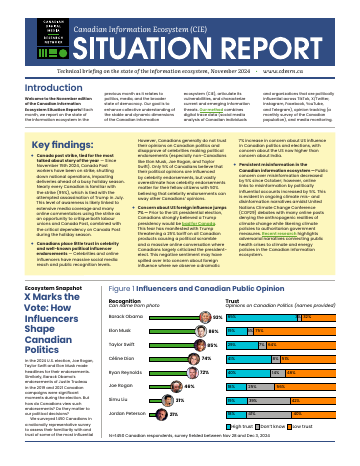
The News Canadians Actually See: Redefining Political Information in the Digital Age
Executive Summary
The Canadian news environment is being reshaped by platform decisions, shifting audience habits, and the rise of new voices in political information. The Meta news ban removed a major distribution channel for Canadian journalism in 2023, posting by news organizations has fallen sharply on X (where the algorithm also deprioritizes news content), and local outlets—particularly in smaller communities—are disappearing from social media. At the same time, political influencers are capturing a growing share of attention, and younger Canadians increasingly get information about politics and current affairs through short videos and memes rather than journalistic content. Drawing on a nationally representative survey of 1,518 Canadians and a dataset of 8,961,693 posts from 856 Canadian news organizations across Facebook, Instagram, X, YouTube, TikTok, and Bluesky from January 2023 to December 2025, the brief documents a growing disconnect: the content Canadians—especially younger Canadians—accept as news is systematically different from the journalistic content it is displacing.
Among the key findings: 18–34-year-olds are far more likely than those 55+ to rate influencer and citizen journalism content as "news." Beyond the Meta news ban, posts from news organizations on X dropped 55%, with TikTok, YouTube, and Bluesky only partly filling the gap. Awareness of the ban remains low—only 41% of Facebook users and 26% of Instagram users know news outlets can no longer publish on Meta's platforms. Feeds also diverge from preferences: 74% of Canadians want to see less AI-generated content and 60% want fewer posts from unknown users.
During 135 major events (2023–2025), news organizations captured the majority of engagement on TikTok (88%) and YouTube (68%), while on X influencers captured 89% of engagement despite publishing fewer posts. Coding of 160,000 YouTube and TikTok video transcripts from 2025 shows news accounts focus on reporting (80%), whereas influencers more often present claims without attribution (76% vs. 31%) and score higher on emotional intensity. The consequences are most acute for rural and small-town communities with the fewest alternatives.
Related Publications
Power shift: The rise of political influencers in Canada
Read more
Conspiratorial Claims and Institutional Distrust in Canada's Online Ecosystem
Read more
Like it or Not: The Changing Canadian Information Ecosystem
Read more