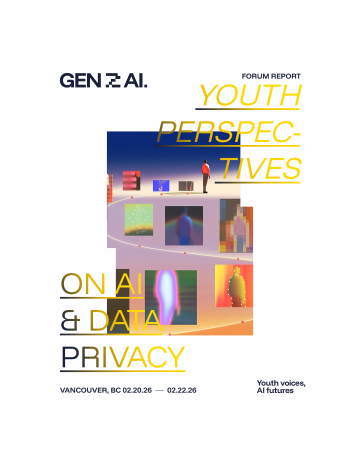
Facial Recognition & Canadian Youth
Luke Stark
Executive Summary
Facial recognition technologies (FRTs) are increasingly deployed by Canadian institutions such as universities, police departments, and immigration and national security agencies, and are also an appealing avenue for advertising and commercial data collection by retailers, social media platforms, and app developers. Canadian youth sit at the intersection of these two trends: they are a population subject to institutions like schools that pursue social control, and they are a coveted demographic for digital advertising and commerce. The essay examines three areas where Canadian youth are likely already exposed to FRTs and their effects: education, policing, and commercially available social media applications.
Despite their spread, FRTs remain technically unreliable and conceptually flawed. Researchers have found that FRT systems fail to recognize and correctly identify Black faces and the faces of other visible minorities, misidentified members of the United States Congress as criminals, and failed up to eighty percent of the time when piloted in public by police. Recognition of children's and youth's faces is even less accurate than for adults. Because these systems classify and compare human faces, they are intrinsically racializing and reinforce racial categories, frequently misgender trans and non-binary people by treating gender as binary, and pose grave threats to privacy, civil liberties, and democratic participation, with scholars terming facial recognition "the perfect tool for oppression."
The essay argues that Canada should heed international debates and the concerns of young people before further entrenching FRTs, rather than repeating mistakes made elsewhere, such as the installation of facial-recognition-equipped security cameras in a Lockport, New York school district by a company headquartered in Gananoque, Ontario. It calls for Canadian youth to press for stronger biometric privacy laws (noting a "significant vacuum" in current data privacy law, including PIPEDA), to organize for immediate bans and moratoria on FRT use in schools and public institutions, and for those working in the technology sector to build alliances committed to privacy-respecting, democratically supportive digital systems.
Related Publications
Gen(Z)AI: Digital Engagement Companion Report
Read more
Gen(Z)AI: Youth Voices, AI Futures - Policy Recommendations for AI and Online Harms Governance in Canada
Read more
Gen(Z)AI | Forum Report: AI & Age Assurance
Read more