Upgrading Environmental Innovation for the 21st Century
Sanjana Paul, Camille Minns
Executive Summary
Who gets to be an innovator, and who gets to decide what innovation is? Sanjana Paul and Camille Minns argue that although the International Organization for Standardization defines innovation broadly (ISO TC 279), dominant narratives confine it to the technologically adept, financially backed, and globally recognized engineer or entrepreneur. This narrow framing excludes the frontline and equity-deserving communities closest to the harms of extractive technology, and voluntary corporate "tech for good" initiatives from firms like Accenture, McKinsey, and the World Economic Forum are insufficient because they are discretionary and imply that mainstream technology is otherwise "tech for bad."
The essay critiques a technosolutionist, market-driven approach that treats environmental problems as purely technical. Efforts like The Ocean Cleanup, Climeworks' Direct Air Capture systems, and recycling programs are likened to mopping up an overflowing bathtub without first turning off the tap. Meanwhile grassroots innovators go unrecognized: Rise St. James, founded by Sharon Lavigne in Louisiana's 85-mile "Cancer Alley" (home to more than 200 petrochemical refineries and plants), fights facility expansion and earned Lavigne the Goldman Environmental Prize and a place on TIME's 100 most influential people of 2024, yet receives none of the funding lavished on platforms like Leonardo AI, which raised $31 million.
The authors propose "environmentally just innovation": contextually aware co-creation that centers justice, traditional and Indigenous knowledge, and the participation of overburdened communities. They point to community-led renewable energy projects and urban food-sovereignty efforts like the Detroit Black Community Food Sovereignty Network as models, arguing we cannot recycle our way out of planetary crisis.
Related Publications
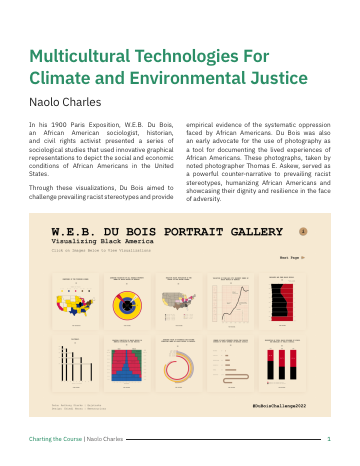
Multicultural Technologies For Climate and Environmental Justice
Read more
Extractive AI
Read more
Resisting Detached Datafication: What Toxic Prisons Teach Us about the Imperative of Restorative/Transformative Data Science for Environmental and Social Justice
Read more